
platform_info
Contains info about the current platform, such as Build mode and Operating system.

- Stars
- 33
- Forks
- 5
- Last push (UTC)
- Aug 13, 2024
- Project status
- Active
Original README
English project snapshot. Visit GitHub for the latest content.
platform_info


About
Cross-platform io/html package. Works on the web, mobile phones, desktops and console. Fully caches itself on first initialization.
Easy to use, just add to pubspec.yaml as dependency and then import:
import 'package:platform_info/platform_info.dart';
Platform is a singleton, and the default way to access an instance of Platform is to call static getters:
Platform.instance or Platform.I or platform
Usage
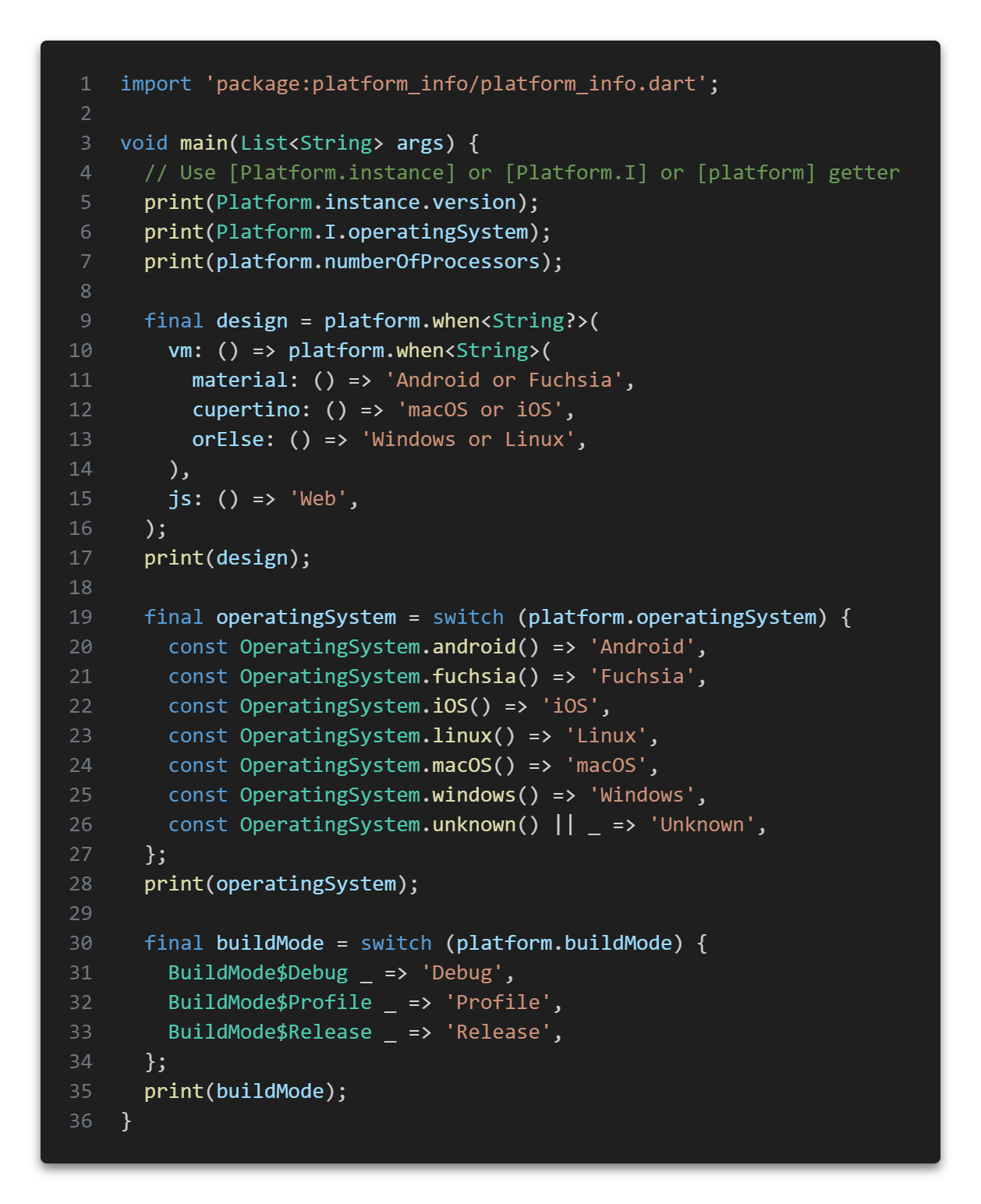 Example of using the library to get the current platform info
Platform Information
Provides platform information such as:
-
Build mode
- release
- profile
- debug
-
Host platform type
- vm (io, desktops, mobile, console, server)
- js (web, html, browser)
-
Operating system
- Fuchsia
- Linux
- MacOS
- Windows
- iOS
- Android
- Unknown
-
Version (
unknownif not available) -
Locale string (
enif not available) -
The number of individual execution units of the machine (
0if not available) -
Operating system is a known type
-
Is a Web-based applications
-
Is a VM supporting for non-web applications
-
Is a mobile device (Android, iOS)
-
Is a desktop device (Windows, macOS, Fuchsia)
-
Is Material design device (Android, Fuchsia)
-
Is Cupertino design device (macOS, iOS)
-
is Linux
-
is macOS
-
is Windows
-
is android
-
is iOS
-
is fuchsia
-
whenmethod allowing to compose a complex condition
Pattern matching
Run functions that satisfy the current state of the platform. You can use nested methods to compose more complex queries.
Operating System
[fuchsia] - whether the operating system is a version of Fuchsia [windows] - whether the operating system is a version of Windows [android] - whether the operating system is a version of Android [iOS] - whether the operating system is a version of iOS [macOS] - whether the operating system is a version of MacOS [linux] - whether the operating system is a version of Linux [unknown] - operating system unknown
Design
[material] - is material (Android, Fuchsia) [cupertino] - is cupertino (macOS, iOS)
Mobile or desktop
[mobile] - is mobile device (Android, iOS) [desktop] - is desktop device (Windows, MacOS, Fuchsia)
VM (IO) or JS (Web)
[js] - is web-based applications [vm] - is I/O supporting for non-web applications
Build mode
[release] - release build mode [profile] - profile build mode [debug] - debug build mode [orElse] - any callback was not called
Sequence of checks
- Operating System
- Design
- Mobile/Desktop
- VM/JS
- Build mode
- Call [orElse] if any callback was not called
Coverage

Changelog
Refer to the Changelog to get all release notes.
Maintainers
Funding
If you want to support the development of our library, there are several ways you can do it:
We appreciate any form of support, whether it's a financial donation or just a star on GitHub. It helps us to continue developing and improving our library. Thank you for your support!
License
Tags
cross, platform, info

Plague Fox ↗
Categories
Dependencies used
How do I choose a repository?
Start with your use case, compare repository activity, and check the original project before adopting it.
- Search by repository name, owner or description, then narrow the results by topic.
- Compare stars, forks and recent pushes. Stars show community interest, not a guarantee of quality.
- Read the README, license and issues on GitHub before using a project.
Sources and maintenance
“A repository is the most basic element of GitHub.”
GitHub Docs — About repositories ↗
- PlugFox/platform_info · GitHub ↗
- GitHub Docs — Saving repositories with stars ↗
- Directory maintained by Ducafecat ↗