
 v0.5.6
directed_graph
सामान्य दिशित ग्राफ और भारित दिशित ग्राफ जिसमें शीर्षों के वर्गीकरण और टॉपोलॉजिकल क्रम के लिए एल्गोरिदम हैं।
70लाइक 15.4 हज़ार30-दिन डाउनलोड150Pub अंक
AndroidiOSWebmacOSWindowsLinux
एक निर्देशित ग्राफ का डार्ट कार्यान्वयन। शीर्षों को व्यवस्थित करने, एक ऊपरी क्रम प्राप्त करने या चक्रों का पता लगाने के लिए एल्गोरिदम प्रदान करता है।

^1.19.1^0.3.2^0.2.5^1.18.2^0.2.7^2.0.2^6.1.0^1.31.1यह अंग्रेज़ी मूल स्नैपशॉट है। नवीनतम सामग्री GitHub पर देखें।
An integral part of storing, manipulating, and retrieving numerical data are data structures or as they are called in Dart: collections. Arguably the most common data structure is the list. It enables efficient storage and retrieval of sequential data that can be associated with an index.
A more general (non-linear) data structure where an element may be connected to one, several, or none of the other elements is called a graph.
Graphs are useful when keeping track of elements that are linked to or are dependent on other elements. Examples include: network connections, links in a document pointing to other paragraphs or documents, foreign keys in a relational database, file dependencies in a build system, etc.
The package directed_graph contains an implementation of a Dart graph that follows the
recommendations found in graphs-examples and is compatible with the algorithms provided by graphs.
It includes methods that enable:
The library provides access to algorithms for finding:
The class GraphCrawler can be used to retrieve paths or walks connecting two vertices.
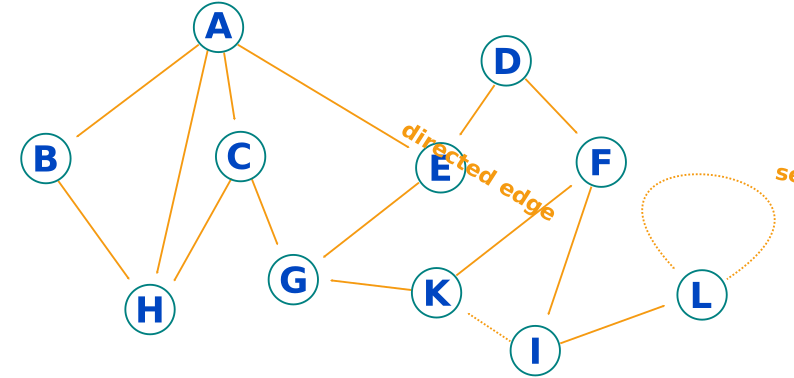
Elements of a graph are called vertices (or nodes) and neighbouring vertices are connected by edges. The figure below shows a directed graph with unidirectional edges depicted as arrows. Graph edges are emanating from a vertex and ending at a vertex. In a weighted directed graph each edge is assigned a weight.
Directed Graph Image
Note: In the context of this package, the definition of edge might be more lax compared to a rigorous mathematical definition. For example, self-loops, that is edges connecting a vertex to itself are explicitly allowed.
To use this library include directed_graph as a dependency in your pubspec.yaml file. The
example below shows how to construct an object of type DirectedGraph.
The graph classes provided by this library are generic with type argument
T extends Object (that is T must be non-nullable). The graphs
extend Iterable making it possible to iterate over the graph vertices.
Graph vertices can be sorted if T is Comparable or
if a custom comparator function is provided.
Note: If T is Comparable and no comparator is provided, then
the following default comparator is automatically provided:
(T left, T right) => (left as Comparable).compareTo(right);
In the example below, a custom comparator is used to sort vertices in lexicographical order.
import 'package:directed_graph/directed_graph.dart';
void main() {
  int comparator(String s1, String s2) => s1.compareTo(s2);
  int inverseComparator(String s1, String s2) => -comparator(s1, s2);

  // Constructing a graph from vertices.

  final graph = DirectedGraph<String>({
    'a': {'b', 'h', 'c', 'e'},
    'b': {'h'},
    'c': {'h', 'g'},
    'd': {'e', 'f'},
    'e': {'g'},
    'f': {'i'},
    //g': {'a'},
    'i': {'l'},
    'k': {'g', 'f'},
  }, comparator: comparator);

  print('Example Directed Graph...');
  print('graph.toString():');
  print(graph);

  print('\nIs Acylic:');
  print(graph.isAcyclic);

  print('\nStrongly connected components:');
  print(graph.stronglyConnectedComponents());

  print('\nLocal sources:');
  print(graph.localSources());

  print('\nshortestPath(d, l):');
  print(graph.shortestPath('d', 'l'));

  print('\nshortestPaths(a)');
  print(graph.shortestPaths('a'));

  print('\nInDegree(C):');
  print(graph.inDegree('c'));

  print('\nOutDegree(C)');
  print(graph.outDegree('c'));

  print('\nVertices sorted in lexicographical order:');
  print(graph.sortedVertices);

  print('\nVertices sorted in inverse lexicographical order:');
  graph.comparator = inverseComparator;
  print(graph.sortedVertices);
  graph.comparator = comparator;

  print('\nInDegreeMap:');
  print(graph.inDegreeMap);

  print('\nSorted Topological Ordering:');
  print(graph.topologicalOrdering(sorted: true));

  print('\nTopological Ordering:');
  print(graph.topologicalOrdering());

  print('\nReverse Topological Ordering:');
  print(graph.reverseTopologicalOrdering());

  print('\nReverse Topological Ordering, sorted: true');
  print(graph.reverseTopologicalOrdering(sorted: true));

  print('\nLocal Sources:');
  print(graph.localSources());

  print('\nAdding edges: i -> k and i -> d');

  // Add edge to render the graph cyclic
  graph.addEdge('i', 'k');
  //graph.addEdge('l', 'l');
  graph.addEdge('i', 'd');

  print('\nCyclic graph:');
  print(graph);

  print('\nCycle:');
  print(graph.cycle());

  print('\nCycle vertex:');
  print(graph.cycleVertex);

  print('\ngraph.isAcyclic: ');
  print(graph.isAcyclic);

  print('\nShortest Paths:');
  print(graph.shortestPaths('a'));

  print('\nEdge exists: a->b');
  print(graph.edgeExists('a', 'b'));

  print('\nStrongly connected components:');
  print(graph.stronglyConnectedComponents());

  print('\nStrongly connected components, sorted:');
  print(
    graph.stronglyConnectedComponents(sorted: true, comparator: comparator),
  );

  print('\nStrongly connected components, sorted, inverse:');
  print(
    graph.stronglyConnectedComponents(
      sorted: true,
      comparator: inverseComparator,
    ),
  );

  print('\nQuasi-Topological Ordering:');
  print(graph.quasiTopologicalOrdering({'d', 'e', 'a', 'g'}));

  print('\nQuasi-Topological Ordering, sorted:');
  print(graph.quasiTopologicalOrdering({'d', 'e', 'a', 'g'}, sorted: true));

  print('\nReverse-Quasi-Topological Ordering, sorted:');
  print(graph.reverseQuasiTopologicalOrdering({'d', 'e', 'a', 'g'}, sorted: true));
}
$ dart example/bin/directed_graph_example.dart
Example Directed Graph...
graph.toString():
{
 'a': {'b', 'h', 'c', 'e'},
 'b': {'h'},
 'h': {},
 'c': {'h', 'g'},
 'e': {'g'},
 'g': {},
 'd': {'e', 'f'},
 'f': {'i'},
 'i': {'l'},
 'l': {},
 'k': {'g', 'f'},
}

Is Acylic:
true

Strongly connected components:
[{h}, {b}, {g}, {c}, {e}, {a}, {l}, {i}, {f}, {d}, {k}]

Local sources:
[{a, d, k}, {b, c, e, f}, {g, h, i}, {l}]

shortestPath(d, l):
[d, f, i, l]

shortestPaths(a)
{b: [b], h: [h], c: [c], e: [e], g: [c, g]}

InDegree(C):
1

OutDegree(C)
2

Vertices sorted in lexicographical order:
{a, b, c, d, e, f, g, h, i, k, l}

Vertices sorted in inverse lexicographical order:
{l, k, i, h, g, f, e, d, c, b, a}

InDegreeMap:
{a: 0, b: 1, h: 3, c: 1, e: 2, g: 3, d: 0, f: 2, i: 1, l: 1, k: 0}

Sorted Topological Ordering:
{a, b, c, d, e, h, k, f, g, i, l}

Topological Ordering:
{a, b, c, d, e, h, k, f, i, g, l}

Reverse Topological Ordering:
{l, g, i, f, k, h, e, d, c, b, a}

Reverse Topological Ordering, sorted: true
{h, b, g, c, e, a, l, i, f, d, k}

Local Sources:
[{a, d, k}, {b, c, e, f}, {g, h, i}, {l}]

Adding edges: i -> k and i -> d

Cyclic graph:
{
 'a': {'b', 'h', 'c', 'e'},
 'b': {'h'},
 'h': {},
 'c': {'h', 'g'},
 'e': {'g'},
 'g': {},
 'd': {'e', 'f'},
 'f': {'i'},
 'i': {'l', 'k', 'd'},
 'l': {},
 'k': {'g', 'f'},
}

Cycle:
[f, i, k, f]

Cycle vertex:
f

graph.isAcyclic:
false

Shortest Paths:
{b: [b], h: [h], c: [c], e: [e], g: [c, g]}

Edge exists: a->b
true

Strongly connected components:
[{h}, {b}, {g}, {c}, {e}, {a}, {l}, {k, i, f, d}]

Strongly connected components, sorted:
[{h}, {b}, {g}, {c}, {e}, {a}, {l}, {d, f, i, k}]

Strongly connected components, sorted, inverse:
[{l}, {g}, {e}, {k, i, f, d}, {h}, {c}, {b}, {a}]

Quasi-Topological Ordering:
{d, a, e, g}

Quasi-Topological Ordering, sorted:
{a, d, e, g}

Reverse-Quasi-Topological Ordering, sorted:
{g, e, a, d}
The example below shows how to construct an object of type WeightedDirectedGraph.
Initial graph edges are specified in the form of map of type Map<T, Map<T, W>>. The vertex type T extends
Object and therefore must be a non-nullable. The type associated with the edge weight W extends Comparable
to enable sorting of vertices by their edge weight.
The constructor takes an optional comparator function
as parameter. Vertices may be sorted if
a comparator function is provided
or if T implements Comparator.
import 'package:directed_graph/directed_graph.dart';

void main(List<String> args) {
  int comparator(String s1, String s2) {
    return s1.compareTo(s2);
  }

  final a = 'a';
  final b = 'b';
  final c = 'c';
  final d = 'd';
  final e = 'e';
  final f = 'f';
  final g = 'g';
  final h = 'h';
  final i = 'i';
  final k = 'k';
  final l = 'l';

  int sum(int left, int right) => left + right;

  var graph = WeightedDirectedGraph<String, int>(
    {
      a: {b: 1, h: 7, c: 2, e: 40, g: 7},
      b: {h: 6},
      c: {h: 5, g: 4},
      d: {e: 1, f: 2},
      e: {g: 2},
      f: {i: 3},
      i: {l: 3, k: 2},
      k: {g: 4, f: 5},
      l: {l: 0},
    },
    summation: sum,
    zero: 0,
    comparator: comparator,
  );

  print('Weighted Graph:');
  print(graph);

  print('\nNeighbouring vertices sorted by weight:');
  print(graph..sortEdgesByWeight());

  final lightestPath = graph.lightestPath(a, g);
  print('\nLightest path a -> g');
  print('$lightestPath weight: ${graph.weightAlong(lightestPath)}');

  final heaviestPath = graph.heaviestPath(a, g);
  print('\nHeaviest path a -> g');
  print('$heaviestPath weigth: ${graph.weightAlong(heaviestPath)}');

  final shortestPath = graph.shortestPath(a, g);
  print('\nShortest path a -> g');
  print('$shortestPath weight: ${graph.weightAlong(shortestPath)}');

  print('\nTransitive Closure');
  print(WeightedDirectedGraph.transitiveClosure(graph));

  print('\nTransitive Weighted Edges:');
  print(graph.transitiveWeightedEdges);

  print('\nVertices reachable from d:');
  print(graph.reachableVertices(d));

  print('\nUpdate weight of edge (a,b) with value 101:');
  graph.updateEdgeWeight(vertex: a, connectedVertex: b, weight: 101);
  print('graph.weightedEdges(a): ${graph.weightedEdges(a)}');
}
$ dart example/bin/weighted_graph_example.dart
Weighted Graph:
{
 'a': {'b': 1, 'h': 7, 'c': 2, 'e': 40, 'g': 7},
 'b': {'h': 6},
 'c': {'h': 5, 'g': 4},
 'd': {'e': 1, 'f': 2},
 'e': {'g': 2},
 'f': {'i': 3},
 'g': {},
 'h': {},
 'i': {'l': 3, 'k': 2},
 'k': {'g': 4, 'f': 5},
 'l': {'l': 0},
}

Neighbouring vertices sorted by weight:
{
 'a': {'b': 1, 'c': 2, 'h': 7, 'g': 7, 'e': 40},
 'b': {'h': 6},
 'c': {'g': 4, 'h': 5},
 'd': {'e': 1, 'f': 2},
 'e': {'g': 2},
 'f': {'i': 3},
 'g': {},
 'h': {},
 'i': {'k': 2, 'l': 3},
 'k': {'g': 4, 'f': 5},
 'l': {'l': 0},
}

Lightest path a -> g
[a, c, g] weight: 6

Heaviest path a -> g
[a, e, g] weigth: 42

Shortest path a -> g
[a, g] weight: 7

Transitive Closure
{
 'a': {'b': 1, 'c': 2, 'h': 7, 'g': 6, 'e': 40},
 'b': {'h': 6},
 'c': {'g': 4, 'h': 5},
 'd': {'e': 1, 'f': 2, 'g': 3, 'i': 5, 'k': 7, 'l': 8},
 'e': {'g': 2},
 'f': {'i': 3, 'k': 5, 'l': 6, 'g': 9, 'f': 10},
 'g': {},
 'h': {},
 'i': {'k': 2, 'l': 3, 'g': 6, 'f': 7, 'i': 10},
 'k': {'g': 4, 'f': 5, 'i': 8, 'k': 10, 'l': 11},
 'l': {'l': 0},
}

Transitive Weighted Edges:
{a: {b: 1, c: 2, h: 7, g: 6, e: 40}, b: {h: 6}, c: {g: 4, h: 5}, d: {e: 1, f: 2, g: 3, i: 5, k: 7, l: 8}, e: {g: 2}, f: {i: 3, k: 5, l: 6, g: 9, f: 10}, g: {}, h: {}, i: {k: 2, l: 3, g: 6, f: 7, i: 10}, k: {g: 4, f: 5, i: 8, k: 10, l: 11}, l: {l: 0}}

Vertices reachable from d:
{e, g, f, i, k, l}

Update weight of edge (a,b) with value 101:
graph.weightedEdges(a): {b: 101, c: 2, h: 7, g: 7, e: 40}
For further information on how to generate a topological sorting of vertices see example.
Please file feature requests and bugs at the issue tracker.