Connection Notifier
A simple way to notify your user about the connection status as well as providing simple tools that help tracking the internet connection status.
Version 4.0+: Now with injectable connectivity handlers, full Navigator 2.0 support, Web support, and seamless support for modern routing solutions.
Version 4.1+: Added async connectivity check via ConnectionNotifierTools.isConnectedAsync.
Gallery
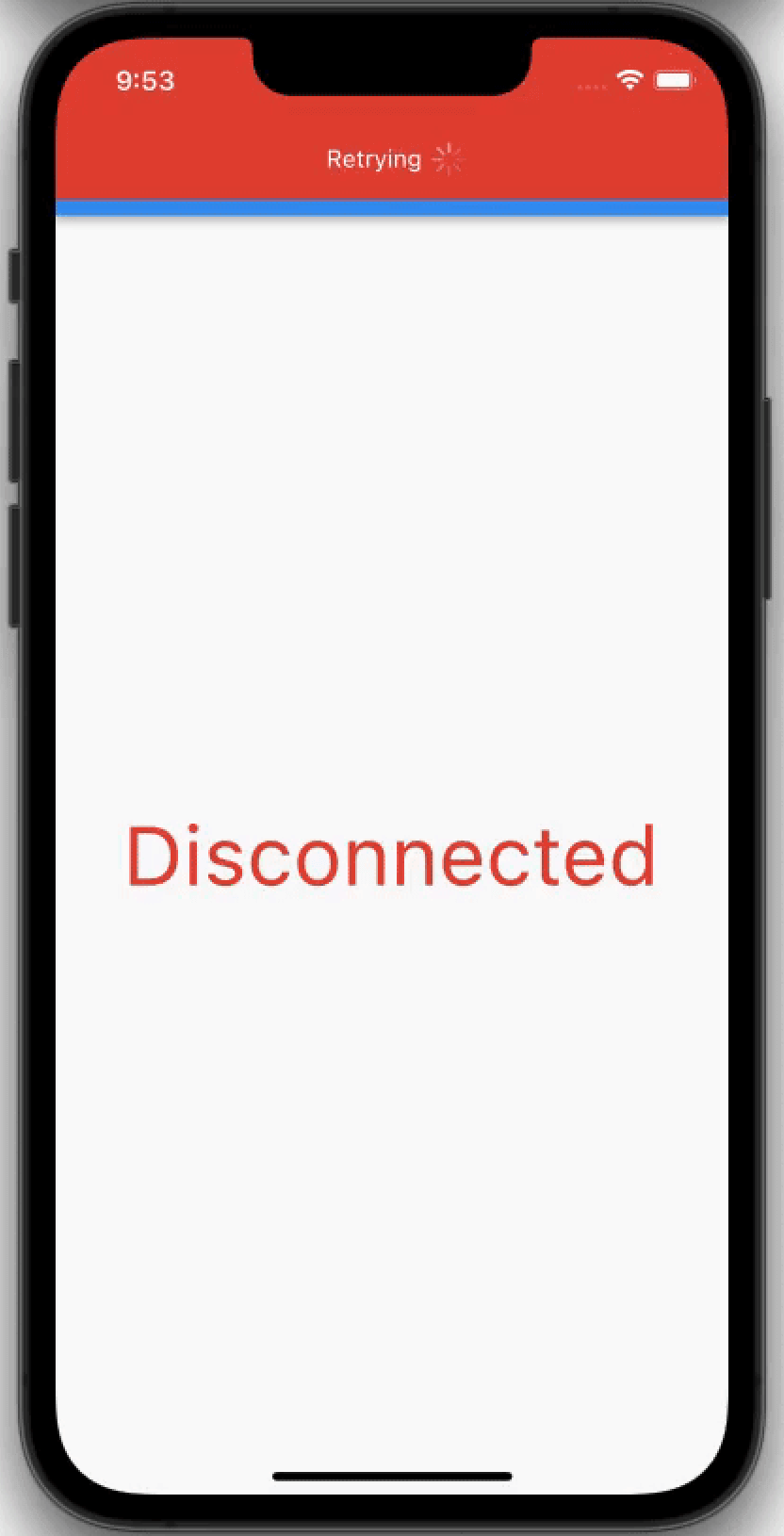
| https://user-images.githubusercontent.com/52869694/152056061-193a6a69-dbdd-48e0-bc10-892723b59478.gif |
https://user-images.githubusercontent.com/52869694/152057700-71f9cccf-3fe0-435d-92c2-e20cddf6a7a3.gif |
| https://user-images.githubusercontent.com/52869694/204103379-2b83ab1b-d9e8-4e82-a98c-5afd60b6a084.gif |
Quick Start
Basic Usage (Without Localization)
If you don't need localization, simply wrap your MaterialApp:
import 'package:connection_notifier/connection_notifier.dart';
import 'package:flutter/material.dart';

void main() async {
  WidgetsFlutterBinding.ensureInitialized();
  await ConnectionNotifierTools.initialize();
  runApp(const MyApp());
}

class MyApp extends StatelessWidget {
  const MyApp({Key? key}) : super(key: key);

  @override
  Widget build(BuildContext context) {
    return GlobalConnectionNotifier(
      connectionNotificationOptions: ConnectionNotificationOptions(
        alignment: Alignment.topCenter,
      ),
      child: MaterialApp(
        title: 'My App',
        home: const MyHomePage(),
      ),
    );
  }
}
Recommended Usage (With Localization)
This is the recommended approach if you're using any localization package (EasyLocalization, flutter_localizations, intl, etc.):
Call ConnectionNotifierTools.initialize(...) once in main() before
runApp(...), same as the basic usage example.
import 'package:connection_notifier/connection_notifier.dart';
import 'package:easy_localization/easy_localization.dart'; // or your localization package
import 'package:flutter/material.dart';

class MyApp extends StatelessWidget {
  const MyApp({Key? key}) : super(key: key);

  @override
  Widget build(BuildContext context) {
    return MaterialApp(
      locale: context.locale,
      supportedLocales: context.supportedLocales,
      localizationsDelegates: context.localizationDelegates,
      builder: (context, child) => GlobalConnectionNotifier(
        connectionNotificationOptions: ConnectionNotificationOptions(
          alignment: Alignment.bottomCenter,
          // Now you can use localized strings with context!
          connectedText: 'connectionRestored'.tr(context: context),
          disconnectedText: 'connectionLost'.tr(context: context),
        ),
        child: child!,
      ),
      home: const MyHomePage(),
    );
  }
}
Why use the builder approach?
- ✅ Full access to localization context
- ✅ Messages automatically update when language changes
- ✅ Works with EasyLocalization, flutter_localizations, intl, and all localization packages
- ✅ Clean and maintainable code
That's it! Connection notifications will work throughout your entire app with full localization support.
✅ Platform Support
Works everywhere:
- ✅ iOS
- ✅ Android
- ✅ Web
- ✅ macOS
- ✅ Windows
- ✅ Linux
✅ Navigation Support
Works with ALL navigation types:
- ✅ Classic Navigator (Navigator 1.0)
- ✅ Navigator 2.0 (GoRouter, AutoRoute, Beamer, and all modern routing solutions)
Example with GoRouter
import 'package:go_router/go_router.dart';

class MyApp extends StatelessWidget {
  const MyApp({Key? key}) : super(key: key);

  final _router = GoRouter(
    routes: [
      GoRoute(path: '/', builder: (context, state) => const HomePage()),
      GoRoute(path: '/details', builder: (context, state) => const DetailsPage()),
    ],
  );

  @override
  Widget build(BuildContext context) {
    return GlobalConnectionNotifier(
      connectionNotificationOptions: ConnectionNotificationOptions(
        alignment: Alignment.topCenter,
      ),
      child: MaterialApp.router(
        title: 'My App',
        routerConfig: _router,
      ),
    );
  }
}
Configuration
ConnectionNotificationOptions Parameters
| Option |
Description |
Type |
Default Value |
Required |
| alignment |
Alignment of the connection notification |
AlignmentGeometry |
AlignmentDirectional.topCenter |
No |
| height |
Height of the connection notification |
double? |
twice top padding |
No |
| width |
Width of the connection notification |
double? |
double.infinity |
No |
| borderRadius |
Border radius of the connection notification |
BorderRadiusGeometry? |
null |
No |
| connectedBackgroundColor |
Background color in connected state |
Color? |
Colors.green |
No |
| disconnectedBackgroundColor |
Background color in disconnected state |
Color? |
Colors.red |
No |
| connectedDuration |
Duration before auto-dismissing in connected state |
Duration? |
2 seconds |
No |
| disconnectedDuration |
Duration before auto-dismissing in disconnected state |
Duration? |
infinity |
No |
| overlayAnimationType |
Animation type of the notification |
OverlayAnimationType |
OverlayAnimationType.fadeAndSlide |
No |
| animationCurve |
Animation curve |
Curve? |
Curves.fastOutSlowIn |
No |
| animationDuration |
Animation duration |
Duration? |
300 milliseconds |
No |
| connectedContent |
Custom widget for connected state |
Widget? |
null |
No |
| disconnectedContent |
Custom widget for disconnected state |
Widget? |
null |
No |
| shouldAlwaysPullContentDownOnTopAlignment |
Pull content down on top alignment |
bool |
true |
No |
| hasIndicationIcon |
Show indication icon in default content |
bool |
true |
No |
| textAndIconSeparationWidth |
Distance between text and icon |
double? |
10 |
No |
| connectedText |
Text for connected state |
String? |
'Back Online' |
No |
| disconnectedText |
Text for disconnected state |
String? |
'Retrying' |
No |
| connectedTextStyle |
Text style for connected state |
TextStyle? |
null |
No |
| disconnectedTextStyle |
Text style for disconnected state |
TextStyle? |
null |
No |
| connectedIcon |
Icon for connected state |
Icon? |
Icon(Icons.check) |
No |
| disconnectedIcon |
Icon for disconnected state |
Icon? |
CircularProgressIndicator |
No |
| iconBoxSideLength |
Size of the icon box |
double? |
10 |
No |
| connectedConnectionNotification |
Custom notification widget for connected state |
Widget? |
null |
No |
| disconnectedConnectionNotification |
Custom notification widget for disconnected state |
Widget? |
null |
No |
Custom Notification Example
GlobalConnectionNotifier(
  connectionNotificationOptions: ConnectionNotificationOptions(
    alignment: Alignment.topCenter,
    connectedConnectionNotification: Container(
      padding: const EdgeInsets.all(16),
      decoration: BoxDecoration(
        color: Colors.green,
        borderRadius: BorderRadius.circular(8),
      ),
      child: Row(
        mainAxisSize: MainAxisSize.min,
        children: [
          const Icon(Icons.wifi, color: Colors.white),
          const SizedBox(width: 8),
          const Text('Connected', style: TextStyle(color: Colors.white)),
        ],
      ),
    ),
    disconnectedConnectionNotification: Container(
      padding: const EdgeInsets.all(16),
      decoration: BoxDecoration(
        color: Colors.red,
        borderRadius: BorderRadius.circular(8),
      ),
      child: Row(
        mainAxisSize: MainAxisSize.min,
        children: [
          const Icon(Icons.wifi_off, color: Colors.white),
          const SizedBox(width: 8),
          const Text('No Connection', style: TextStyle(color: Colors.white)),
        ],
      ),
    ),
  ),
  child: MaterialApp(home: MyHomePage()),
)
Localization
Recommended Approach: Use MaterialApp Builder (Best Practice)
The easiest and most powerful way to handle localization is using the MaterialApp builder pattern. This gives you full access to the localization context:
import 'package:connection_notifier/connection_notifier.dart';
import 'package:easy_localization/easy_localization.dart'; // or any localization package
import 'package:flutter/material.dart';

class MyApp extends StatelessWidget {
  @override
  Widget build(BuildContext context) {
    return MaterialApp(
      locale: context.locale,
      supportedLocales: context.supportedLocales,
      localizationsDelegates: context.localizationDelegates,
      // Use the builder to access localization context
      builder: (context, child) => GlobalConnectionNotifier(
        connectionNotificationOptions: ConnectionNotificationOptions(
          alignment: Alignment.bottomCenter,
          // Access localized strings with full context support
          connectedText: 'connectionRestored'.tr(context: context),
          disconnectedText: 'connectionLost'.tr(context: context),
        ),
        child: child!,
      ),
      home: const MyHomePage(),
    );
  }
}
Benefits:
- ✅ Works with any localization package (EasyLocalization, flutter_localizations, intl, etc.)
- ✅ Messages automatically update when language changes
- ✅ Full access to localization context
- ✅ Clean and maintainable
- ✅ No need for custom widgets or manual locale detection
Alternative: Custom Notification Widgets
If you need more control over the UI, create custom widgets:
GlobalConnectionNotifier(
  connectionNotificationOptions: ConnectionNotificationOptions(
    connectedConnectionNotification: MyLocalizedConnectedWidget(),
    disconnectedConnectionNotification: MyLocalizedDisconnectedWidget(),
  ),
  child: MaterialApp(...),
)

class MyLocalizedConnectedWidget extends StatelessWidget {
  @override
  Widget build(BuildContext context) {
    final String message = 'connectionRestored'.tr(context: context);

    return Container(
      padding: EdgeInsets.all(16),
      decoration: BoxDecoration(
        color: Colors.green,
        borderRadius: BorderRadius.circular(8),
      ),
      child: Text(message, style: TextStyle(color: Colors.white)),
    );
  }
}
Additional Widgets
ConnectionNotifierToggler
Toggle between widgets based on connection state:
ConnectionNotifierToggler(
  onConnectionStatusChanged: (connected) {
    if (connected == null) return; // Still initializing
    print(connected);
  },
  connected: Center(
    key: UniqueKey(),
    child: const Text(
      'Connected',
      style: TextStyle(color: Colors.green, fontSize: 48),
    ),
  ),
  disconnected: Center(
    key: UniqueKey(),
    child: const Text(
      'Disconnected',
      style: TextStyle(color: Colors.red, fontSize: 48),
    ),
  ),
);
LocalConnectionNotifier
Show connection notification for a specific screen only:
class MyScreen extends StatelessWidget {
  @override
  Widget build(BuildContext context) {
    return LocalConnectionNotifier(
      connectionNotificationOptions: const ConnectionNotificationOptions(
        alignment: Alignment.bottomCenter,
      ),
      child: Scaffold(
        appBar: AppBar(title: const Text('My Screen')),
        body: Center(child: Text('Content')),
      ),
    );
  }
}
ConnectionNotifierTools
Check connection status programmatically anywhere in your app:
First, initialize:
void main() async {
  WidgetsFlutterBinding.ensureInitialized();
  await ConnectionNotifierTools.initialize();
  runApp(const MyApp());
}
Then use:
// Check if connected (synchronous, last known status)
bool isConnected = ConnectionNotifierTools.isConnected;

// Async live check — use when you need a guaranteed up-to-date result,
// since isConnected may briefly hold stale data during a connection change.
bool isOnline = await ConnectionNotifierTools.isConnectedAsync;

// Listen to connection changes
ConnectionNotifierTools.onStatusChange.listen((isConnected) {
  print('Connection status: $isConnected');
});
Custom Connection Handler (Inject Your Own Connectivity Source)
The package is agnostic to how connectivity is detected. By default it uses
ConnectionNotifierHandlerImpl (internet_connection_checker_plus). If you have
your own source (socket, native SDK, etc.), implement ConnectionHandler and
pass it to ConnectionNotifierTools.initialize(...).
import 'package:connection_notifier/connection_notifier.dart';

class MySocketConnectionHandler implements ConnectionHandler {
  @override
  Stream<ConnectionNotifierInternetConnectionStatus> get onStatusChange =>
      mySocketStatusStream.map((isOnline) {
        return isOnline
            ? ConnectionNotifierInternetConnectionStatus.connected
            : ConnectionNotifierInternetConnectionStatus.disconnected;
      });

  @override
  Future<bool> get hasInternetAccess async => mySocketIsConnected;
}

void main() async {
  WidgetsFlutterBinding.ensureInitialized();
  await ConnectionNotifierTools.initialize(
    connectionHandler: MySocketConnectionHandler(),
  );
  runApp(const MyApp());
}
The package UI reacts to the handler stream. No manual notification API calls
are required.
Migration Guide
From v3.x to v4.0
Version 4.0 introduces breaking changes. Please read below.
What's Changed:
- Removed
pauseConnectionListenerWhenAppInBackground — Background/foreground lifecycle is now managed internally
- Injectable
ConnectionHandler support — Bring your own connectivity source
- Automatic, stable reconnect flow — App pauses in background, resumes with 3s delay in foreground
Migration Steps:
Step 1: Remove pauseConnectionListenerWhenAppInBackground
If you were using this option, simply remove it:
// ❌ Before (v3.0):
GlobalConnectionNotifier(
  connectionNotificationOptions: ConnectionNotificationOptions(
    alignment: Alignment.topCenter,
    pauseConnectionListenerWhenAppInBackground: true, // ← REMOVE THIS
  ),
  child: MaterialApp(...),
)

// ✅ After (v4.0):
GlobalConnectionNotifier(
  connectionNotificationOptions: ConnectionNotificationOptions(
    alignment: Alignment.topCenter,
    // Background/foreground is handled automatically now
  ),
  child: MaterialApp(...),
)
Step 2: (Optional) Use custom connectivity source
New in v4.0: bring your own connectivity handler:
class MyCustomHandler implements ConnectionHandler {
  @override
  Stream<ConnectionNotifierInternetConnectionStatus> get onStatusChange {
    // Your custom connectivity source
    return myCustomConnectivityStream;
  }

  @override
  Future<bool> get hasInternetAccess async {
    // Your custom connectivity check
    return myCustomCheckInternet();
  }
}

void main() async {
  WidgetsFlutterBinding.ensureInitialized();
  await ConnectionNotifierTools.initialize(
    connectionHandler: MyCustomHandler(), // ← Inject your handler
  );
  runApp(const MyApp());
}
Behavior Changes:
| Behavior |
v3.0 |
v4.0 |
| Background handling |
Optional, manual via option |
Always active, automatic |
| Resume delay |
None |
3 seconds (for OS to settle) |
| Status deduplication |
No |
Yes (same status ignored) |
| Custom connectivity |
No |
Yes, via ConnectionHandler injection |
From v2.x to v3.0
See CHANGELOG.md for detailed migration instructions.
Quick Migration:
Before (v2.x):
ConnectionNotifier(
  locale: const Locale('en', 'US'),
  supportedLocales: [Locale('en', 'US')],
  localizationsDelegates: [...],
  connectionNotificationOptions: ConnectionNotificationOptions(...),
  child: MaterialApp(
    home: MyHomePage(),
  ),
)
After (v3.0):
GlobalConnectionNotifier(
  connectionNotificationOptions: ConnectionNotificationOptions(...),
  child: MaterialApp(
    locale: const Locale('en', 'US'),
    supportedLocales: [Locale('en', 'US')],
    localizationsDelegates: [...],
    home: MyHomePage(),
  ),
)
Migration Steps:
- Replace
ConnectionNotifier with GlobalConnectionNotifier
- Move locale properties to
MaterialApp: locale, supportedLocales, localizationsDelegates, etc.
- Keep
connectionNotificationOptions in GlobalConnectionNotifier
- Handle localization using one of the methods described in the Localization section
- Test your app!
Complete Example
import 'package:connection_notifier/connection_notifier.dart';
import 'package:flutter/material.dart';

void main() async {
  WidgetsFlutterBinding.ensureInitialized();
  await ConnectionNotifierTools.initialize();
  runApp(const MyApp());
}

class MyApp extends StatelessWidget {
  const MyApp({Key? key}) : super(key: key);

  @override
  Widget build(BuildContext context) {
    return GlobalConnectionNotifier(
      connectionNotificationOptions: ConnectionNotificationOptions(
        alignment: Alignment.topCenter,
        height: 60,
        connectedBackgroundColor: Colors.green,
        disconnectedBackgroundColor: Colors.red,
        connectedText: 'Back Online!',
        disconnectedText: 'No Internet Connection',
        connectedDuration: const Duration(seconds: 3),
      ),
      child: MaterialApp(
        title: 'Connection Notifier Demo',
        theme: ThemeData(primarySwatch: Colors.blue),
        home: const MyHomePage(),
      ),
    );
  }
}

class MyHomePage extends StatelessWidget {
  const MyHomePage({Key? key}) : super(key: key);

  @override
  Widget build(BuildContext context) {
    return Scaffold(
      appBar: AppBar(title: const Text('Connection Notifier Demo')),
      body: ConnectionNotifierToggler(
        connected: Center(
          child: const Text(
            'Connected',
            style: TextStyle(color: Colors.green, fontSize: 48),
          ),
        ),
        disconnected: Center(
          child: const Text(
            'Disconnected',
            style: TextStyle(color: Colors.red, fontSize: 48),
          ),
        ),
      ),
    );
  }
}
Attribution
This package depends on the following (Big Thanks):
More from the Developer
Check out my other open-source project:
- workspace-bridge-mcp — An MCP server that bridges AI coding agents with multi-project workspaces, enabling cross-project file access, git history, and more.
License
MIT License

 v4.1.1