cached_network_image_ce is the actively maintained fork of
cached_network_image,
rebuilt around a caching engine that doesn't block your UI thread. Same widget and provider API you already use.
cached_network_image by Baseflow is one of the most widely used packages in the Flutter ecosystem. It has also been effectively unmaintained since August 2024, sitting on 300+ open issues, including memory leaks and scroll-performance bugs that never got fixed.
Under the hood it leans on sqflite for cache metadata: a full SQL engine routed through a platform channel just to answer "have I already downloaded this image?" On image-heavy lists, that overhead shows up as jank you can feel.
We didn't fork this just to merge dependabot PRs. We rebuilt the caching layer.
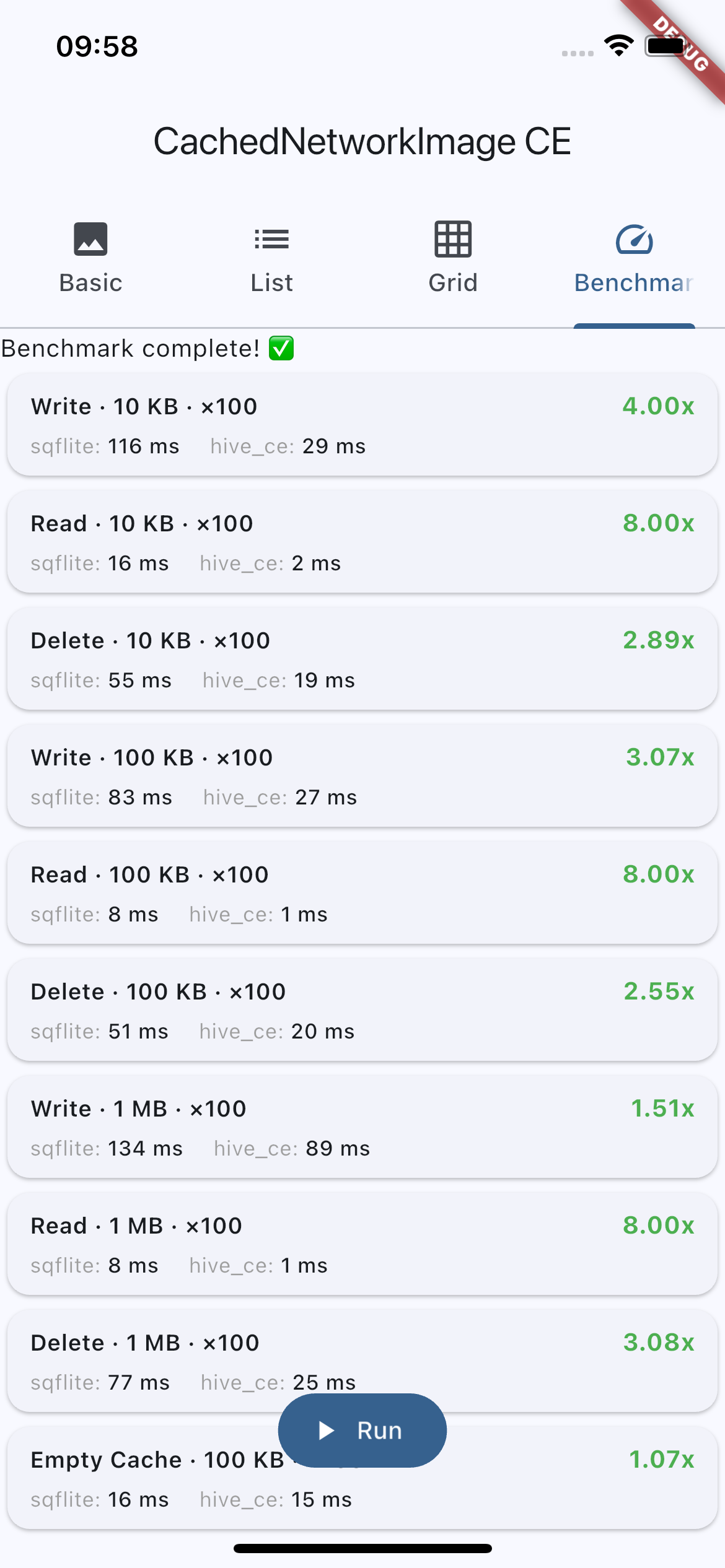
We swapped sqflite for hive_ce, a pure-Dart, non-blocking key-value store. It skips the platform channel round trip and the SQL parser entirely, so there's no jank left to fix.
How we stack up
vs. the original cached_network_image:
Original (cached_network_image)
This fork (cached_network_image_ce)
Cache backend
sqflite (platform channel)
✅ hive_ce (pure Dart)
Maintenance
❌ stale since Aug 2024
✅ active, regular releases
Web caching
⚠️ browser cache only
✅ full persistent IndexedDB cache
HTTP / cache interceptors
❌
✅ full chains (auth, logging, custom responses)
Cache eviction
❌ fixed
✅ pluggable — TTL or LRU
Cache read (10 KB)
16 ms
✅ 2 ms — 8x faster
Unsupported formats (SVG/AVIF/HEIC)
❌ opaque decode error
✅ unsupportedImageBuilder hook
vs. other popular alternatives, checked live against pub.dev, so this is current rather than a guess:
Package
Cache backend
Web support
Interceptors
Cleanup strategy
Maintenance
cached_network_image_ce (this)
hive_ce
✅ full IndexedDB
✅ HTTP + cache
✅ TTL / LRU
✅ active
cached_network_image
sqflite
⚠️ browser only
❌
❌ fixed
❌ stale
flutter_cache_manager
sqflite / plain JSON
✅
❌
❌ fixed
✅ active
extended_image
undisclosed
✅
⚠️ headers/retry only
⚠️ manual clear
✅ active
fast_cached_network_image
hive (plain)
✅ (claimed)
❌
⚠️ TTL only
⚠️ stale (17mo)
Worth saying plainly: flutter_cache_manager and extended_image are both actively maintained by reputable teams. They're solving different problems than we are: a generic file cache, and a broad image/gesture toolkit, respectively. The "actively maintained fork" pitch applies specifically against the original cached_network_image, which this package is a drop-in replacement for.
Architecture
flowchart LR
    W[CachedNetworkImage widget] --> P[CachedNetworkImageProvider]
    P --> M[DefaultCacheManager]
    M --> H[("Hive CE<br/>metadata: URL, path,<br/>validTill, eTag")]
    M --> FS[("Native filesystem<br/>raw image bytes")]
    H -.cache hit.-> P
    FS -.cache hit.-> P

    subgraph Original[Original package, for comparison]
        direction LR
        W2[CachedNetworkImage] --> M2[CacheManager]
        M2 --> PC[Platform Channel]
        PC --> SQL[(SQLite via sqflite)]
    end
The quick start above covers the basics. For interceptors, cleanup strategies, connection timeouts, custom cache and metadata directories, web render modes, and unsupported-format handling, see the full reference:
Q: Will I lose my users' existing cache if I migrate?
A: Yes. Because we switched the storage engine from SQLite to Hive, the old cache files will be ignored. Users will re-download images once as they browse. This is a one-time migration cost for a permanent performance gain.
Q: My app crashes/pauses on errors?
A: In Debug mode, Flutter may pause on exceptions even if they are caught. This is expected behavior for network errors (404s). In Release mode, these are handled silently by the errorWidget.
Q: Why is web caching slower, or why does it use Hive for image bytes?
A: On Mobile & Desktop (IO), this package stores image bytes directly on the native file system and uses Hive only for metadata. Web lacks a native file system, so hive_ce stores both metadata and image bytes in IndexedDB there. Serializing large byte arrays in and out of IndexedDB carries overhead that doesn't exist on IO.
Alternative: if persistent caching across sessions isn't critical for your web users, consider conditionally using Image.network on web, which relies on the browser's built-in caching.
Contributing
We welcome contributions! If you want to help maintain this package, check CONTRIBUTING.md.