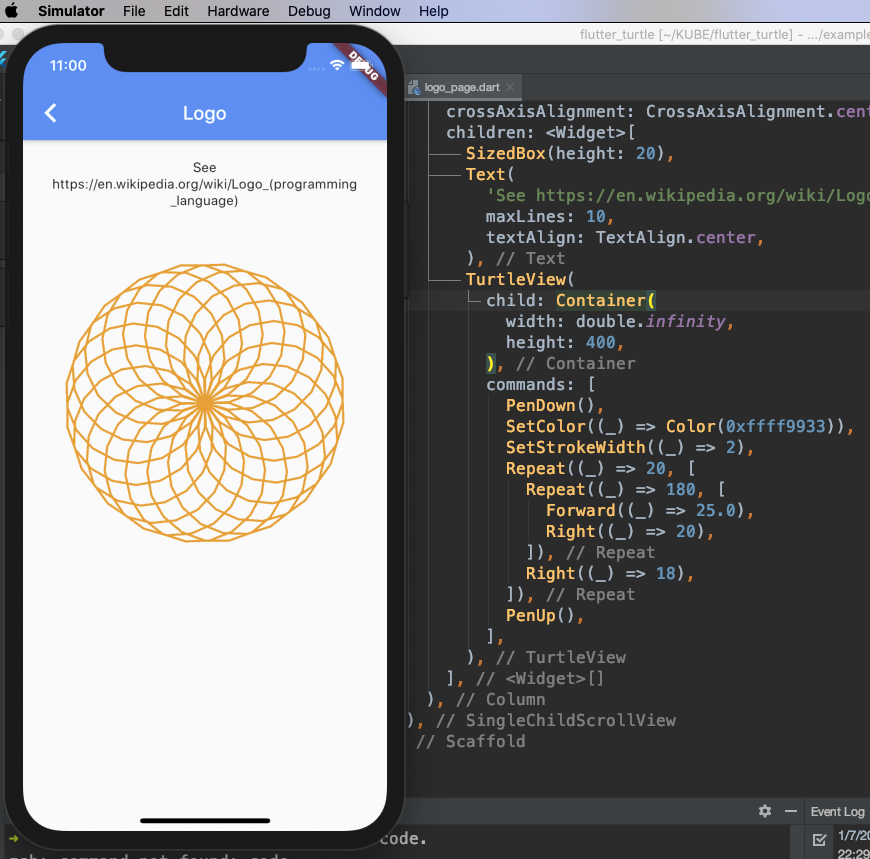
flutter_turtle 是一個輕量級的 Flutter 套件,將海龜圖形引入 Dart 生態系統,讓使用者能使用簡單、類似 Logo 的指令繪製形狀與圖案。它利用自訂繪圖器直接在組件內渲染圖形,非常適合教育工具、視覺化程式設計實驗與創意編程專案。此套件支援所有主要平台,包含行動裝置、網頁與桌面端,確保廣泛的相容性。其直覺式的 API 讓初學者與教育工作者能透過視覺反饋來教授程式設計概念。
適用情境
教授程式設計基礎
用程式碼創造視覺藝術
兒童教育應用
互動式程式碼教學
產生幾何圖案
主要特色
類 Logo 命令語法
基於自定繪製器的渲染
跨平台支援
面向初學者的簡單 API
即時繪圖更新
適合對象
教授程式設計的教育工作者
初學者程式設計師
創意程式設計師
兒童學習程式設計
可視化程式設計實驗
使用建議
限制為2D向量圖形
未針對高性能量化動畫進行優化
最適合簡單的繪圖
需要理解基本幾何
無內建的撤銷/重做功能
原始 README
以下為關聯原始碼儲存庫的 README 原文快照,最新內容請造訪原始碼儲存庫。
flutter_turtle
flutter_turtle is a simple yet powerful implementation of turtle graphics for Flutter. It leverages Flutter's CustomPainter to draw graphics using a declarative, Logo-like Domain-Specific Language (DSL) written entirely in Dart.
Turtle graphics is a popular method for introducing programming to beginners. It involves a "turtle" (an on-screen cursor) that carries a pen. By giving commands like "move forward," "turn right," and "pen down," you can create complex geometric shapes and intricate patterns. It was a key feature of the Logo programming language and remains a foundational concept in computer science education.
For further information about turtle graphics, please refer to Wikipedia:
Building a Domain-Specific Language (DSL) within Dart is an excellent exercise in API design, and turtle graphics are a universally engaging way to introduce programming concepts through visual feedback!
flutter_turtle provides two core visualization widgets:
TurtleView: Serves as your canvas and immediately renders the fully evaluated graphics based on the provided commands.
AnimatedTurtleView: An animated variant that sequentially visualizes the turtle's drawing process over time.
To use them, simply instantiate TurtleView or AnimatedTurtleView, pass your declarative commands via the commands parameter, and embed the widget directly into your Flutter widget tree.
Technical Details & Architecture
flutter_turtle is built to be efficient, extensible, and seamlessly integrated into Flutter's rendering pipeline. The architecture is primarily divided into three stages: the DSL Command Definition, the Compiler, and the Painter.
1. The Command DSL
The library provides a set of classes (e.g., Forward, Right, Repeat, IfElse) that represent Logo-like instructions. Unlike a traditional interpreter that reads a text script, the DSL is constructed using native Dart objects. This provides full type safety, code completion, and allows you to seamlessly mix Flutter logic (like using Flutter Color or BuildContext state) directly into your turtle commands.
2. Compilation
Before any graphics are drawn, the tree of nested TurtleCommand objects is processed by the TurtleCompiler. The compiler evaluates flow-control commands (Repeat, If, IfElse) and flattens the execution tree into a linear sequence of atomic Instruction objects.
Macros: Macros are managed during compilation. A SetMacro command registers a sub-tree of commands, which are injected and compiled in place whenever a RunMacro command is encountered.
State Management: While compiling, the framework does not draw anything. It simply prepares a highly optimized sequence of operations.
3. Rendering Pipeline
The actual drawing happens inside TurtlePainter, which is a CustomPainter implementation.
TurtlePainter receives the compiled list of Instruction objects.
It initializes a PaintContext (providing access to the Canvas and Paint objects) and a TurtleState (which tracks the turtle's position, degrees, isPenDown status, colors, and line widths).
As TurtlePainter iterates through the instructions, each instruction executes against the PaintContext, mutating the state and calling raw Canvas drawing methods.
4. Animation Mechanism
AnimatedTurtleView leverages Flutter's AnimationController and AnimatedBuilder. When built, it calculates the total number of compiled instructions. As the animation progresses from 0.0 to 1.0, the widget progressively passes a growing sublist of instructions (e.g., from index 0 to total_instructions * animation.value) to the TurtlePainter. This simple yet effective approach smoothly simulates real-time drawing without requiring complex frame-by-frame state serialization.
Flutter Turtle DSL
If you have Logo code like this:
repeat 5 [ fd 100 rt 144 ]
The equivalent code in the Flutter Turtle DSL would be:
Flow control commands are evaluated dynamically during compilation. You can use the IfElse class just like an if...else statement in Dart, and the Repeat class for loops.
An example of IfElse:
// If the condition evaluates to true, move forward; otherwise, move backward.IfElse((_) => true, [Forward((_) => 10.0)], [Back(() => 10.0)]),
While the DSL does not support traditional named functions natively, you can achieve reusable components using macros. Use the SetMacro command to register a parameterized block of commands:
SetMacro('macro', [Forward((_) => 10.0)]), // Registers a new macro named "macro".
You can then execute the macro dynamically using the RunMacro command:
You can pass arguments when calling a macro. These arguments are provided as a Dart Map and are accessible via the callback parameter _ to every command within the macro. For example:
SetMacro('macro', [Forward((_) => _['arg1'])]), // Uses the "arg1" value from the arguments map.RunMacro('macro', (_) => {'arg1': 10.0}),
Supported Commands
The currently supported primitives and logic structures include: