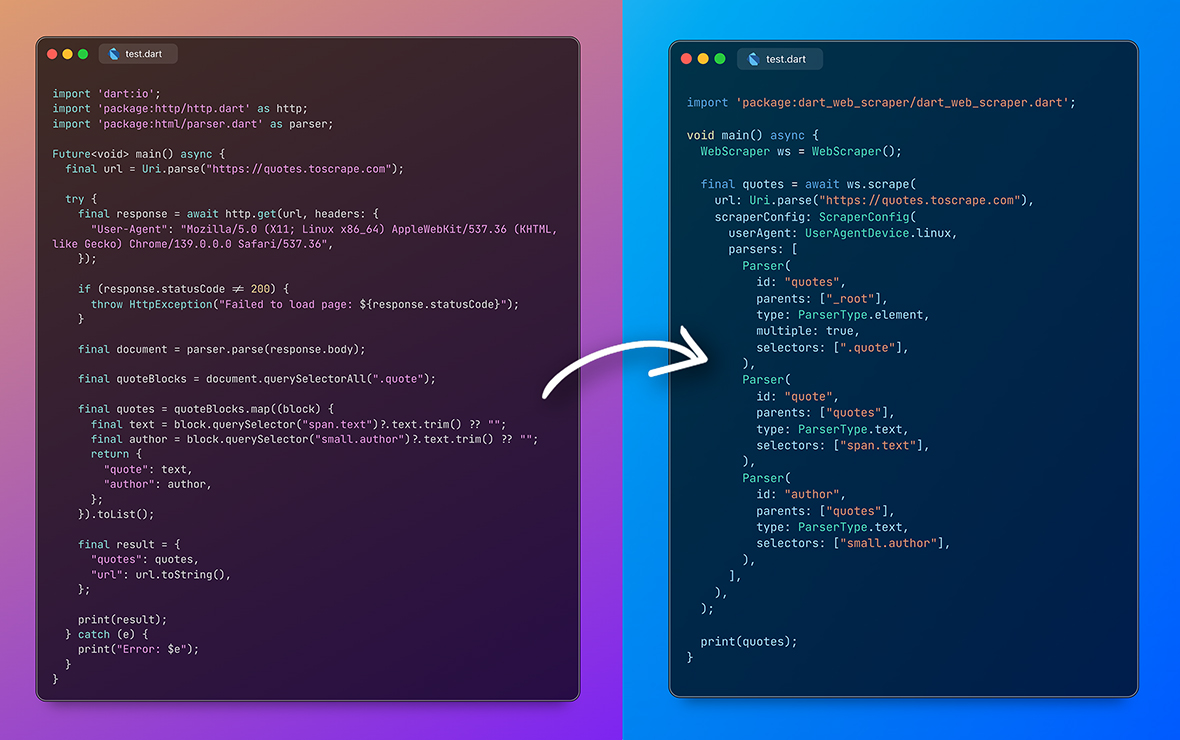
Ferramenta poderosa e fácil de usar para scraping de páginas web e APIs. Encadeie parsers e transformações para extrair exatamente os dados que você precisa.
Orientação gerada a partir de informações públicas. Apenas para referência.
Um pacote poderoso e intuitivo de web scraping para Dart e Flutter, que permite aos desenvolvedores extrair dados estruturados de páginas da web e APIs. Com suporte para encadear parsers e transformações, simplifica o processo de navegação em HTML, filtragem de conteúdo e conversão de dados em formatos utilizáveis. Projetado para uso cross-platform, funciona perfeitamente em Android, iOS, Web, macOS, Windows e Linux. Ideal para criar ferramentas de agregação de dados, rastreadores de preços ou coletores de conteúdo com pouca quantidade de código repetitivo.
Casos de uso
Extração de dados da web
Monitoramento de preços
Agregação de conteúdo
Análise de resposta da API
Coleta automática de dados
Web scraping de feed RSS
Principais recursos
Analisadores e transformações encadeados
Compatibilidade multiplataforma
Suporte a HTML e API
Configuração mínima
Transformação de dados flexível
Tratamento robusto de erros
Indicado para
Projetos de coleta de dados
Coletores de informações em tempo real
Scripts de automação
Scraping beginners
Desenvolvedores que precisam de soluções leves
Aplicativos que exigem dados externos
Considerações
Respeite o robots.txt e os termos de serviço
Gerenciar limitação de taxa
Garantir conformidade legal
Monitorar alterações no site-alvo
Evite raspagem agressiva
Teste em conjuntos de dados pequenos primeiro
README original
Snapshot do README original do repositório-fonte vinculado. Consulte o repositório para o conteúdo mais recente.
Config-based, reusable web scraper for web and API scraping. Scrape, parse web pages or APIs without writing parsers or scraping logic, using simple key/value based configs.
Features
Config-based, reusable web scraper for web and API scraping.
Scrape, parse web pages or APIs without writing parsers or scraping logic, using simple key/value based configs.
High-level web scraper that combines HTML fetching and data parsing.
WebScraperWebScraper()
// Main scraping methodFuture<Map<String, Object>> scrape({
// The URL to scraperequiredUri url,
// Scraper configuration for the URLScraperConfig? scraperConfig,
// Map of domain names to lists of scraper configurationsScraperConfigMap? scraperConfigMap,
// Enable debug logging, also dumps scraped file into current path /dump folderbool debug = false,
// Pre-fetched HTML document (optional, avoids HTTP request if provided)String? html,
// Custom cookies to include in HTTP requests (Overrides ScraperConfig cookies)Map<String, String>? overrideCookies,
// Custom HTTP headers to include in requests (Overrides ScraperConfig headers)Map<String, String>? overrideHeaders,
// Overrides proxy config in ScraperConfig and HTTP Parser optionsProxyAPIConfig? overrideProxyAPIConfig,
// Custom user agent string (overrides ScraperConfig userAgent)String? overrideUserAgent,
})
ScraperConfig class
Configuration for targeting and scraping specific types of URLs.
ScraperConfigScraperConfig({
// List of URL path patterns that this configuration should handleList<String> pathPatterns = const [],
// List of parsers that define how to extract data from the pagerequiredList<Parser> parsers,
// Whether HTML content needs to be fetched from the URLbool requiresHtml = true,
// URL preprocessing and cleaning configurationUrlCleaner? urlCleaner,
// Proxy API configProxyAPIConfig? proxyAPIConfig;
// Cookies for base requestMap<String, String>? cookies;
// Headers for base requestMap<String, String>? headers;
// Whether to force a fresh HTTP request even if HTML is providedbool forceRefresh = false,
// User agent device type for base requestUserAgentDevice userAgent = UserAgentDevice.mobile,
})
UrlCleaner class
Clean the URL before it's passed to a scraper.
UrlCleanerUrlCleaner({
// Set whitelisted or blacklisted URL parameters.List<String>? whitelistParams,
List<String>? blacklistParams,
// Set custom static parameters to a URL.Map<String, String>? appendParams,
})
Parser class
Easy to use and reusable parser class :)
ParserParser({
// `id` is used for final result.// Child parsers can reference to parent parser using `id`.// You can have multiple parsers with same id and same parent and will execute one by one and stop execution once data is successfully parsed by one parser.requiredString id,
// A child can have multiple parents, it will execute once parent parser is successfully executed.requiredList<String> parents,
// Set the parser types.requiredParserType type,
// List of selectors will execute one by one and stop execution once data is successfully parsed by one selector.List<String> selectors = const [],
// Set parser for private usage. Will be not added to final result.bool isPrivate = false,
// Set multiple to `true` if data is a List.bool multiple = false,
// Some parsers require additional options to work properly.// You can pass these options here.// For example, `ParserType.table` requires `ParserOptions.table`.ParserOptions? parserOptions;
// Data transformation options to apply after extraction.TransformationOptions? transformationOptions,
// Custom cleaner function, clean the data and return data.Object? Function(Data, bool)? cleaner,
// If you plan to create configs from JSON, you can pass cleaner name here.// This cleaner should be registered in `CleanerRegistry` to be used.// If you pass cleaner along with cleanerName, cleanerName function will be ignored.String? cleanerName,
})
Parser Types
Type
Description
Selector
ParserOptions
ParserType.element
Extracts element nodes from HTML using CSS selectors.
CSS selector required.
-
ParserType.attribute
Extracts attribute value from HTML element using CSS selectors.
Use CSS selector to select an element and append attribute name with ::. Ex: div#myid::name where name refers to the attribute name.
-
ParserType.text
Extracts text from HTML element using CSS selectors.
CSS selector required.
-
ParserType.image
Extracts image URL from HTML element.
CSS selector required. After selecting an element it tries to find src attribute.
-
ParserType.url
Extracts URL from an HTML element
CSS selector required. After selecting an element it tries to find href attribute.
-
ParserType.urlParam
From an URL it extracts query parameter.
Add parameter name in selector.
ParserOptions.urlParam
ParserType.table
Extracts data from HTML table.
CSS selector required. Select table using this selector.
ParserOptions.table
ParserType.sibling
Used when target element doesn't have a valid selector but sibling does.
CSS selector is required.
ParserOptions.sibling
ParserType.strBetween
Extracts the string between two strings.
Not required
ParserOptions.stringBetween
ParserType.http
Get data using http request
Not required
ParserOptions.http
ParserType.responseHeaders
Sends a GET/POST request and extracts a value from the response headers (e.g. a cookie from set-cookie).
Parser-specific configuration options that control how individual parsers behave during data extraction.
Use the appropriate named constructor for the parser type you're configuring:
// For HTTP parsersParserOptions.http(options: HttpParserOptions(...))
// For response header parsersParserOptions.responseHeaders(options: ResponseHeaderParserOptions(...))
// For table and JSON table parsersParserOptions.table(options: TableParserOptions(...))
// For sibling parsersParserOptions.sibling(options: SiblingParserOptions(...))
// For static value parsersParserOptions.staticValue(options: StaticValueParserOptions(...))
// For string between parsersParserOptions.stringBetween(options: StringBetweenParserOptions(...))
// For URL parameter parsersParserOptions.urlParam(options: UrlParamParserOptions(...))
Response Headers parser
ParserType.responseHeaders sends a request and returns a value from the response headers — handy for grabbing a cookie out of set-cookie.
Parser(
  id: "session",
  parents: ["_root"],
  type: ParserType.responseHeaders,
  parserOptions: ParserOptions.responseHeaders(
    options: ResponseHeaderParserOptions(
      // Optional: defaults to the URL passed to WebScraper.scrape
      url: "https://example.com/login",
      // HttpMethod.get (default) or HttpMethod.post
      method: HttpMethod.get,
      // Response header to read (case-insensitive). Omit to return all headers as a Map.
      headerName: "set-cookie",
      // Optional: extract a single cookie's value from the header
      cookieName: "at",
    ),
  ),
)
TransformationOptions class
Comprehensive data transformation system that can be applied to extracted data.
TransformationOptionsTransformationOptions({
// Text to add to the beginningString? prepend,
// Text to add to the endString? append,
// List of values to check for matches, returns booleanList<Object>? match,
// Index to extract from a list (negative for reverse indexing)int? nth,
// Delimiter to split data byString? splitBy,
// Whether to decode URL-encoded stringsbool? urldecode,
// Whether to convert map values to a listbool? mapToList,
// Regular expression extraction optionsRegexTransformationOptions? regexMatch,
// Regular expression replacement optionsRegexReplaceTransformationOptions? regexReplace,
// Text replacement optionsReplaceTransformationOptions? replace,
// Text cropping options (start/end)CropTransformationOptions? crop,
// Extract text between two stringsStringBetweenTransformationOptions? stringBetween,
// Extract sibling elementsSiblingTransformationOptions? sibling,
// Table processing optionsTableTransformationOptions? table,
// Return static value optionsStaticValueTransformationOptions? staticValue,
// Custom order for applying transformationsList<TransformationType>? transformationOrder,
})
Error handling
Scraping throws WebScraperError. When a request (the base fetch, or an http / responseHeaders parser) returns 404, the error carries statusCode: 404, signalling the URL is no longer available:
try {
final result = await webScraper.scrape(url: url, scraperConfig: config);
} onWebScraperErrorcatch (e) {
if (e.statusCode == 404) {
// URL is gone
} else {
print(e.message);
}
}
Browser-like requests
Every request automatically includes a coherent set of browser headers — a randomized User-Agent plus matching Accept, Accept-Language, Sec-Fetch-*, and (for Chromium User-Agents) version-aligned Sec-CH-UA client hints. Choose the device profile with ScraperConfig.userAgent (UserAgentDevice.mobile, desktop, windows, mac, linux, android, ios, random). Any headers or overrideUserAgent you set take precedence.
Note: this mimics header-level fingerprints only. TLS/JA3 and HTTP/2 fingerprints come from the Dart networking stack and can't be changed here — route through a ProxyAPIConfig unblocker for sites that fingerprint at those layers.
Creating configs from JSON
You can now create configs from JSON string using ScraperConfig.fromJson method.
Cleaner Registry for parsers created using JSON
You can register cleaners using CleanerRegistry.register method. This is useful when you want to create configs from JSON and want to use custom cleaner for Parser.