Orientação gerada a partir de informações públicas. Apenas para referência.
genai_primitives fornece ferramentas fundamentais para integrar funcionalidades de IA generativa em aplicativos Flutter. Oferece interfaces padronizadas e utilitários para interagir com modelos de linguagem grandes (LLMs) e outras serviços de IA generativa, permitindo que desenvolvedores criem recursos impulsionados por IA, como chat, geração de conteúdo e análise de texto. Projetado para consistência e facilidade de uso entre plataformas, suporta Android, iOS, Linux, macOS, Web e Windows. O pacote faz parte da iniciativa Flutter UI Labs, promovendo componentes de IA reutilizáveis e bem estruturados.
Casos de uso
Construindo interfaces de chat com IA
Gerando conteúdo de texto dinamicamente
Implementando fluxos de trabalho de processamento de linguagem natural
Criando assistentes de IA interativos
Habilitar sugestões de conteúdo em tempo real
Suporte a interações de IA multilíngues
Principais recursos
APIs padronizadas de interação com LLM
Compatibilidade multiplataforma
Design modular e extensível
Tratamento embutido de solicitação/resposta
Pronto para integração com widgets do Flutter
Gerenciamento consistente de erros e estado
Indicado para
Desenvolvedores Flutter construindo recursos de IA
Equipes usando LLMs em aplicativos de produção
Projetos que exigem integrações de IA escalonáveis
Aplicativos destinados a múltiplas plataformas
Desenvolvedores em busca de blocos de construção de IA reutilizáveis
Considerações
Requer integração com serviço externo de modelo de linguagem grande
Depende da disponibilidade da rede para chamadas de IA
Pode ser necessário adaptadores personalizados para modelos proprietários
Melhor usado com um backend para operações sensíveis
Não é um motor de IA autônomo, mas uma ferramenta do lado do cliente
README original
Snapshot do README original do repositório-fonte vinculado. Consulte o repositório para o conteúdo mais recente.
Generative UI SDK for Flutter (genui)
A Flutter library to enable developers to easily add interactive
generative UI to their applications.
This is a highly experimental package, which means the API will change (sometimes drastically).
Feedback is very welcome.
Summary
Our goal for the GenUI SDK for Flutter is to help you replace static "walls of text" from your LLM with
dynamic, interactive, graphical UI.
It uses a JSON-based format to compose UIs from your existing widget catalog, turning
conversations or agent interactions into rich, intuitive experiences. State changes in the UI update
a client-side data model, which is fed back to the agent, creating a
powerful, high-bandwidth interaction loop. The GenUI SDK for Flutter aims to be easy to integrate
into your Flutter application to significantly improve the usability and satisfaction of your
chatbots and next-generation agent-based user experiences.
High-level goals
Increase Interaction Bandwidth for Users: allow users to interact with data and controls directly,
making task completion faster and more intuitive. Move beyond a "wall of text".
Simple and easy to use by developers: seamlessly integrate with your existing Flutter workflow,
design systems, and widget catalogs.
Drive agent-human UX forward: innovate ways to dramatically improve how users interact with their
LLMs and Agents. Radically simplify the process of building UI-based agent interactions, by
eliminating custom middleware between the agent and the UI layer.
Features
Multiple agent and LLM provider support
A2UI support
Standard UI catalog
Custom widgets
Data binding
Chat UX
Canvas UX
Use cases
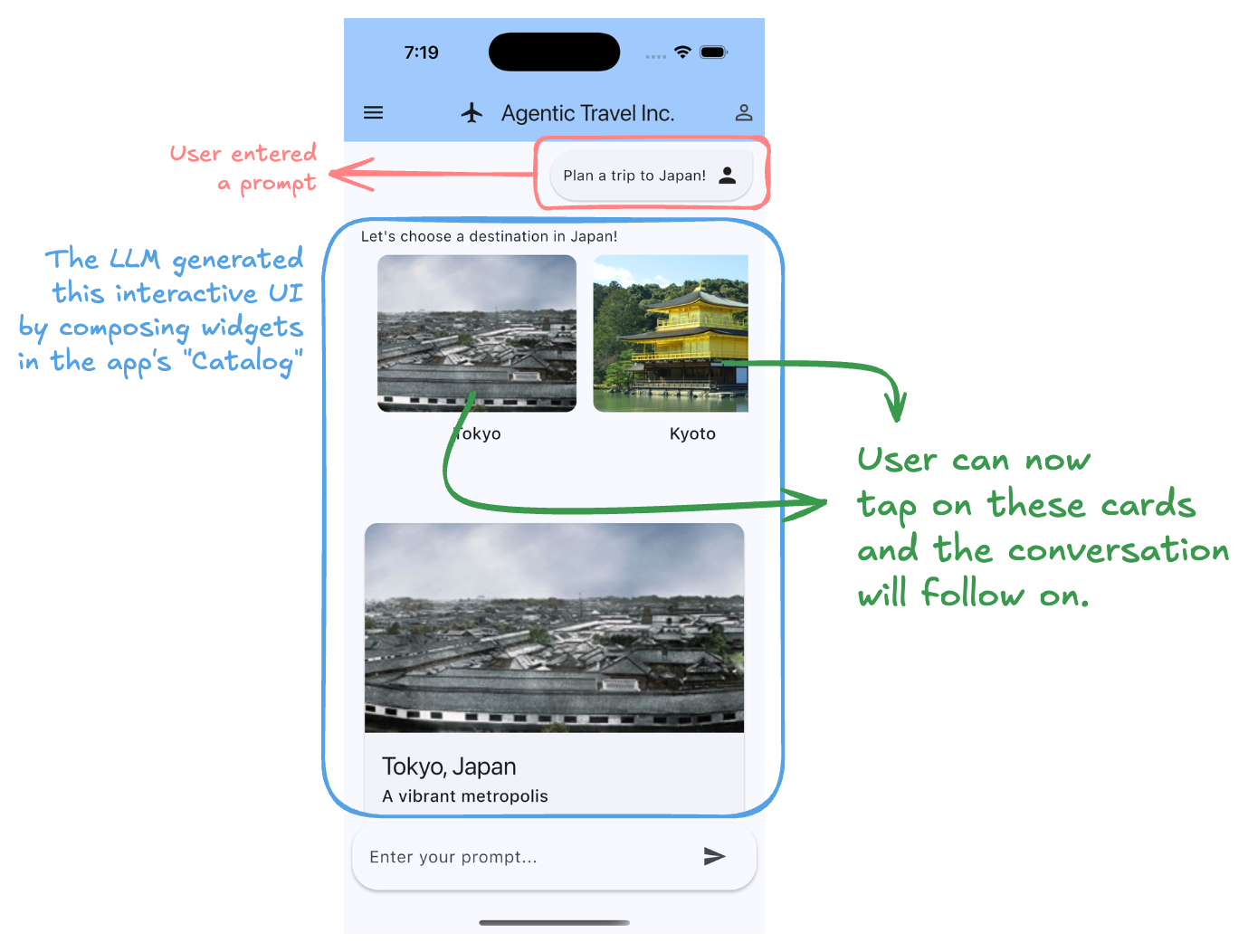
Incorporate graphical UI into chatbots: instead of describing a list of products in text,
the LLM can render an interactive carousel of product widgets. Instead of asking for a user to
type out answers to questions, the LLM can render sliders, checkboxes, and more.
Create dynamically composed UIs: an agent can generate a complete form with sliders, date pickers,
and text fields on the fly based on a user's request to "book a flight."
Look & feel
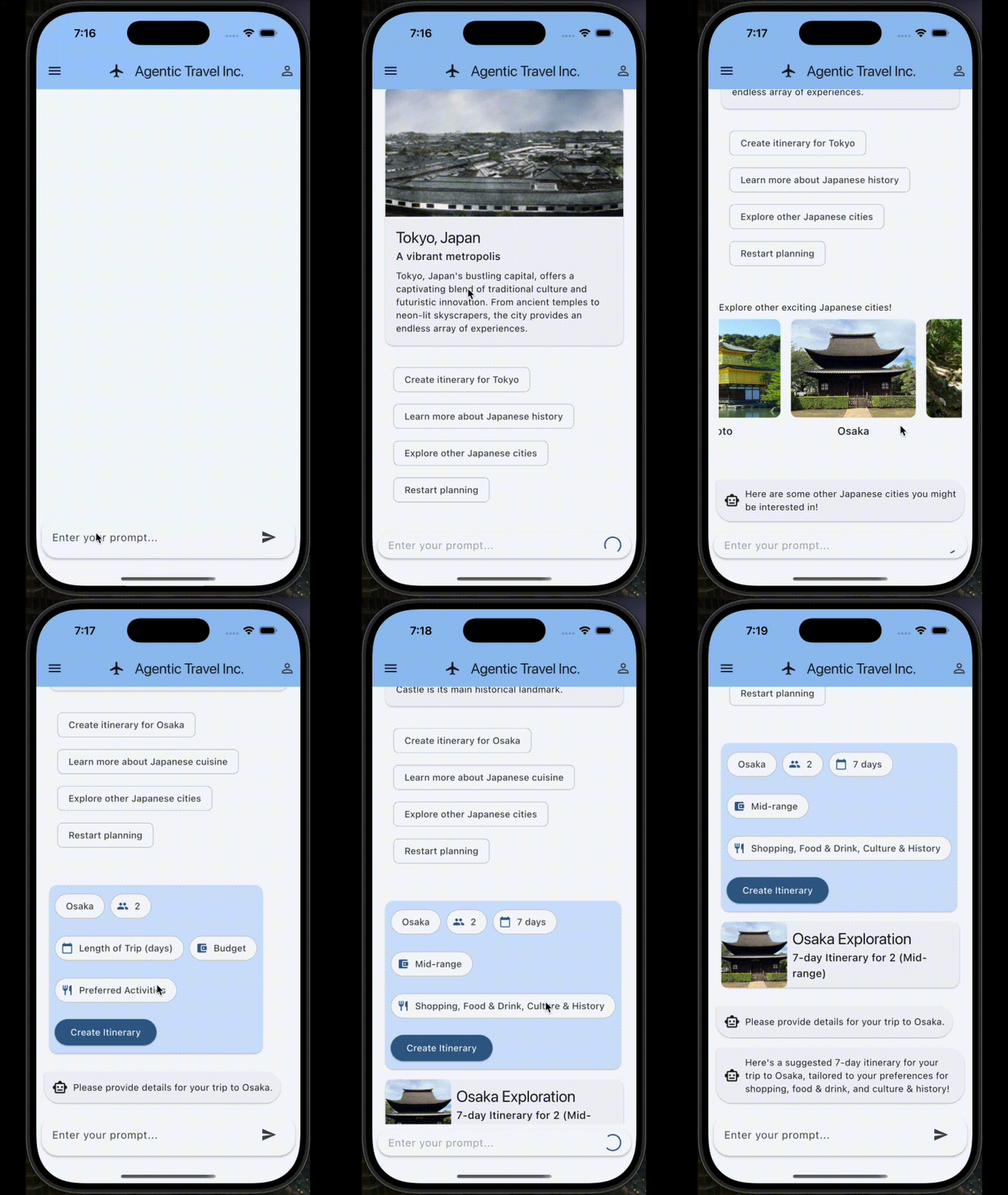
The GIF above shows how GenUI enables dynamic, interactive UI generation,instead of text descriptions or code from a traditional AI coding agent.
Core difference
This UI is not generated in the form of code; rather, it's generated at runtime
based on a widget catalog from the developers' project.
Implementation goals
Integrate with your LLM: Work with your chosen LLM and backend to incorporate graphical
UI responses alongside traditional text.
Leverage Your Widget Catalog: Render UI using your existing, beautifully crafted widgets
for brand and design consistency.
Interactive State Feedback: Widget state changes are sent back to the LLM, enabling a
true interactive loop where the UI influences the agent's next steps.
Framework Agnostic: Be integrated into your agent library or LLM framework of choice.
JSON Based: Use a simple, open standard for UI definition—no proprietary formats.
Cross-Platform Flutter: Work anywhere Flutter works (mobile, iOS, Android, Web, and more).
Widget Composition: Support nested layouts and composition of widgets for complex UIs.
Basic Layout: LLM-driven basic layout generation.
Any Model: Integrate with any LLM that can generate structured JSON output.
Connecting to an AI agent
The genui framework is designed to be backend agnostic. You can use any AI SDK (such as firebase_ai or dartantic_ai) to generate content. The framework provides adapters (like A2uiTransportAdapter) to ingest the AI response and render it.
For custom agent servers that implement the A2UI protocol, you can use the genui_a2a package.
See the package table below for more details on each.
The Flutter Gen UI SDK uses the A2UI protocol to represent UI content internally. The genui_a2a package allows it to act as a renderer for UIs generated by an A2UI backend agent, similar to the other A2UI renderers which are maintained within the A2UI repository.
The Flutter Gen UI SDK currently supports A2UI v0.9.
This repo contains skill files for developers building with agentic coding tools. They can be copied directly into an agent's preferred location or installed using the skills package: