Orientação gerada a partir de informações públicas. Apenas para referência.
HSLuv é uma implementação em Dart do espaço de cores HSLuv, projetada como uma alternativa mais intuitiva e uniforme perceptualmente ao HSL tradicional. Baseado em experimentos com visão humana, melhora a seleção de cores garantindo brilho e saturação consistentes entre tons. Este pacote permite aos desenvolvedores converter entre modelos de cor RGB e HSLuv com resultados precisos e centrados no ser humano. Ideal para aplicações que exigem esquemas de cores acessíveis e visualmente equilibrados, como ferramentas de design, frameworks de UI e aplicativos focados em acessibilidade.
Casos de uso
Criando paletas de cores acessíveis
Projetando interfaces de usuário com consistência perceptiva
Implementando seletores de cores com distribuição de matiz aprimorada
Melhorando o contraste de cores nos recursos de acessibilidade
Gerando temas de cores harmônicas
Principais recursos
Transições de cor perceptualmente uniformes
Melhoria na consistência de brilho e saturação
modelo de cor centrado no ser humano baseado em experimentos
Conversão bidirecional RGB ↔ HSLuv
Suporta todas as principais plataformas
Indicado para
Designers de UI/UX procurando melhor precisão de cor
Desenvolvedores construindo ferramentas de seleção de cores
Aplicativos focados em acessibilidade e clareza visual
Projetos de codificação criativa e arte gerativa
Aplicações multiplataforma que precisam de renderização consistente de cores
Considerações
Pode exigir uma curva de aprendizado para quem está acostumado ao HSL
Documentação limitada em comparação com modelos de cor padrão
Impacto no desempenho em operações de cor de alta frequência
Não adequado para sistemas legados que dependem do HSL
Melhor usado em conjunto com ferramentas de validação de contraste de cor
README original
Snapshot do README original do repositório-fonte vinculado. Consulte o repositório para o conteúdo mais recente.
It is like HSL, but color only gets perceptually lighter or darker when the Lightness attribute changes.
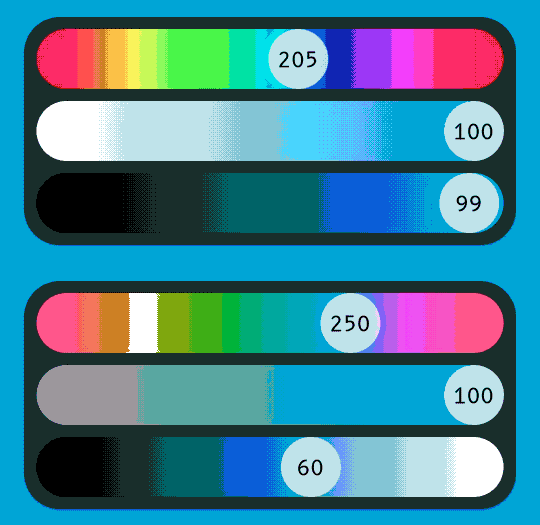
In HSL, if you go from a green hue to a red one, there will be big differences in the perceived lightness. In HSLuv, almost none.
If you want to see for yourself, check the sample app and open the Color Compare screen. Contrast "only" changes when Lightness changes.
When Hue or Saturation attributes change, there might be minimal changes in contrast (in the 0.01 range), but nothing perceivable and certainly better than HSV/HSL.
HPLuv is a similar color space where the perceptual saturation/chroma of a color always stays the same under hue changes. HPL is illustrated by the smaller circle within the hsluv homepage color picker, which consists of the maximum saturation HPL values available for the given lightness level. HPL is restricted to Pastel colors, as many hues cannot reach saturation levels that equal the other hues (eg, in the image, at lightness = 60.2, the most saturated cyan is only about half as saturated as the most saturated possible orange, so the maximum saturation of HPL colors there is constrained to that of cyan).
You can make a Color in HPLuv with toColor(Hsluv.hpluvToRgb([hue, saturation, lightness)) where hue: [0...360], saturation: [0..100], lightness: [0..100].
Usage
In the pubspec.yaml of your flutter project, add the following dependency:
dependencies:hsluv:^VERSION
In your project you can use it in two different ways, either low level (directly accessing values as a list<double>) or high level (similar to HSLColor).
HSLuvColor is easier to use, but has less flexibility than a raw list.
Sample app showing HSV (top) vs HSLuv (bottom). See how the perceived lightness changes as the hue slider moves.
Color values ranges
RGB values are ranging in [0...1]
HSLuv and HPLuv values have different ranging for their components
H : [0...360]
S and L : [0...100]
LUV has different ranging for their components
L* : [0...100]
u* and v* : [-100...100]
LCh has different ranging for their components
L* : [0...100]
C* : [0...?] Upper bound varies depending on L* and H*
H* : [0...360]
XYZ values are ranging in [0...1]
Important: Flutter's HSLColor has lightness and saturation ranging from 0 to 1.0. HSLuv uses 0 to 100.
There is a class, called HSInterColor in the sample that tries to mitigate this.
API functions
Note
The passing/returning values, when not String are List<double> containing each component of the given color space/system in the name's order :
RGB : [red, blue, green]
XYZ : [X, Y, Z]
LCH : [L, C, H]
LUV : [L, u, v]
HSLuv/HPLuv : [H, S, L]
Function listing
xyzToRgb(List<double> tuple)
rgbToXyz(List<double> tuple)
xyzToLuv(List<double> tuple)
luvToXyz(List<double> tuple)
luvToLch(List<double> tuple)
lchToLuv(List<double> tuple)
hsluvToLch(List<double> tuple)
lchToHsluv(List<double> tuple)
hpluvToLch(List<double> tuple)
lchToHpluv(List<double> tuple)
lchToRgb(List<double> tuple)
rgbToLch(List<double> tuple)
hsluvToRgb(List<double> tuple)
rgbToHsluv(List<double> tuple)
hpluvToRgb(List<double> tuple)
rgbToHpluv(List<double> tuple)
hsluvToHex(List<double> tuple)
hpluvToHex(List<double> tuple)
hexToHsluv(String s)
hexToHpluv(String s)
rgbToHex(List<double> tuple)
hexToRgb(String hex)
Reporting Issues
Issues and Pull Requests are welcome.
You can report here.
License
Copyright 2020 Bernardo Ferrari

Permission is hereby granted, free of charge, to any person obtaining a copy of this software and associated documentation files (the "Software"), to deal in the Software without restriction, including without limitation the rights to use, copy, modify, merge, publish, distribute, sublicense, and/or sell copies of the Software, and to permit persons to whom the Software is furnished to do so, subject to the following conditions:

The above copyright notice and this permission notice shall be included in all copies or substantial portions of the Software.

THE SOFTWARE IS PROVIDED "AS IS", WITHOUT WARRANTY OF ANY KIND, EXPRESS OR IMPLIED, INCLUDING BUT NOT LIMITED TO THE WARRANTIES OF MERCHANTABILITY, FITNESS FOR A PARTICULAR PURPOSE AND NONINFRINGEMENT. IN NO EVENT SHALL THE AUTHORS OR COPYRIGHT HOLDERS BE LIABLE FOR ANY CLAIM, DAMAGES OR OTHER LIABILITY, WHETHER IN AN ACTION OF CONTRACT, TORT OR OTHERWISE, ARISING FROM, OUT OF OR IN CONNECTION WITH THE SOFTWARE OR THE USE OR OTHER DEALINGS IN THE SOFTWARE.