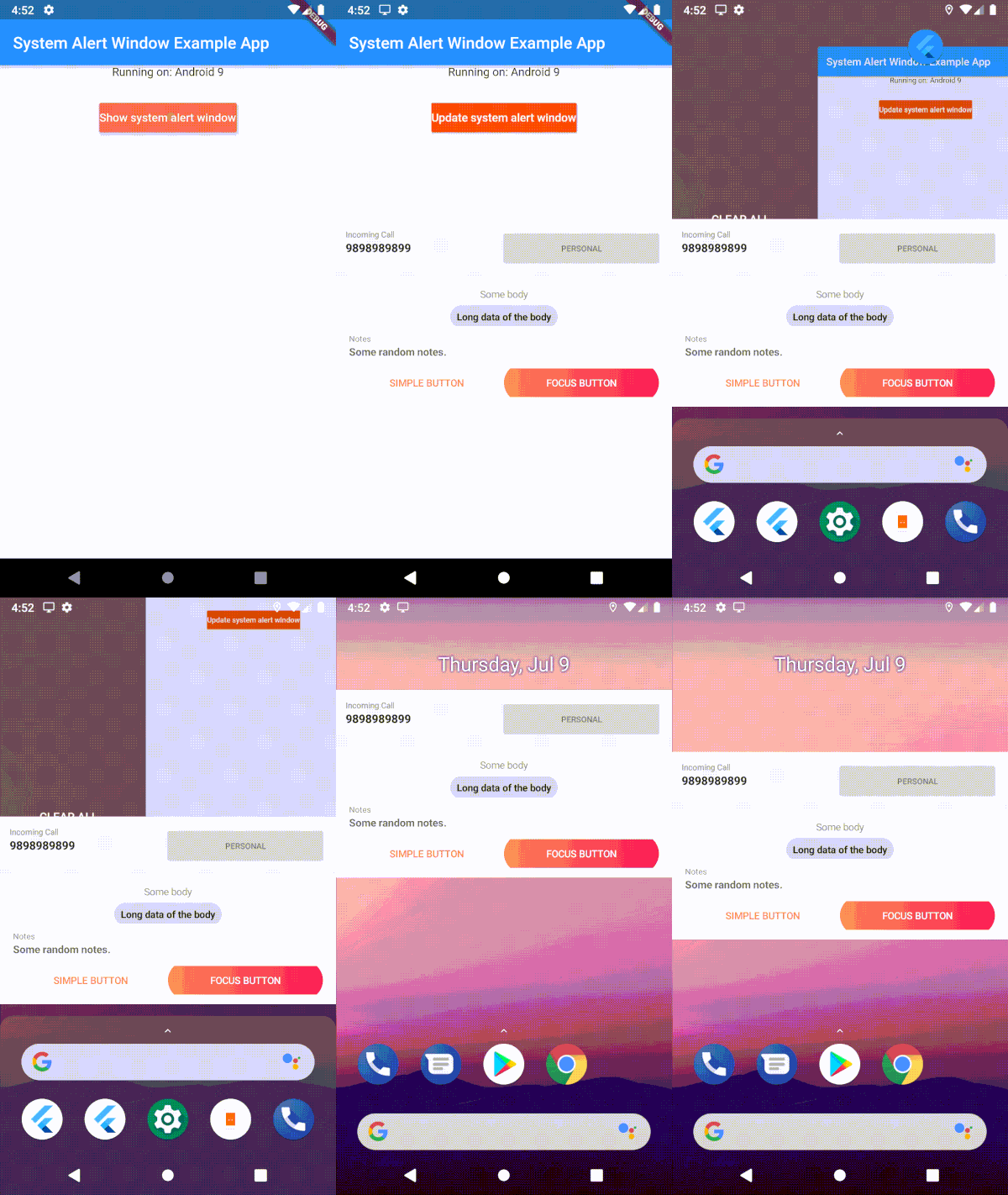
Um plugin do Flutter para mostrar uma janela de sobreposição semelhante ao Truecaller, sobre todos os outros aplicativos, junto com eventos de retorno.
Orientação gerada a partir de informações públicas. Apenas para referência.
Um plugin Flutter que permite exibir uma janela de sobreposição persistente e de nível do sistema no Android e no iOS, semelhante à interface de alerta do Truecaller. Funciona acima de todos os outros aplicativos e suporta eventos de retorno para interações do usuário. Projetado para notificações de alta visibilidade ou alertas urgentes, integra-se perfeitamente às permissões nativas do sistema. O plugin é útil para aplicações que exigem atenção imediata do usuário sem depender de notificações push padrão.
Casos de uso
Exibindo alertas urgentes
Criando janelas de notificação sempre no topo
Implementando interfaces de bloqueio de chamadas
Habilitar sobreposições de status em tempo real
Fornecendo prompts de interação de nível de sistema
Principais recursos
Suporte de sobreposição do sistema
Multiplataforma (Android e iOS)
Manipulação de eventos de retorno
Exibição persistente sobre outros aplicativos
Integração com as configurações de permissão do sistema
Indicado para
Aplicativos de segurança e privacidade
Ferramentas de gerenciamento de chamadas
Utilitários de monitoramento em tempo real
Sistemas de alerta de emergência
Aplicativos que exigem interação de alta prioridade do usuário
Considerações
Requer permissão do sistema no Android
Funcionalidade limitada do iOS devido a restrições da plataforma
Pode ser sinalizado por aplicativos de segurança
O usuário deve habilitar manualmente as permissões de sobreposição
Impacto potencial na bateria e no desempenho
README original
Snapshot do README original do repositório-fonte vinculado. Consulte o repositório para o conteúdo mais recente.
system_alert_window
A flutter plugin to show Truecaller like overlay window, over all other apps along with callback events. Android Go or Android 11 & above, this plugin shows notification bubble, in other android versions, it shows an overlay window.
Android
Demo
1. Clip of example app and 2. Working of button click in the background
Uses 'draw on top' permission and displays it as a overlay window
Android 11 & above
With SystemWindowPrefMode.OVERLAY, system alert windows uses 'overlay functionality' wherever it's supported. In that mode, it will show as bubbles if the 'display over other apps' is not supported.
With SystemWindowPrefMode.DEFAULT/SystemWindowPrefMode.BUBBLE, User has to allow 'All conversations can bubble' in the notification settings of the app. Uses Android Bubble APIs to show the overlay window inside a notification bubble.
Edge-to-edge content and window insets are handled automatically inside the bubble container — wrap your overlay widget with SafeArea to avoid content being obscured by system bars.
Android GO (API 29)
User has to manually enable bubbles from the developer options. Uses Android Bubble APIs to show the overlay window inside a notification bubble.
IOS
Displays as a notification in the notification center [Help Needed]
Example
Show Overlay
Request overlay permission
await SystemAlertWindow.requestPermissions;
Inside main.dart create an entry point for your Overlay widget;
// overlay entry point@pragma("vm:entry-point")
voidoverlayMain() {
runApp(constMaterialApp(
debugShowCheckedModeBanner: false,
home: Material(child: Text("My overlay"))
));
}
//Open overLay content// - Optional arguments:/// `gravity` Position of the window and default is [SystemWindowGravity.CENTER]/// `width` Width of the window and default is [Constants.MATCH_PARENT]/// `height` Height of the window and default is [Constants.WRAP_CONTENT]/// `notificationTitle` Notification title, applicable in case of bubble/// `notificationBody` Notification body, applicable in case of bubble/// `prefMode` Preference for the system window. Default is [SystemWindowPrefMode.DEFAULT]/// `layoutParamFlags` List of List of WindowManager.LayoutParams. This is not applicable for bubbles.awaitSystemAlertWindow.showSystemWindow();
/// update the overlay flag while the overlay in action/// - Optional arguments:/// `gravity` Position of the window and default is [SystemWindowGravity.CENTER]/// `width` Width of the window and default is [Constants.MATCH_PARENT]/// `height` Height of the window and default is [Constants.WRAP_CONTENT]/// `notificationTitle` Notification title, applicable in case of bubble/// `notificationBody` Notification body, applicable in case of bubble/// `prefMode` Preference for the system window. Default is [SystemWindowPrefMode.DEFAULT]/// `layoutParamFlags` List of List of WindowManager.LayoutParams. This is not applicable for bubbles.awaitFlutterOverlayWindow.updateSystemWindow();
// closes overlay if openawaitSystemAlertWindow.closeSystemWindow();
// broadcast data to overlay app from main appawaitSystemAlertWindow.sendMessageToOverlay("Hello from the other side");
//streams message from main app to overlay.SystemAlertWindow.overlayListener.listen((event) {
log("Current Event: $event");
});
Isolate communication
Use this snippet, if you want the callbacks on your main thread
While initializing system alert window in your code
awaitSystemAlertWindow.checkPermissions;
ReceivePort _port = ReceivePort();
IsolateManager.registerPortWithName(_port.sendPort);
_port.listen((message) {
log("message from OVERLAY: $message");
print("Do what ever you want here. This is inside your application scope");
});
Use this to send data to isolate mentioned above
voidcallBackFunction(String tag) {
print("Got tag " + tag);
SendPort port = IsolateManager.lookupPortByName();
port.send(tag);
}