パッケージ、リポジトリ、アプリカテゴリを検索

パッケージ詳細v2.0.0+5

mu_state

Flutterの組み込みプリミティブを使用した最小限のCubitスタイルの状態管理。外部依存関係なし。

AndroidiOSWebmacOSWindowsLinux
30日間ダウンロード
29
いいね数
2
Pub ポイント
160

パッケージをインストール

flutter pub add mu_state

パッケージ概要

公開情報に基づく選定ガイドです。参考としてご利用ください。

mu_state は、Cubit からインスパイアされた、Flutter 向けの軽量で依存関係のない状態管理ソリューションです。Stream や ValueNotifier といった Flutter の組み込みプリミティブを活用して、外部依存なしに最小限かつ効率的なアプリ状態管理を実現します。シンプルさとパフォーマンスを重視し、状態変更の発行とウィジェットでの反応を明確な API で提供します。フル機能の状態管理ライブラリが不要な中小規模のアプリに最適です。

用途

  • 小さなアプリにおけるシンプルな状態管理
  • 複雑な状態ソリューションの置き換え
  • Bloc/Cubit の軽量な代替手段
  • 最小限のオーバーヘッドでリアルタイムUI更新
  • モジュール型またはマイクロサービス型アーキテクチャにおける状態の取り扱い

主な機能

  • 外部の依存関係なし
  • Flutter のネイティブプリミティブに基づいて構築されています
  • 最小限のボイラープレート
  • Cubit を参考にした API
  • 既存のFlutterコードへの簡単な統合
  • ストリームベースの状態発行

適している対象

  • 軽量な状態管理を求める開発者
  • サードパーティライブラリを避けるプロジェクト
  • 迅速な状態更新が必要なアプリ
  • ステート管理のコンセプトを学ぶ
  • シンプルさと保守性を重視するチーム

注意事項

  • 非常に大規模なアプリケーションには適していません
  • 限定された組み込みエラー処理
  • 組み込みの永続化またはシリアライゼーションなし
  • 手動での状態遷移ロジックが必要
  • Bloc のようなフルフレームワークよりも、より意見の少ないもの

元の README

関連するソースリポジトリの README 原文のスナップショットです。最新の内容はリポジトリをご覧ください。

mu_state

Minimal Cubit-inspired state management using Flutter's built-in primitives. No external dependencies.

See my article From ValueNotifier to Cubit-inspired state management for more info

Overview

mu_state provides a lightweight alternative to Bloc/Cubit using Flutter's built-in ValueNotifier, ValueListenableBuilder and InheritedWidget. It follows the same patterns you know from Bloc but with zero dependencies and minimal boilerplate.

Key concepts:

  • MuLogic<S> - Your business logic (like Cubit)
  • MuBuilder<S> - Rebuilds UI on state changes (like BlocBuilder)
  • MuListener<S> - Performs side effects (like BlocListener)
  • MuConsumer<S> - Combines builder and listener (like BlocConsumer)
  • MuProvider<T> - Provides values down the widget tree (like Provider or BlocProvider)

Additional widgets are available for handling multiple states or providers: MuMultiBuilder, MuMultiListener, and MuMultiProvider. The MuComparable mixin is also available for state equality comparison. See the Components section for details.

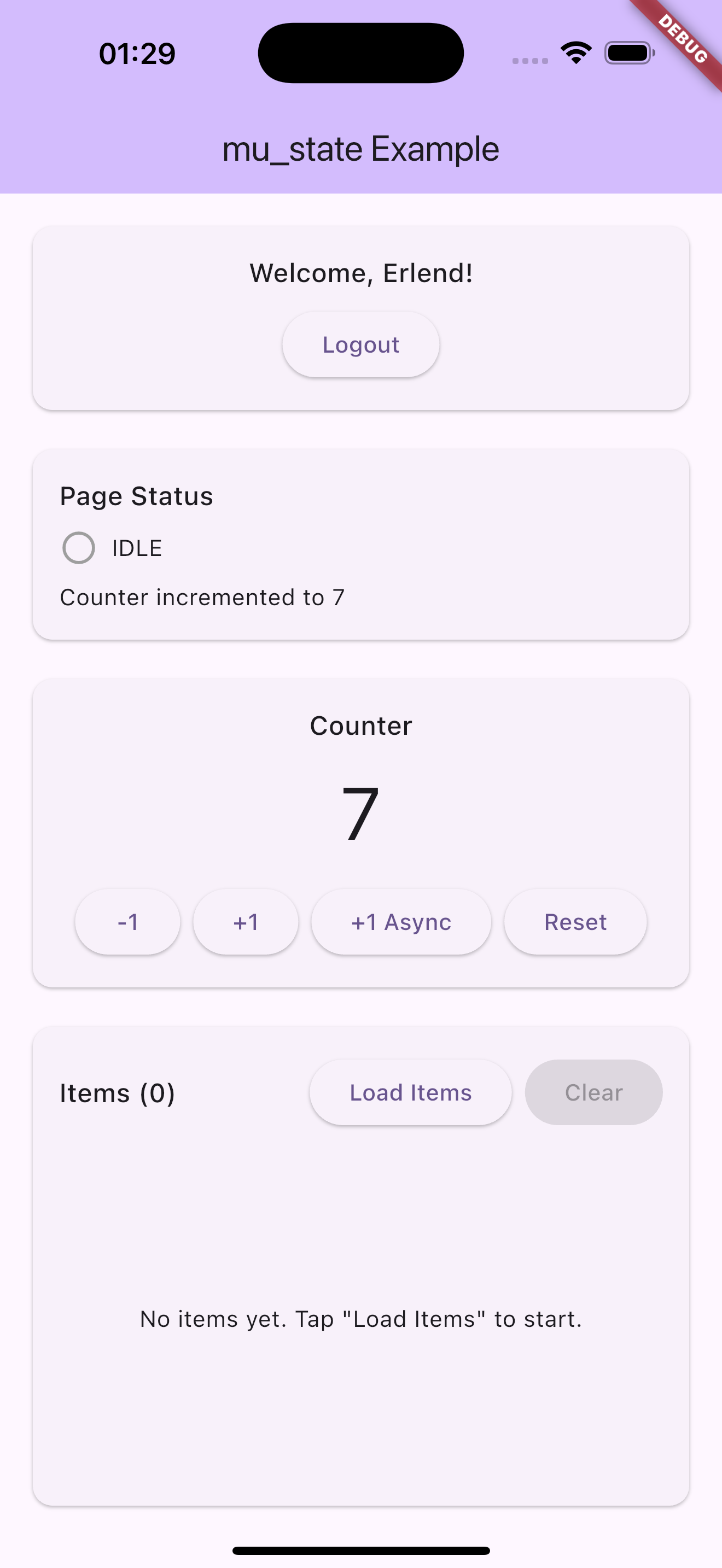
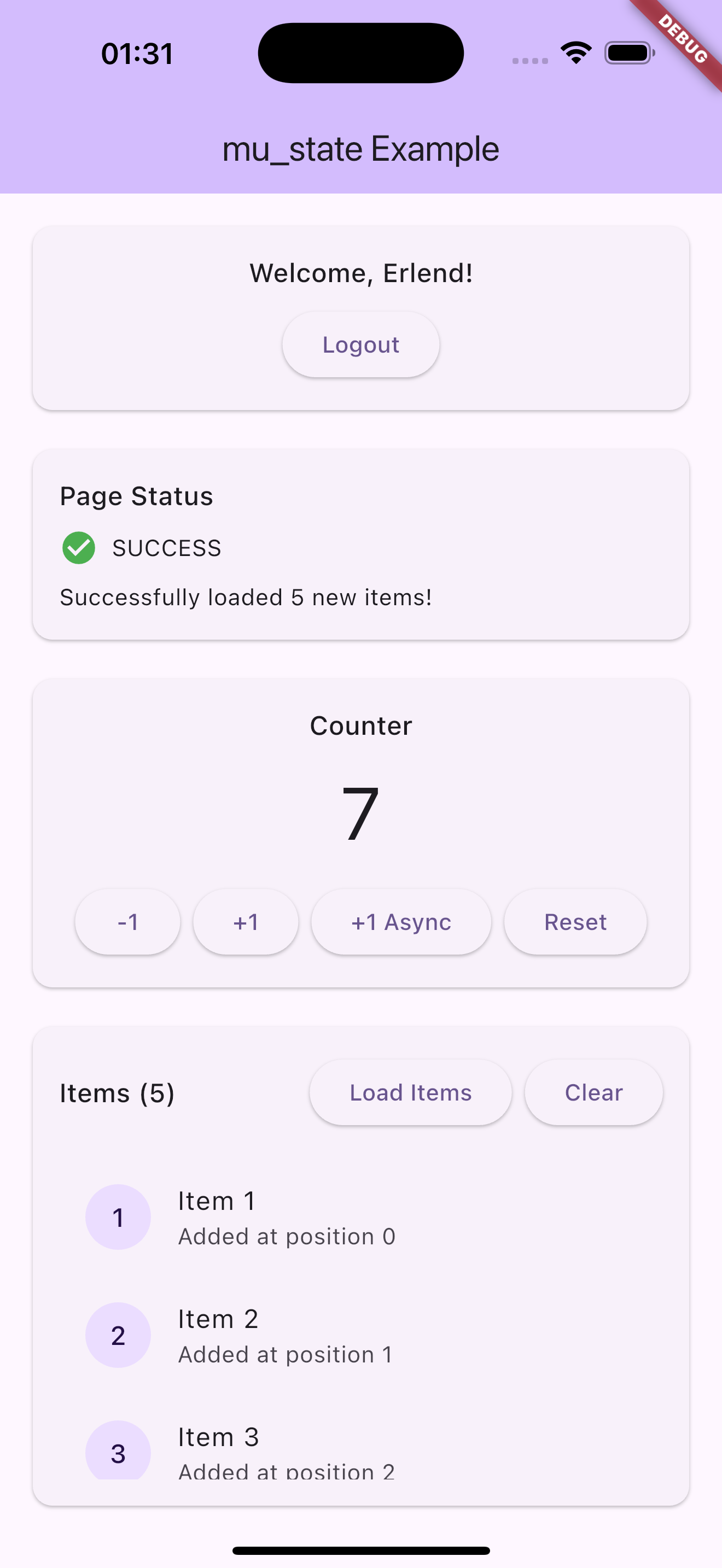
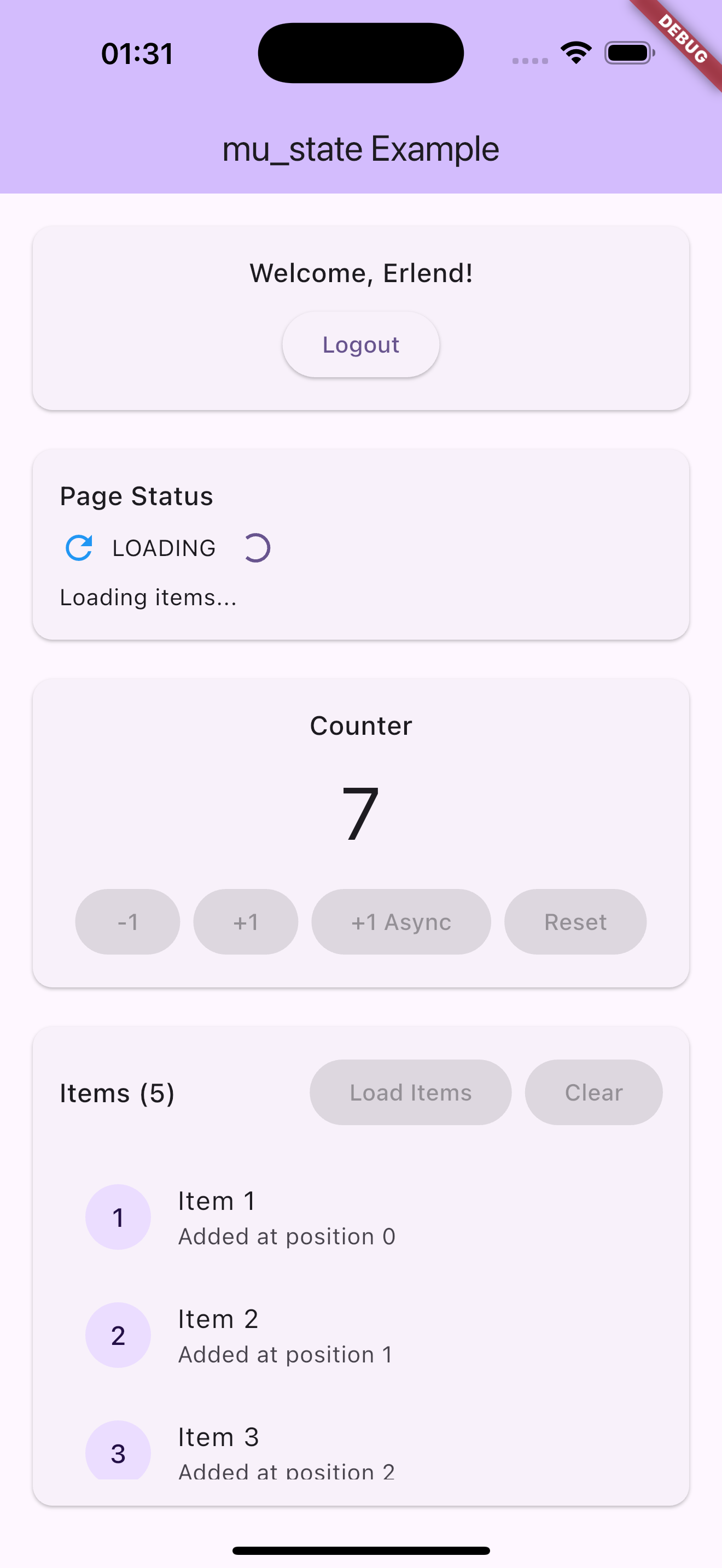
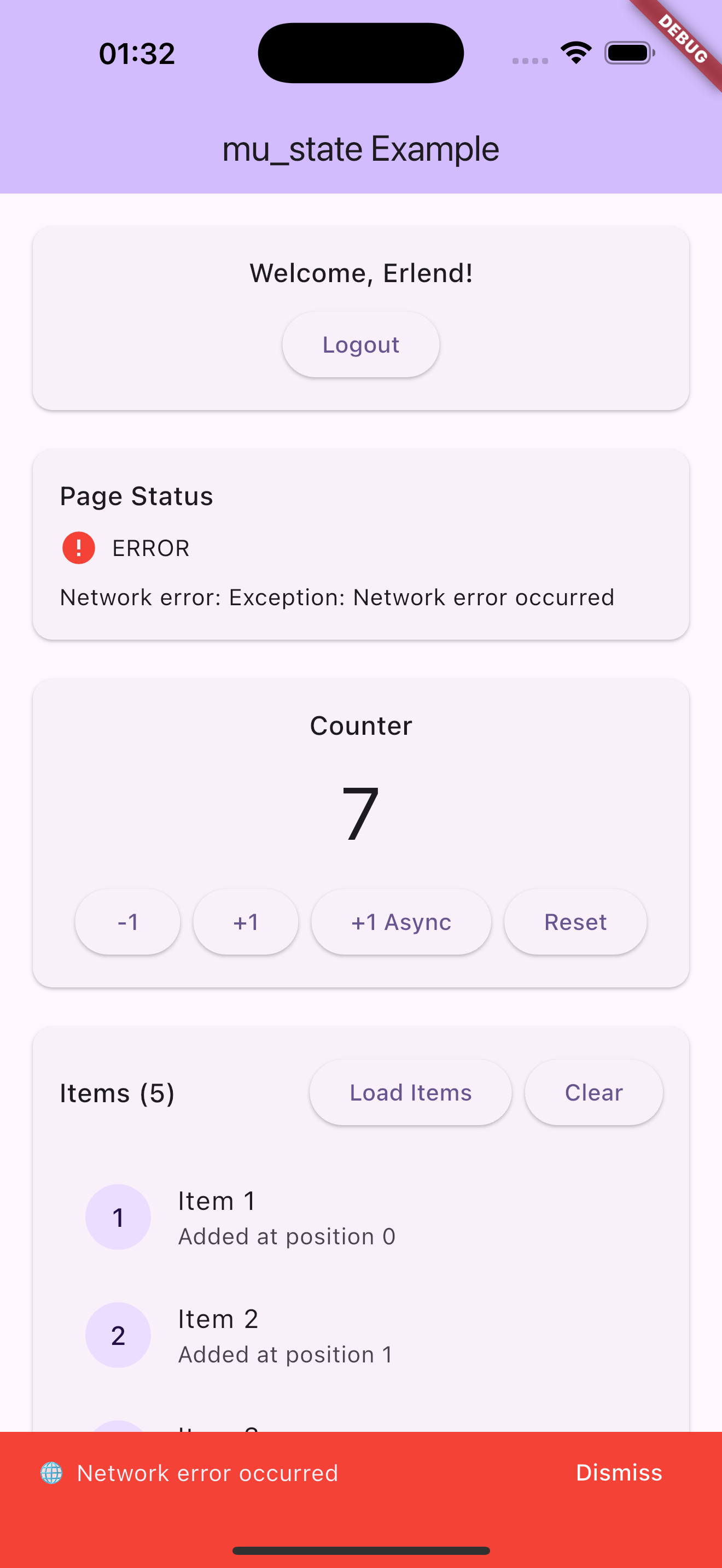
Screenshots

Usage

Let's create a simple counter to see how mu_state works:

counter_logic.dart
import 'package:mu_state/mu_state.dart';

class CounterState with MuComparable {
  final int counter;
  final bool isLoading;
  final String? error;

  const CounterState({required this.counter, required this.isLoading, this.error});

  CounterState copyWith({int? counter, bool? isLoading, String? error}) {
    return CounterState(
      counter: counter ?? this.counter,
      isLoading: isLoading ?? this.isLoading,
      error: error ?? this.error,
    );
  }

  @override
  List<Object?> get props => [counter, isLoading, error];
}

class CounterLogic extends MuLogic<CounterState> {
  CounterLogic() : super(const CounterState(counter: 0, isLoading: false));

  void increment() {
    value = value.copyWith(counter: value.counter + 1);
  }

  Future<void> incrementAsync() async {
    value = value.copyWith(isLoading: true, error: null);
    await Future.delayed(const Duration(seconds: 1));
    
    // Simulate random error
    if (DateTime.now().millisecondsSinceEpoch % 3 == 0) {
      value = value.copyWith(isLoading: false, error: 'Failed to increment');
    } else {
      value = value.copyWith(counter: value.counter + 1, isLoading: false);
    }
  }
}
main.dart
import 'package:flutter/material.dart';
import 'package:mu_state/mu_state.dart';
import 'counter_logic.dart';

void main() => runApp(CounterApp());

class CounterApp extends StatelessWidget {
  @override
  Widget build(BuildContext context) {
    return MaterialApp(
      home: MuProvider<CounterLogic>(
        value: CounterLogic(),
        child: CounterPage(),
      ),
    );
  }
}
counter_page.dart
class CounterPage extends StatelessWidget {
  @override
  Widget build(BuildContext context) {
    final logic = context.logic<CounterLogic>();
    
    return Scaffold(
      appBar: AppBar(title: Text('Counter')),
      body: MuListener<CounterState>(
        logic: logic,
        listener: (context, state) {
          if (state.error != null) {
            ScaffoldMessenger.of(context).showSnackBar(
              SnackBar(content: Text('⚠️ ${state.error}')),
            );
          }
        },
        listenWhen: (prev, curr) => prev.error != curr.error && curr.error != null,
        child: Center(
          child: Column(
            mainAxisAlignment: MainAxisAlignment.center,
            children: [
              MuBuilder<CounterState>(
                valueListenable: logic,
                builder: (context, state, child) {
                  return Column(
                    children: [
                      Text('Counter: ${state.counter}', style: Theme.of(context).textTheme.headlineMedium),
                      if (state.isLoading) CircularProgressIndicator(),
                    ],
                  );
                },
              ),
              SizedBox(height: 20),
              ElevatedButton(
                onPressed: () => logic.increment(),
                child: Text('Increment'),
              ),
              SizedBox(height: 8),
              ElevatedButton(
                onPressed: () => logic.incrementAsync(),
                child: Text('Async Increment'),
              ),
            ],
          ),
        ),
      ),
    );
  }
}

At this point we have successfully separated our presentational layer from our business logic layer. Notice that CounterPage knows nothing about what happens when a user taps the buttons. The widget simply notifies the CounterLogic that the user has pressed increment.

Alternative: You could also use MuConsumer to combine the listener and builder functionality in a single widget. See the MuConsumer section below for details.

Components

MuLogic

MuLogic<S> is a typedef for ValueNotifier<S> that serves as the foundation for your business logic. It manages state and notifies listeners when the state changes. MuLogic is essentially an alias that makes the code more semantic for state management purposes.

class CounterLogic extends MuLogic<CounterState> {
  CounterLogic() : super(const CounterState(counter: 0, isLoading: false));

  void increment() {
    value = value.copyWith(counter: value.counter + 1);
  }
}

Since MuLogic extends ValueNotifier, you get all the familiar methods like addListener, removeListener, and the value property for getting and setting state.

MuBuilder

MuBuilder<S> is a typedef for ValueListenableBuilder<S> that rebuilds the widget when the state changes. It's essentially an alias that makes the code more semantic for state management, but underneath it's just Flutter's built-in ValueListenableBuilder.

See MuListener if you want to "do" anything in response to state changes such as navigation, showing a dialog, etc...

MuBuilder<CounterState>(
  valueListenable: logic,
  builder: (context, state, child) {
    return Text('Counter: ${state.counter}');
  }
)
MuComparable

MuComparable is a mixin that provides equality comparison for state classes. It's a lightweight alternative to packages like Equatable and helps MuBuilder and other listeners determine when to rebuild.

class CounterState with MuComparable {
  final int counter;
  final String? error;

  const CounterState({required this.counter, this.error});

  @override
  List<Object?> get props => [counter, error];
}

The props list should include all properties that determine equality. When state changes, widgets will only rebuild if the new state is different from the previous state based on these properties.

Updating collections

Equality is shallow: entries in props are compared with Dart's default ==. For List, Map, and Set that means reference equality, not content equality. Always create a new collection when updating state — never mutate in place:

// ✅ Correct — new list reference, listeners fire.
emit(state.copyWith(items: [...state.items, newItem]));

// ❌ Wrong — same reference, listeners do NOT fire.
state.items.add(newItem);
emit(state.copyWith(items: state.items));

If you'd rather have deep collection equality out of the box, equatable is a drop-in alternative with the same props API.

MuListener

MuListener performs side effects in response to state changes - navigation, showing dialogs, etc. The listener is called once per state change and by default NOT on initial state (lazy: true). Set lazy: false to call the listener immediately with the current state.

MuListener<CounterState>(
  logic: logic,
  listener: (context, state) {
    if (state.error != null) {
      ScaffoldMessenger.of(context).showSnackBar(
        SnackBar(content: Text('Error: ${state.error}')),
      );
    }
  },
  listenWhen: (prev, curr) => prev.error != curr.error,
  child: Container(),
)
MuProvider

MuProvider is a Flutter widget which provides any value to its children via dependency injection. While originally designed for MuLogic instances, it's now fully generic and can provide any type - making it perfect for injecting repositories, services, or other dependencies throughout your widget tree.

You provide the instance to MuProvider via the value parameter. MuProvider will automatically handle disposing the value when the provider is disposed (if it implements ChangeNotifier, which MuLogic does).

MuProvider<CounterLogic>(
  value: CounterLogic(),
  child: CounterPage(),
);

Access from anywhere in the subtree:

// For MuLogic instances
final logic = context.logic<CounterLogic>();

// For any type
final repo = context.read<AuthRepository>();
MuMultiProvider

MuMultiProvider is a Flutter widget that merges multiple MuProvider widgets into one. MuMultiProvider improves the readability and eliminates the need to nest multiple MuProviders. By using MuMultiProvider we can go from:

MuProvider<LogicA>(
  value: LogicA(),
  child: MuProvider<LogicB>(
    value: LogicB(),
    child: MuProvider<LogicC>(
      value: LogicC(),
      child: ChildA(),
    )
  )
)

to:

MuMultiProvider([
  (child) => MuProvider<LogicA>(value: LogicA(), child: child),
  (child) => MuProvider<LogicB>(value: LogicB(), child: child),
  (child) => MuProvider<LogicC>(value: LogicC(), child: child),
], child: ChildA())
MuMultiBuilder

MuMultiBuilder is a Flutter widget which listens to multiple MuLogic instances and rebuilds when any of them change. This is useful when you need to build UI that depends on multiple state sources.

MuMultiBuilder(
  listenables: [logicA, logicB],
  builder: (context, values, child) {
    final stateA = values[0] as StateA;
    final stateB = values[1] as StateB;
    return Text('A: ${stateA.value}, B: ${stateB.value}');
  },
)
MuMultiListener

MuMultiListener is a Flutter widget that merges multiple MuListener widgets into one. MuMultiListener improves the readability and eliminates the need to nest multiple MuListeners. By using MuMultiListener we can go from:

MuListener<StateA>(
  logic: logicA,
  listener: (context, state) {
    // handle state A changes
  },
  child: MuListener<StateB>(
    logic: logicB,
    listener: (context, state) {
      // handle state B changes
    },
    child: ChildWidget(),
  ),
)

to:

MuMultiListener(
  listeners: [
    (child) => MuListener<StateA>(
      logic: logicA,
      listener: (context, state) {
        // handle state A changes
      },
      child: child,
    ),
    (child) => MuListener<StateB>(
      logic: logicB,
      listener: (context, state) {
        // handle state B changes
      },
      child: child,
    ),
  ],
  child: ChildWidget(),
)
MuConsumer

MuConsumer combines MuBuilder and MuListener functionality in a single widget.

MuConsumer<CounterState>(
  logic: logic,
  listener: (context, state) {
    if (state.error != null) {
      ScaffoldMessenger.of(context).showSnackBar(
        SnackBar(content: Text('Error: ${state.error}')),
      );
    }
  },
  builder: (context, state, child) {
    return Text('Counter: ${state.counter}');
  },
)

An optional listenWhen and buildWhen can be implemented for more granular control over when listener and builder are called. The listenWhen and buildWhen functions take the previous state and the current state and return a bool which determines whether or not the listener or builder function will be invoked.

MuConsumer<CounterState>(
  logic: logic,
  listenWhen: (previous, current) {
    // return true/false to determine whether or not
    // to invoke listener with state
    return previous.error != current.error;
  },
  listener: (context, state) {
    // do stuff here based on state
  },
  buildWhen: (previous, current) {
    // return true/false to determine whether or not
    // to rebuild the widget with state
    return previous.counter != current.counter;
  },
  builder: (context, state, child) {
    // return widget here based on state
    return Text('Counter: ${state.counter}');
  }
)

See the example project for a complete implementation with more features.

カテゴリー

ソースリポジトリ

このパッケージを使用しているプロジェクト

データはまだありません。