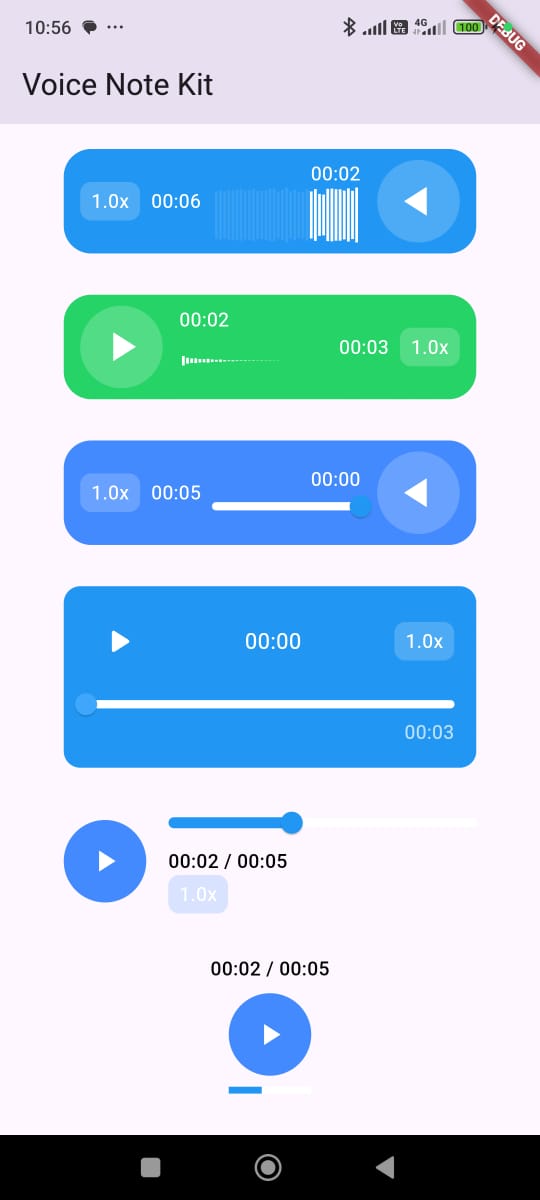
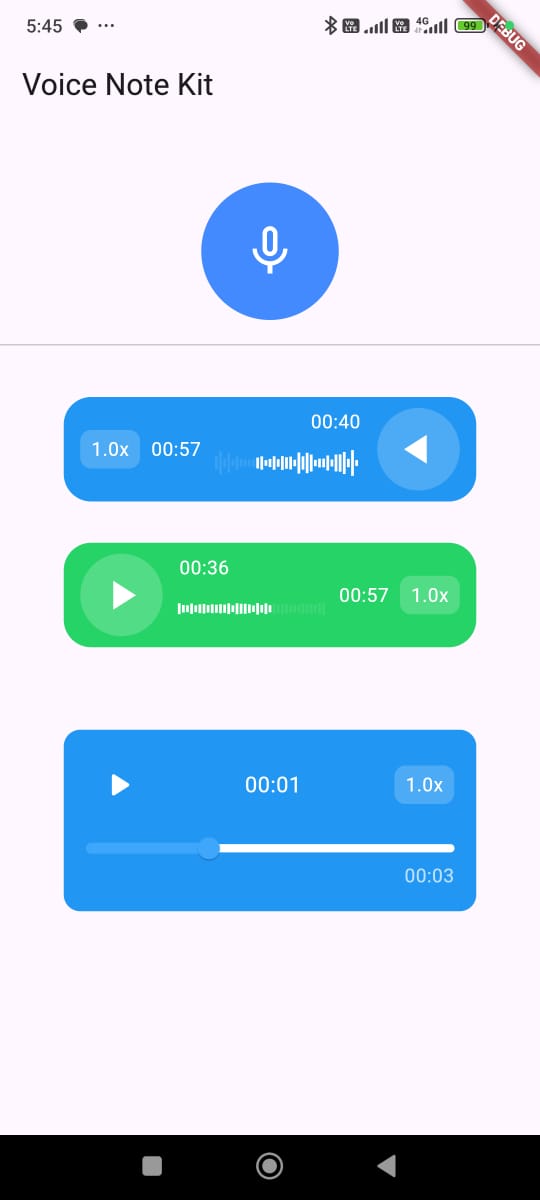
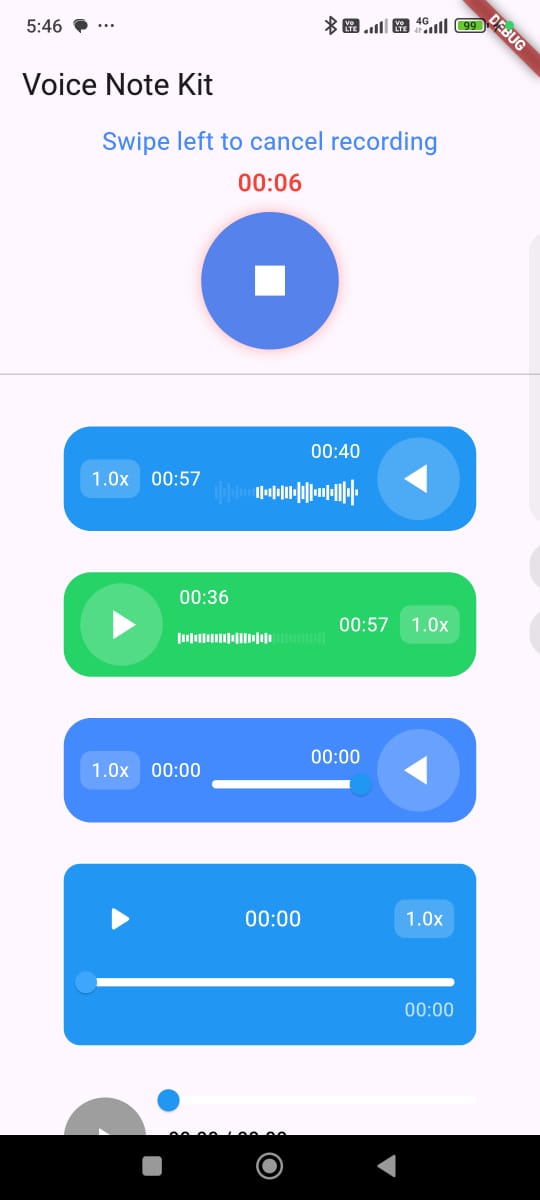
🎙️ Voice Note Kit is a Flutter plugin that allows you to record, save, and play voice notes with waveform visualization. It's built for mobile apps needing voice features like audio memos, task recordings, and more.
🎤 Record audio: Capture high-quality audio using the device's microphone.
💾 Save audio files locally: Store audio files locally on the device for later use.
🔊 Play recorded audio: Easily play back the recorded audio with built-in controls.
📈 Waveform visualization: Display a dynamic waveform using just_waveform for a visual representation of the audio.
🔁 Playback controls: Play, pause, resume, and stop recorded audio seamlessly.
🔐 Permissions management: Automatically handles permissions for recording audio and accessing the microphone using permission_handler.
🎨 Multiple audio player styles: Choose from various customizable player styles to fit the app’s theme and user interface.
🚀 Easy usage: Simple plug-and-play integration with minimal setup required, designed for seamless use in Flutter apps.
🏃♂️ Adjustable playback speed: Set the playback speed to multiple values (e.g., 0.5x, 1.0x, 1.5x, 2.0x, etc.) to suit the user’s preference for fast-forwarding or slowing down the audio.
🔧 Customizable UI components: Tailor the look and feel of the recorder and player with configurable options for icon sizes, colors, button shapes, and more.
Getting Started
Add dependency:
In your pubspec.yaml:
dependencies:voice_note_kit:^1.2.0
Install Package In your project:
flutter pub get
Android Configuration: In your AndroidManifest.xml:
<uses-permissionandroid:name="android.permission.RECORD_AUDIO" /><!-- Optional: Add this permission if you want to use bluetooth telephony device like headset/earbuds --><uses-permissionandroid:name="android.permission.MODIFY_AUDIO_SETTINGS" /><!-- Optional: Add this permission if you want to save your recordings in public folders --><uses-permissionandroid:name="android.permission.WRITE_EXTERNAL_STORAGE" />
in /android/app/build.gradle
minSdk = 23// Prefered
compileSdk = 35
iOS Configuration: In your iOS Info.plist, add:
<key>NSMicrophoneUsageDescription</key>
<string>This app needs access to the microphone to record audio.</string>
In Your Podfile
platform :ios, '12.0'
post_install do |installer|
  installer.pods_project.targets.each do |target|
    flutter_additional_ios_build_settings(target)
    target.build_configurations.each do |config|
      config.build_settings['GCC_PREPROCESSOR_DEFINITIONS'] ||= [
        '$(inherited)',
        'PERMISSION_MICROPHONE=1',
      ]
    end
  end
end
Macos Configuration: In your Macos Info.plist, add:
<key>NSMicrophoneUsageDescription</key>
<string>This app needs access to the microphone to record audio.</string>
In Your Podfile
platform :osx, '10.15'
Open your macos/Runner/DebugProfile.entitlements and macos/Runner/Release.entitlements files.
AudioPlayerWidget(
        autoPlay: false, // Whether to automatically start playback when the widget builds
        autoLoad: true, // Whether to preload the audio before the user presses play
        audioPath:
            "https://commondatastorage.googleapis.com/codeskulptor-demos/riceracer_assets/fx/engine-10.ogg", // The path or URL of the audio file
        audioType: AudioType.url, // Specifies if the audio is from a URL, asset, , file , or blobforWeb(for flutter web)
        playerStyle: PlayerStyle.style5, // The visual style of the player (you can choose between different predefined styles)
        textDirection: TextDirection.rtl, // Text direction for RTL or LTR languages
        size: 60, // Size of the play/pause button
        progressBarHeight: 5, // Height of the progress bar
        backgroundColor: Colors.blue, // Background color of the widget
        progressBarColor: Colors.blue, // Color of the progress bar (played portion)
        progressBarBackgroundColor: Colors.white, // Background color of the progress bar
        iconColor: Colors.white, // Color of the play/pause icon
        shapeType: PlayIconShapeType.circular, // Shape of the play/pause button (e.g., circular or square)
        showProgressBar: true, // Whether to show the progress bar
        showTimer: true, // Whether to display the current time/duration
        width: 300, // Width of the whole audio player widget
        audioSpeeds: const [0.5, 1.0, 1.5, 2.0, 3.0], // Supported audio playback speeds
        onSeek: (value) => print('Seeked to: $value'), // Callback when user seeks to a new position
        onError: (message) => print('Error: $message'), // Callback when an error occurs
        onPause: () => print("Paused"), // Callback when audio is paused
        onPlay: (isPlaying) => print("Playing: $isPlaying"), // Callback when audio starts or resumes playing
        onSpeedChange: (speed) => print("Speed: $speed"), // Callback when playback speed is changed
),
// If You Want to User Controller For The PlayerlatefinalVoiceNotePlayerController playerController;
@overridevoidinitState() {
playerController = VoiceNotePlayerController();
super.initState();
}
@overridevoiddispose() {
playerController.dispose();
super.dispose();
}
// Play the audio from the current position
playerController.play();
// Pause the audio playback
playerController.pause();
// Set the playback speed. Accepts a double value (e.g., 1.0 for normal speed, 1.5 for 1.5x speed)
playerController.setSpeed(1.5);
// Seek to a specific position in the audio. The value should be between 0 and 1, where 0 represents the beginning of the audio and 1 represents the end.
playerController.seekTo(0.2); // Seeks to 20% of the audio's total duration
This package uses (You do not have to import them):
just_audio:
just_waveform:
record:
path_provider:
permission_handler:
http:
About the Developer
Hello! 👋 I'm Abdallah Yassein, a Senior Flutter Developer with extensive experience in building high-quality mobile applications. I specialize in using clean architecture and native integrations to create scalable and efficient solutions with Flutter.
In addition to my development work, I am also a content creator and educator. I run a YouTube channel where I share in-depth Flutter tutorials in Arabic, helping developers across the Middle East enhance their skills and advance their careers in mobile app development.
I am also excited to offer an in-depth Flutter course on Udemy, designed to guide complete beginners to becoming job-ready Flutter developers. This course covers the fundamentals and best practices to help you build professional-quality Flutter apps.
Feel free to explore my YouTube channel and Udemy course for Flutter development tips, advanced topics, and step-by-step tutorials. Don’t forget to subscribe and enroll to continue your learning journey!