Pakete, Repositories und App-Kategorien suchen

Cover von google_maps_cluster_manager
Paketdetailsv3.1.0

google_maps_cluster_manager

Einfache Flutter-Clustering-Bibliothek für Google Maps basierend auf Geohash.

30-Tage-Downloads
3020
Likes
311
Pub-Punkte
90

Paket installieren

flutter pub add google_maps_cluster_manager

Paketübersicht

Aus öffentlichen Paketdaten erstellte Orientierung.

Eine einfache Flutter-Clustering-Bibliothek für Google Maps, die Geohash verwendet, um benachbarte Marker effizient zu gruppieren. Sie reduziert die Karte durch Zusammenfassen mehrerer Punkte in Clustern und verbessert so Leistung und Benutzererfahrung bei der Anzeige großer Mengen von Standorten. Die Bibliothek integriert sich nahtlos mit Google Maps for Flutter und bietet anpassbare Cluster-Symbole sowie fließende Animationen. Ideal für Anwendungen, die bei dichten Markersets visuelle Klarheit erfordern.

Anwendungsfälle

  • Anzeigen großer Datensätze auf Karten
  • Verbesserung der Kartenleistung mit vielen Markern
  • Verbesserung der Benutzererfahrung in ortsbasierten Apps
  • Visualisierung von geospatialen Datenclustern
  • Interaktive Kartenoberflächen erstellen

Hauptmerkmale

  • Geohash-basierte Clustering
  • Anpassbare Clusterecken
  • Glatte Animationsübergänge
  • Einfache Integration mit Google Maps
  • Unterstützt dynamische Markierungsaktualisierungen

Geeignet für

  • Apps mit hochdichter Standortdaten
  • kartenintensive Anwendungen
  • Entwickler, die leichte Clustering suchen
  • Projekte, die Google Maps für Flutter verwenden
  • Benutzer, die eine effiziente Markierungskontrolle benötigen

Hinweise

  • Google Maps für Flutter Einrichtung erforderlich
  • Beschränkt auf die Google Maps-Plattform
  • Die Clustering-Logik muss möglicherweise für spezifische Anwendungsfälle angepasst werden
  • Keine integrierte Unterstützung für nicht-Geohash-Methoden
  • Hängt von externem Repository für Aktualisierungen ab

Original-README

Originaler README-Schnappschuss aus dem verknüpften Quell-Repository. Aktuelle Inhalte finden Sie im Repository.

pub package

Flutter Cluster Manager for Google Maps

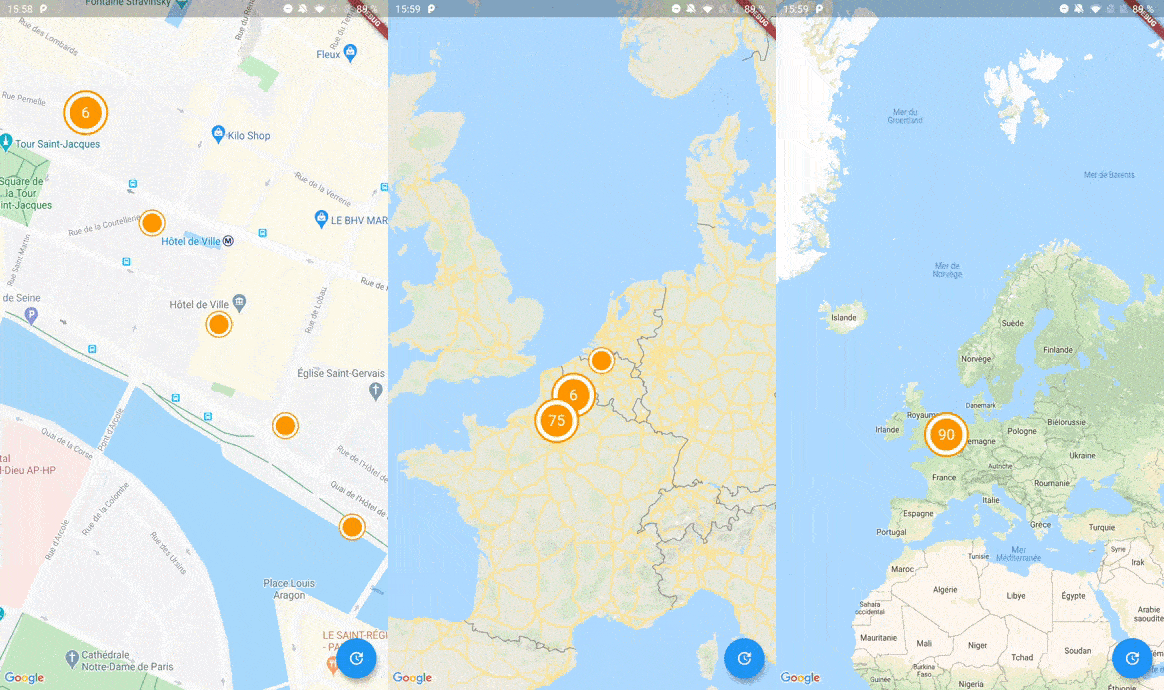
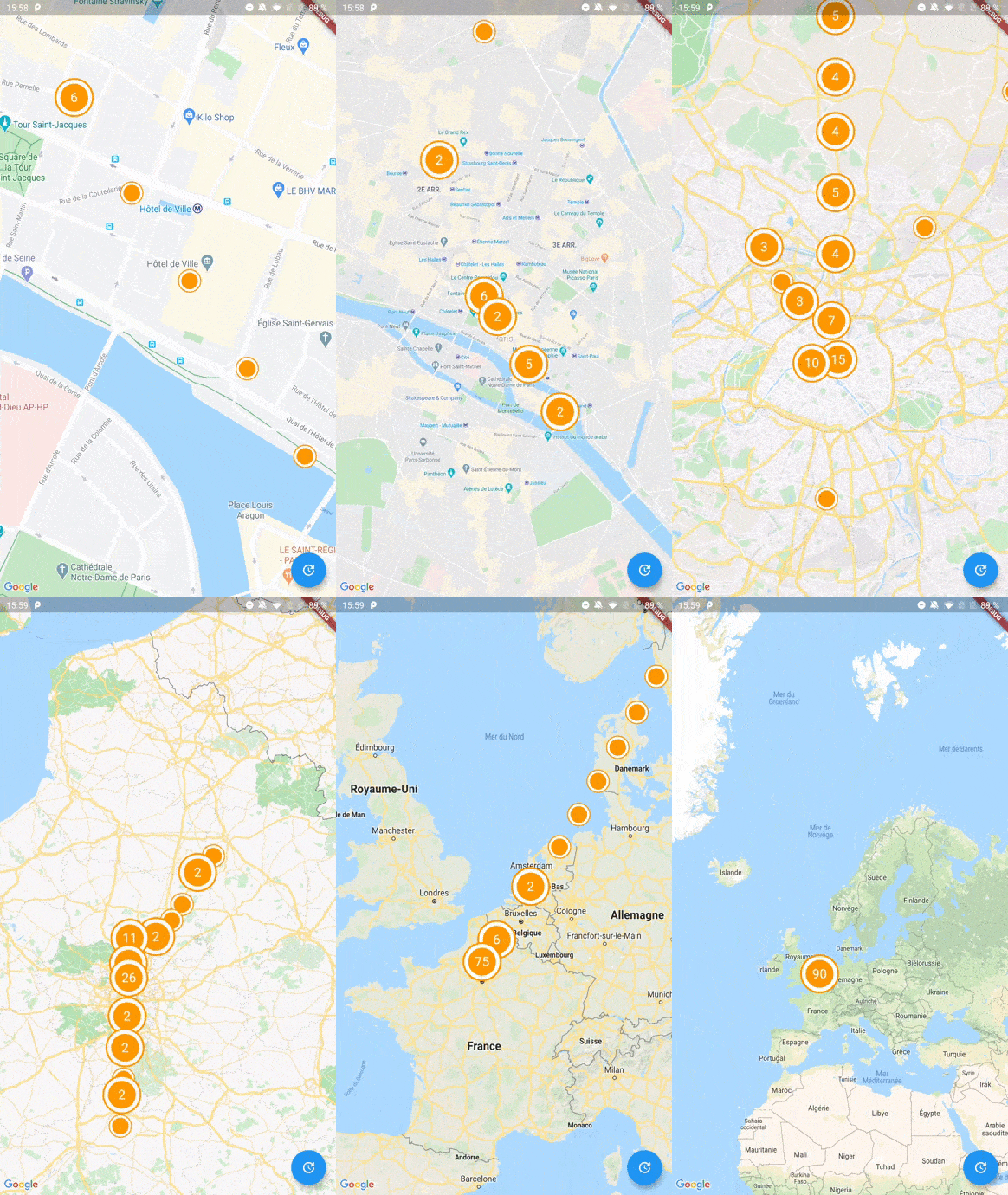
Screenshot

A Flutter package to cluster items on a Google Maps widget based on Geohash. Highly inspired by clustering_google_maps

Usage

To use this package, add google_maps_cluster_manager as a dependency in your pubspec.yaml file.

Getting Started

Your map items has to use ClusterItem as a mixin (or extends this class) and implements the LatLng location getter.

class Place with ClusterItem {
  final String name;
  final LatLng latLng;

  Place({required this.name, required this.latLng});

  @override
  LatLng get location => latLng;
}

To start with Cluster Manager, you have to initialize a ClusterManager instance.

ClusterManager<Place>(
    _items, // Your items to be clustered on the map (of Place type for this example)
    _updateMarkers, // Method to be called when markers are updated
    markerBuilder: _markerBuilder, // Optional : Method to implement if you want to customize markers
    levels: [1, 4.25, 6.75, 8.25, 11.5, 14.5, 16.0, 16.5, 20.0], // Optional : Configure this if you want to change zoom levels at which the clustering precision change
    extraPercent: 0.2, // Optional : This number represents the percentage (0.2 for 20%) of latitude and longitude (in each direction) to be considered on top of the visible map bounds to render clusters. This way, clusters don't "pop out" when you cross the map.
    stopClusteringZoom: 17.0 // Optional : The zoom level to stop clustering, so it's only rendering single item "clusters"
);

When your GoogleMapController is created, you have to set the mapId with the setMapId method :

_manager.setMapId(controller.mapId);

You are able to add an new item to the map by calling addItem method on your ClusterManager instance. You can also completely change the items on your maps by calling setItems method.

You can customize the icon of a cluster by using Future<Marker> Function(Cluster<T extends ClusterItem>) markerBuilder parameter.

static Future<Marker> Function(Cluster) get markerBuilder => (cluster) async {
  return Marker(
    markerId: MarkerId(cluster.getId()),
    position: cluster.location,
    onTap: () {
        print(cluster.items);
    },
    icon: await getClusterBitmap(cluster.isMultiple ? 125 : 75,
    text: cluster.isMultiple? cluster.count.toString() : null),
  );
};

static Future<BitmapDescriptor> getClusterBitmap(int size, {String text?}) async {
  final PictureRecorder pictureRecorder = PictureRecorder();
  final Canvas canvas = Canvas(pictureRecorder);
  final Paint paint1 = Paint()..color = Colors.red;

  canvas.drawCircle(Offset(size / 2, size / 2), size / 2.0, paint1);

  if (text != null) {
    TextPainter painter = TextPainter(textDirection: TextDirection.ltr);
    painter.text = TextSpan(
    text: text,
    style: TextStyle(
        fontSize: size / 3,
        color: Colors.white,
        fontWeight: FontWeight.normal),
    );
    painter.layout();
    painter.paint(
      canvas,
      Offset(size / 2 - painter.width / 2, size / 2 - painter.height / 2),
    );
  }

  final img = await pictureRecorder.endRecording().toImage(size, size);
  final data = await img.toByteData(format: ImageByteFormat.png);

  return BitmapDescriptor.fromBytes(data.buffer.asUint8List());
}

Every cluster (even one item clusters) is rendered by the library as a Cluster<T extends ClusterItem> object. You can differentiate single item clusters from multiple ones by using the isMultiple variable (or the count variable). This way, you can create different markers icon depending on the type of cluster.

You can create multiple managers for a single map, see the multiple.dart example.

Complete Basic Example

See the example directory for a complete sample app.

Kategorien

Abhängigkeiten

Abhängigkeiten 1 Einträge

  • google_maps_flutter_platform_interface^2.4.3

Quell-Repository

Projekte, die dieses Paket verwenden