Aus öffentlichen Paketdaten erstellte Orientierung.
Das Logger-Paket ist eine leichte, anpassbare Logging-Lösung für Flutter-Anwendungen. Es bietet saubere, lesbare und ansprechend formatierte Logs mit Unterstützung für mehrere Protokollstufen, strukturierte Ausgabe und einfache Integration. Speziell für Debugging und Überwachung entwickelt, hilft es Entwicklern, das Anwendungsverhalten effizient auf allen Plattformen zu verfolgen. Das Paket ist erweiterbar und ermöglicht benutzerdefinierte Formate und Ausgabedestinationen. Sein geringer Ressourcenverbrauch und die einfache API machen es sowohl für Entwicklung als auch für den Produktiveinsatz ideal.
Anwendungsfälle
Debugging des Anwendungsflusses
Überwachung des Laufzeitverhaltens
Fehler und Warnungen verfolgen
Protokollierung in Produktionsanwendungen
Integration in CI/CD-Pipelines
Hauptmerkmale
Schön formatierte Protokolle
Erweiterbares Formatiersystem
Mehrere Protokollstufen
Plattformübergreifende Unterstützung
Einfache API
Benutzerdefinierte Ausgabedestinationen
Geeignet für
Entwickler, die einfaches Protokollieren suchen
Teams, die strukturierte Protokolle benötigen
Apps mit Debug-Sichtbarkeit
Produktionsumgebungen mit Logging-Anforderungen
Plattformübergreifende Flutter-Projekte
Hinweise
Kann für den Produktiveinsatz konfiguriert werden
Ausführliche Ausgabe kann die Leistung beeinträchtigen, wenn sie nicht verwaltet wird
Begrenzte integrierte Filteroptionen
Nicht für komplexe Protokollspeicherung oder -analyse ausgelegt
Original-README
Originaler README-Schnappschuss aus dem verknüpften Quell-Repository. Aktuelle Inhalte finden Sie im Repository.
Logger
Small, easy to use and extensible logger which prints beautiful logs.
Inspired by logger for Android.
Show some ❤️ and star the repo to support the project
When creating a logger, you can pass some options:
var logger = Logger(
  filter: null, // Use the default LogFilter (-> only log in debug mode)
  printer: PrettyPrinter(), // Use the PrettyPrinter to format and print log
  output: null, // Use the default LogOutput (-> send everything to console)
);
If you use the PrettyPrinter, there are more options:
var logger = Logger(
printer: PrettyPrinter(
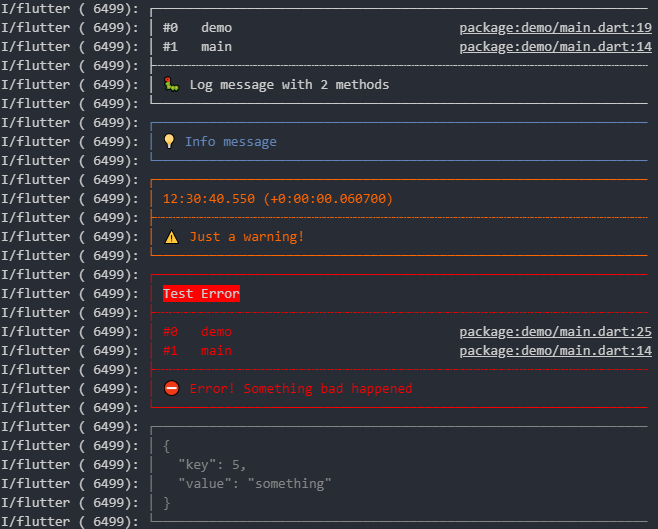
methodCount: 2, // Number of method calls to be displayed
errorMethodCount: 8, // Number of method calls if stacktrace is provided
lineLength: 120, // Width of the output
colors: true, // Colorful log messages
printEmojis: true, // Print an emoji for each log message// Should each log print contain a timestamp
dateTimeFormat: DateTimeFormat.onlyTimeAndSinceStart,
),
);
Auto detecting
With the io package you can auto detect the lineLength and colors arguments.
Assuming you have imported the io package with import 'dart:io' as io; you
can auto detect colors with io.stdout.supportsAnsiEscapes and lineLength
with io.stdout.terminalColumns.
You should probably do this unless there's a good reason you don't want to
import io, for example when using this library on the web.
LogFilter
The LogFilter decides which log events should be shown and which don't.
The default implementation (DevelopmentFilter) shows all logs with level >= Logger.level while
in debug mode (i.e., running dart with --enable-asserts).
In release mode all logs are omitted.
This will show all logs even in release mode. (NOT a good idea)
LogPrinter
The LogPrinter creates and formats the output, which is then sent to the LogOutput.
You can implement your own LogPrinter. This gives you maximum flexibility.
If you created a cool LogPrinter which might be helpful to others, feel free to open a pull
request.
:)
Colors
Please note that in some cases ANSI escape sequences do not work under macOS.
These escape sequences are used to colorize the output.
This seems to be related to a Flutter bug that affects iOS builds:
https://github.com/flutter/flutter/issues/64491
However, if you are using a JetBrains IDE (Android Studio, IntelliJ, etc.)
you can make use of
the Grep Console Plugin
and the PrefixPrinter
decorator to achieve colored logs for any logger:
var logger = Logger(
    printer: PrefixPrinter(PrettyPrinter(colors: false))
);
LogOutput
LogOutput sends the log lines to the desired destination.
The default implementation (ConsoleOutput) send every line to the system console.
classConsoleOutputextendsLogOutput{
@overridevoidoutput(OutputEvent event) {
for (var line in event.lines) {
print(line);
}
}
}
Other provided LogOutputs are:
FileOutput/AdvancedFileOutput
StreamOutput
Possible future LogOutputs could send to Firebase or to Logcat. Feel free to open pull
requests.
Acknowledgments
This package was originally created by Simon Choi, with further
development by Harm Aarts, greatly enhancing its functionality over
time.