Aus öffentlichen Paketdaten erstellte Orientierung.
mu_state ist eine leichte, abhängigkeitsfreie Zustandsverwaltungslösung für Flutter, die von Cubit inspiriert ist. Sie nutzt die eingebauten Primitiven von Flutter wie Stream und ValueNotifier, um eine minimale und effiziente Möglichkeit zur Verwaltung der App-Zustände ohne externe Abhängigkeiten bereitzustellen. Entwickelt für Einfachheit und Leistung bietet sie eine klare API zum Ausgeben von Zustandsänderungen und Reagieren darauf in Widgets. Ideal für kleine bis mittelgroße Apps, bei denen eine voll ausgestattete Zustandsverwaltungsbibliothek überflüssig wäre.
Anwendungsfälle
Einfache Zustandsverwaltung in kleinen Anwendungen
Komplexe Zustandslösungen ersetzen
Leichte Alternativen zu Bloc/Cubit
Echtzeit-UI-Updates mit minimalem Overhead
Zustandsverwaltung in modularen oder mikroservices-artigen Architekturen
Hauptmerkmale
Keine externen Abhängigkeiten
Auf den nativen Primitiven von Flutter aufgebaut
Minimales Boilerplate
Cubit-inspirierte API
Einfache Integration in bestehenden Flutter-Code
strombasierte Zustandsemission
Geeignet für
Entwickler, die leichten Zustandsmanagement suchen
Projekte, die Drittanbieter-Bibliotheken vermeiden
Apps, die schnelle Zustandsaktualisierungen benötigen
Lernen von Zustandsverwaltungs-Konzepten
Teams, die Einfachheit und Wartbarkeit priorisieren
Hinweise
Nicht geeignet für sehr groß angelegte Anwendungen
Eingeschränkte eingebaute Fehlerbehandlung
Keine integrierte Persistenz oder Serialisierung
Manuelle Zustandsübergangslogik erforderlich
Unabhängiger von Meinungen als vollständige Frameworks wie Bloc
Original-README
Originaler README-Schnappschuss aus dem verknüpften Quell-Repository. Aktuelle Inhalte finden Sie im Repository.
mu_state
Minimal Cubit-inspired state management using Flutter's built-in primitives. No external dependencies.
mu_state provides a lightweight alternative to Bloc/Cubit using Flutter's built-in ValueNotifier, ValueListenableBuilder and InheritedWidget. It follows the same patterns you know from Bloc but with zero dependencies and minimal boilerplate.
Key concepts:
MuLogic<S> - Your business logic (like Cubit)
MuBuilder<S> - Rebuilds UI on state changes (like BlocBuilder)
MuListener<S> - Performs side effects (like BlocListener)
MuConsumer<S> - Combines builder and listener (like BlocConsumer)
MuProvider<T> - Provides values down the widget tree (like Provider or BlocProvider)
Additional widgets are available for handling multiple states or providers: MuMultiBuilder, MuMultiListener, and MuMultiProvider. The MuComparable mixin is also available for state equality comparison. See the Components section for details.
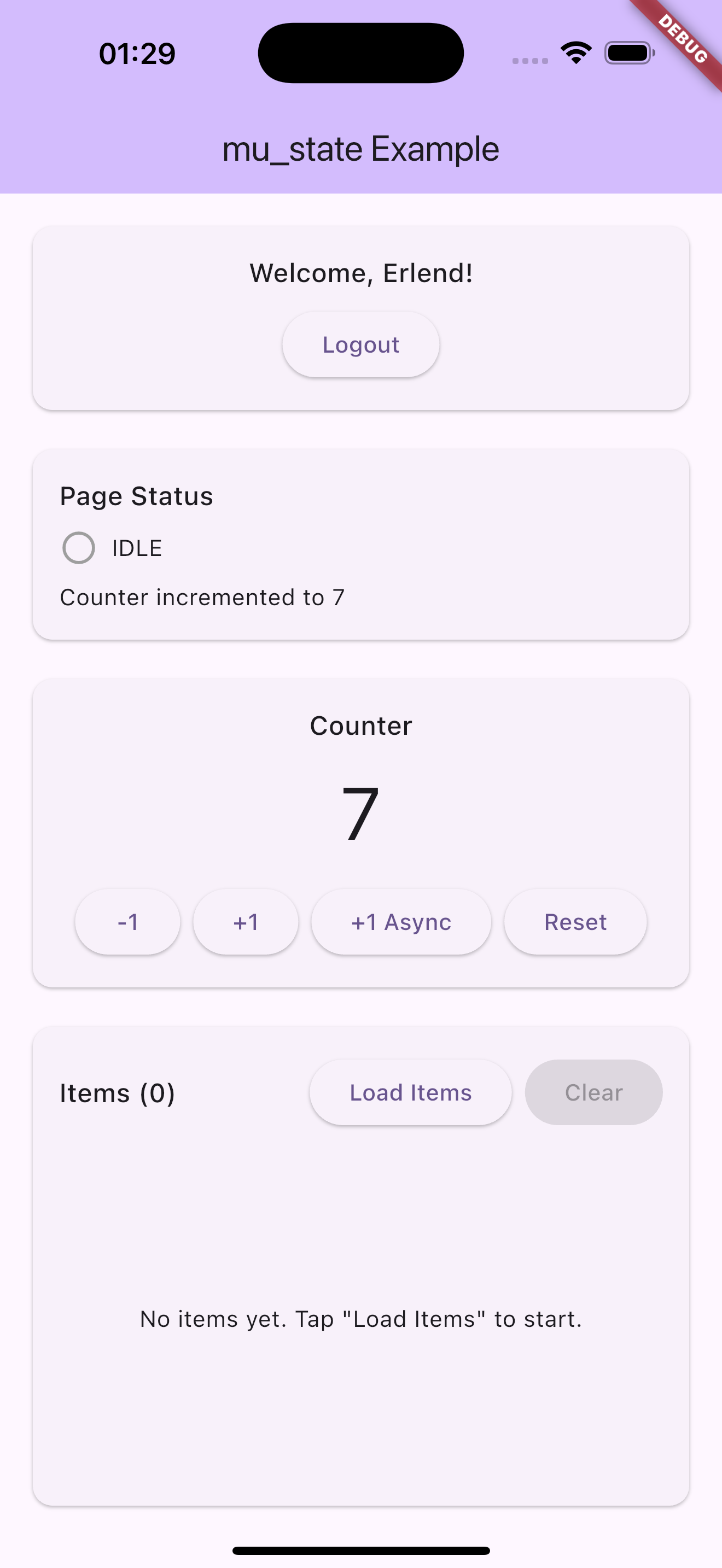
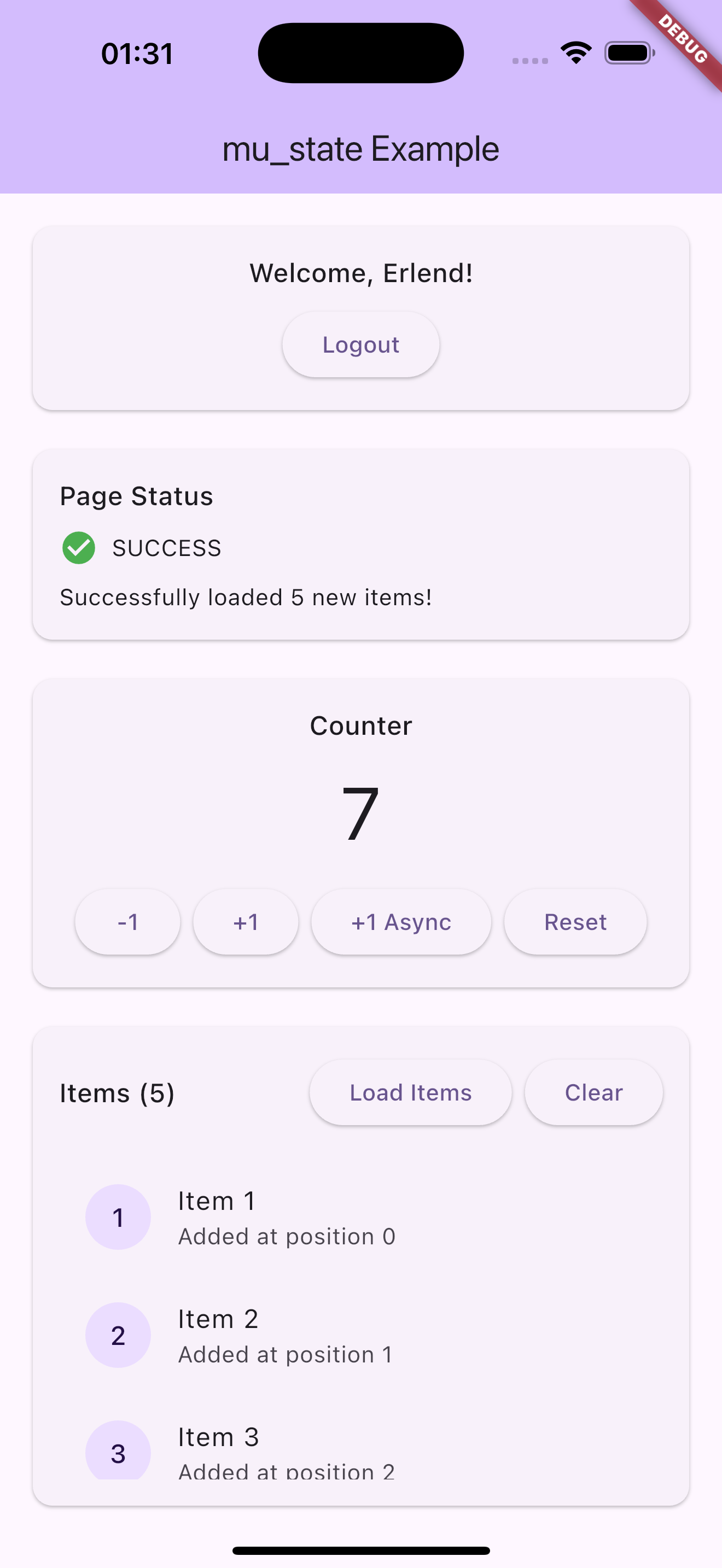
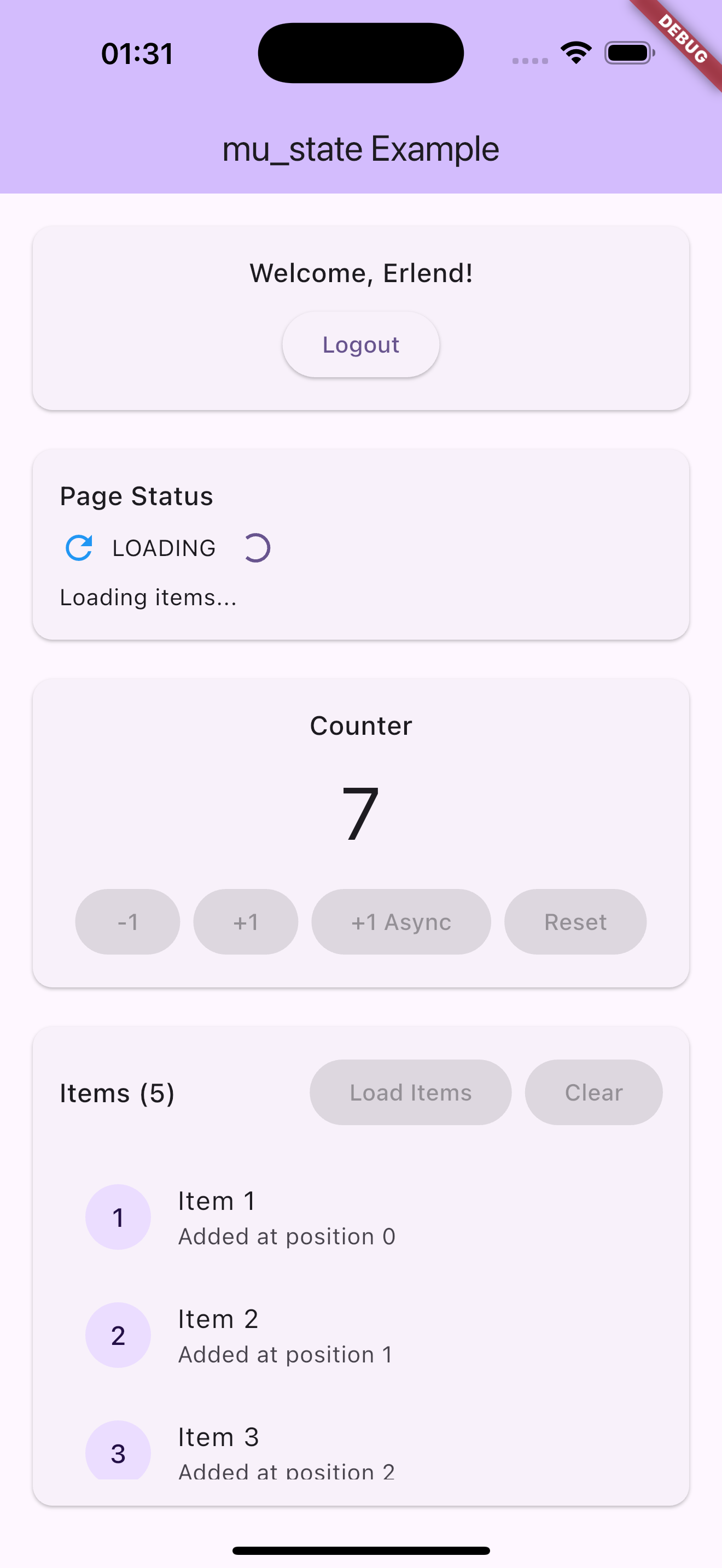
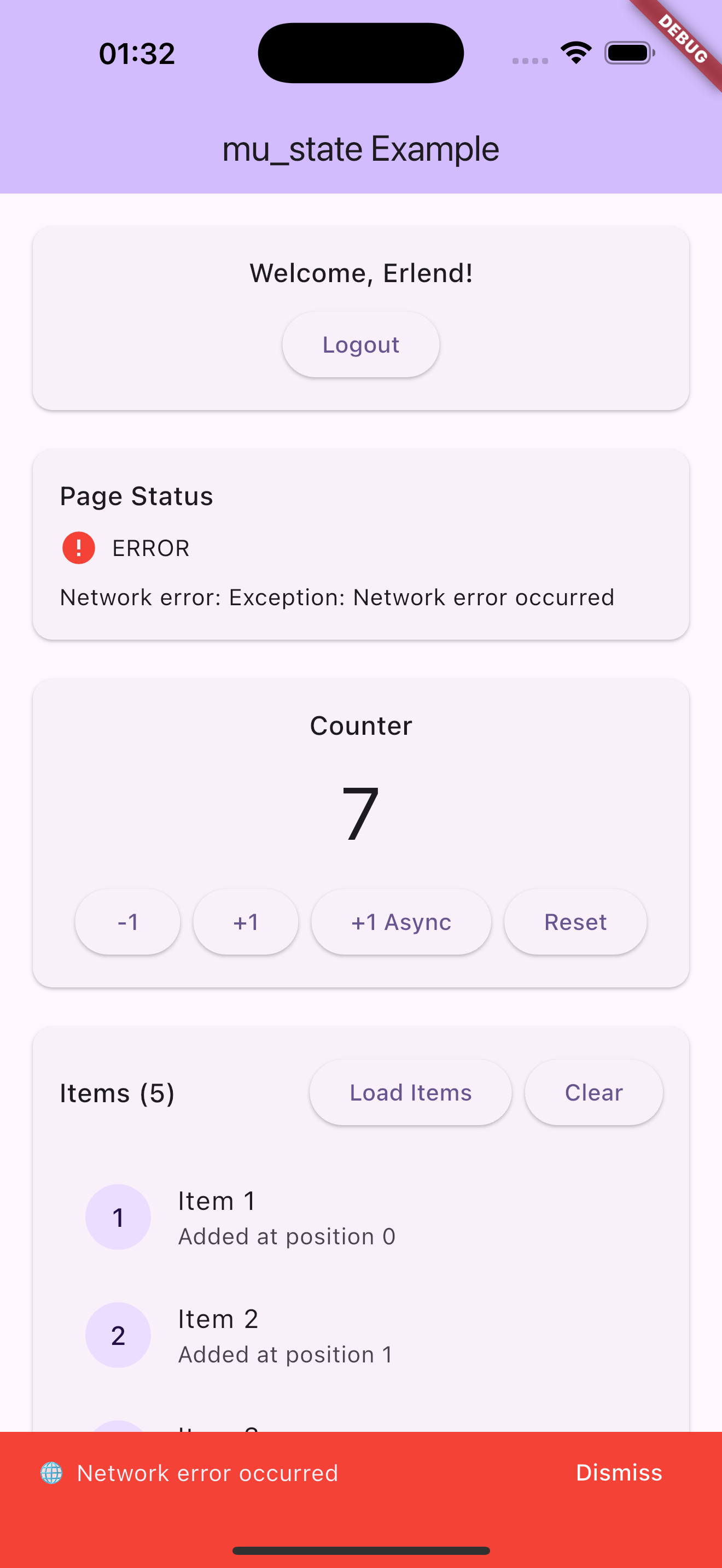
Screenshots
Usage
Let's create a simple counter to see how mu_state works:
At this point we have successfully separated our presentational layer from our business logic layer. Notice that CounterPage knows nothing about what happens when a user taps the buttons. The widget simply notifies the CounterLogic that the user has pressed increment.
Alternative: You could also use MuConsumer to combine the listener and builder functionality in a single widget. See the MuConsumer section below for details.
Components
MuLogic
MuLogic<S> is a typedef for ValueNotifier<S> that serves as the foundation for your business logic. It manages state and notifies listeners when the state changes. MuLogic is essentially an alias that makes the code more semantic for state management purposes.
Since MuLogic extends ValueNotifier, you get all the familiar methods like addListener, removeListener, and the value property for getting and setting state.
MuBuilder
MuBuilder<S> is a typedef for ValueListenableBuilder<S> that rebuilds the widget when the state changes. It's essentially an alias that makes the code more semantic for state management, but underneath it's just Flutter's built-in ValueListenableBuilder.
See MuListener if you want to "do" anything in response to state changes such as navigation, showing a dialog, etc...
MuComparable is a mixin that provides equality comparison for state classes. It's a lightweight alternative to packages like Equatable and helps MuBuilder and other listeners determine when to rebuild.
The props list should include all properties that determine equality. When state changes, widgets will only rebuild if the new state is different from the previous state based on these properties.
Updating collections
Equality is shallow: entries in props are compared with Dart's default ==. For List, Map, and Set that means reference equality, not content equality. Always create a new collection when updating state — never mutate in place:
// ✅ Correct — new list reference, listeners fire.emit(state.copyWith(items: [...state.items, newItem]));
// ❌ Wrong — same reference, listeners do NOT fire.
state.items.add(newItem);
emit(state.copyWith(items: state.items));
If you'd rather have deep collection equality out of the box, equatable is a drop-in alternative with the same props API.
MuListener
MuListener performs side effects in response to state changes - navigation, showing dialogs, etc. The listener is called once per state change and by default NOT on initial state (lazy: true). Set lazy: false to call the listener immediately with the current state.
MuProvider is a Flutter widget which provides any value to its children via dependency injection. While originally designed for MuLogic instances, it's now fully generic and can provide any type - making it perfect for injecting repositories, services, or other dependencies throughout your widget tree.
You provide the instance to MuProvider via the value parameter. MuProvider will automatically handle disposing the value when the provider is disposed (if it implements ChangeNotifier, which MuLogic does).
// For MuLogic instancesfinal logic = context.logic<CounterLogic>();
// For any typefinal repo = context.read<AuthRepository>();
MuMultiProvider
MuMultiProvider is a Flutter widget that merges multiple MuProvider widgets into one. MuMultiProvider improves the readability and eliminates the need to nest multiple MuProviders. By using MuMultiProvider we can go from:
MuMultiBuilder is a Flutter widget which listens to multiple MuLogic instances and rebuilds when any of them change. This is useful when you need to build UI that depends on multiple state sources.
MuMultiListener is a Flutter widget that merges multiple MuListener widgets into one. MuMultiListener improves the readability and eliminates the need to nest multiple MuListeners. By using MuMultiListener we can go from:
MuListener<StateA>(
  logic: logicA,
  listener: (context, state) {
    // handle state A changes
  },
  child: MuListener<StateB>(
    logic: logicB,
    listener: (context, state) {
      // handle state B changes
    },
    child: ChildWidget(),
  ),
)
An optional listenWhen and buildWhen can be implemented for more granular control over when listener and builder are called. The listenWhen and buildWhen functions take the previous state and the current state and return a bool which determines whether or not the listener or builder function will be invoked.
MuConsumer<CounterState>(
logic: logic,
listenWhen: (previous, current) {
// return true/false to determine whether or not// to invoke listener with statereturn previous.error != current.error;
},
listener: (context, state) {
// do stuff here based on state
},
buildWhen: (previous, current) {
// return true/false to determine whether or not// to rebuild the widget with statereturn previous.counter != current.counter;
},
builder: (context, state, child) {
// return widget here based on statereturnText('Counter: ${state.counter}');
}
)
See the example project for a complete implementation with more features.