सार्वजनिक जानकारी से बना चयन मार्गदर्शन। केवल संदर्भ हेतु।
एक फ्लटर पैकेज जो एंड्रॉइड और आईओएस ऐप्स के लिए सीधे फेसबुक लॉगिन एन्टीग्रेशन की अनुमति देता है। यह उपयोगकर्ताओं को उनके फेसबुक खातों के साथ साइन इन करने की अनुमति देकर प्रमाणीकरण प्रक्रिया को सरल बनाता है, और स्वचालित रूप से उपयोगकर्ता के प्रोफ़ाइल जानकारी जैसे नाम, ईमेल और प्रोफ़ाइल छवि प्राप्त करता है। इस पैकेज को विकासकर्ताओं के लिए डिज़ाइन किया गया है जो विस्तृत सेटअप के बिना सोशल लॉगिन कार्यक्षमता जोड़ने के लिए एक सीधा तरीका चाहते हैं। यह फेसबुक के SDKs का उपयोग नीचे के तरीके से करता है, जिससे वर्तमान प्लेटफॉर्म की आवश्यकताओं के साथ सुगमता सुनिश्चित होती है।
उपयोग
सोशल लॉगिन कार्यान्वयन
फेसबुक के माध्यम से उपयोगकर्ता प्रमाणीकरण
प्रोफ़ाइल डेटा प्राप्त करना
मोबाइल ऐप ऑनबोर्डिंग
सुरक्षित पहचान सत्यापन
क्रॉस-प्लेटफॉर्म लॉगिन समर्थन
मुख्य विशेषताएँ
Flutter के साथ आसान एकीकरण
स्वचालित उपयोगकर्ता प्रोफ़ाइल लेना
Android और iOS के लिए समर्थन
न्यूनतम बॉयलरप्लेट कोड
सुरक्षित OAuth प्रवाह
एम्बेडेड त्रुटि संभाल
इनके लिए उपयुक्त
सोशल लॉगिन की आवश्यकता वाले ऐप्स
त्वरित एमवीपी निर्माण कर रहे स्टार्टअप
मुख्य प्रमाणीकरण के रूप में फेसबुक का उपयोग करने वाले विकासकर्मी
उपयोगकर्ता प्रोफ़ाइल डेटा की आवश्यकता वाले प्रोजेक्ट
क्रॉस-प्लेटफॉर्म मोबाइल एप्लिकेशन्स
विचार योग्य बातें
फेसबुक ऐप आईडी कॉन्फ़िगरेशन की आवश्यकता है
सही अनुमति सेटअप की आवश्यकता है
फेसबुक SDK के निर्भर है
अतिरिक्त गोपनीयता नीति उद्घाटन की आवश्यकता हो सकती है
केवल फेसबुक प्रमाणीकरण तक सीमित
प्लेटफॉर्म-विशिष्ट कॉन्फ़िगरेशन की आवश्यकता होती है
मूल README
संबंधित सोर्स रिपॉज़िटरी के मूल README का स्नैपशॉट। नवीनतम सामग्री के लिए रिपॉज़िटरी देखें।
flutter_login_facebook
Flutter Plugin to login via Facebook.
Easily add Facebook login feature in your application. User profile information included.
Add values to /android/app/src/main/res/values/strings.xml (create file if it doesn't exist).
You don't need to add fb_login_protocol_scheme, only facebook_app_id and facebook_client_token:
Generate Development and Release keys as described in the documentation. Note: if your application uses Google Play App Signing then you should get certificate SHA-1 fingerprint from Google Play Console and convert it to base64
echo"{sha1key}" | xxd -r -p | openssl base64
Add generated keys in Key Hashes.
Click "Save".
⚠️ Important! You should add key hashes for every build variants. E.g. if you have CI/CD which build APK for testing
with it's own certificate (it may be auto generated debug certificate or some another) than you should add it's key too.
Add your Bundle Identifier - set Bundle ID (you can find it in Xcode: Runner - Target Runner - General, section Identity, field Bundle Identifier) and click "Save".
Enable Single Sign-On for Your App if you need it and click "Save".
In Xcode right-click on Info.plist, and choose Open As Source Code.
Copy and paste the following XML snippet into the body of your file (<dict>...</dict>),
replacing [APP_ID] with Facebook application id,
[CLIENT_TOKEN] value found under Settings > Advanced > Client Token in your App Dashboard
and [APP_NAME] with Facebook application name
(you can copy prepared values from Step 4 in Facebook Quickstart).
⚠️ NOTE. Check if you already have CFBundleURLTypes or LSApplicationQueriesSchemes keys in your Info.plist. If you have, you should merge their values, instead of adding a duplicate key.
Skip Step 5 (Connect Your App Delegate) and all the rest.
And that's it for iOS.
Additional information
Privacy Manifest for App Store Review requirements
Additional guidance for developers from Facebook documentation:
Our Privacy Manifest only provides information collected by default and the SDKs that depend on the Core SDK for functionality may restate the data usage details of the Core SDK. Some app developers may choose to send us more or less information in code, or via the Events Manager or through Advanced matching functionality. These developers will need to provide details around additional data usage details in their Privacy Manifest or App Store Privacy Labels in accordance with their own practices. Refer to the following article for more information on additional data that may be sent by developers through Meta’s SDKs.
Note that we do not attempt to associate all collected data with Meta users.
We have pre-populated the tracking domain field for the FB SDK in the Privacy Manifest to help ensure that our services continue to function properly. We do not advise manually adding domains. Listing “www.facebook.com” or subdomains of “facebook.com” in the tracking domain field of a Privacy Manifest may break functionality.
Note: Developers can find additional details around the tracking domain field in the Privacy Manifests for Meta SDKs. What is pre-populated in the tracking domain field is intended to receive traffic when a user has provided AppTrackingTransparency (ATT) permission to the app. If our check determines that a request or event from an iOS14.5+ device lacks ATT permission, then usage of such data will be restricted and we will use privacy preserving methods (like those available in Aggregated Event Measurement) to remove or combine information before delivering or measuring ads.
Additional Facebook app setup
Go to My App on Facebook and select your application.
Icon
You should add the App Icon (in Settings -> Basic) to let users see
your application icon instead of the default icon when they attempt to log in.
Add store IDs
In Setting -> Basic -> iOS fill up field "iPhone Store ID" ("iPad Store ID").
Permissions and features
To use the profile data, you must raise the access level for the "public_profile" and "email" functions to "Advanced Access" in App Review -> Permissions and features (Administrator rights required).
Optional settings
You may want to change some other settings.
For example Display Name, Contact Email, Category, etc.
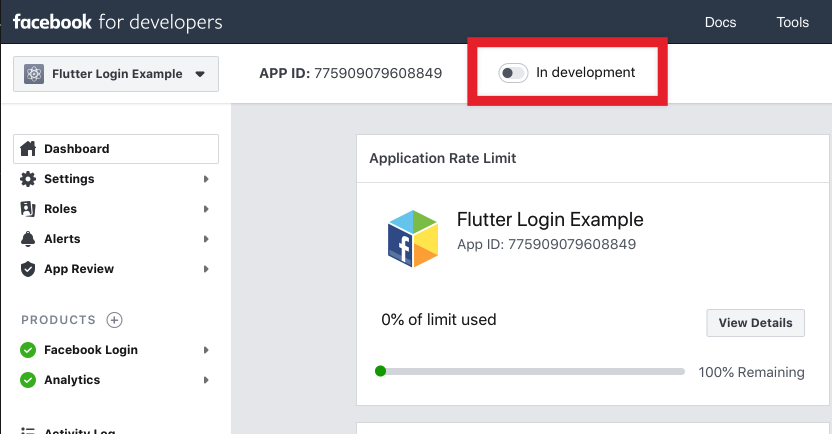
Enable application
By default, your application has the status "In development".
You should enable application before log in feature goes public.
Facebook will show a warning if your application is not fully set up.
For example, you may need to provide a Privacy Policy. You can use your
Privacy Policy from Google Play/App Store.
Usage in application
You can:
log in via Facebook;
get access token;
get user profile;
get user profile image url;
get user email (if has permissions);
check if logged in;
log out.
Sample code:
import'package:flutter_login_facebook/flutter_login_facebook.dart';
// Create an instance of FacebookLoginfinal fb = FacebookLogin();
// Log infinal res = await fb.logIn(permissions: [
FacebookPermission.publicProfile,
FacebookPermission.email,
]);
// Check result statusswitch (res.status) {
caseFacebookLoginStatus.success:
// Logged in// Send access token to server for validation and authfinalFacebookAccessToken accessToken = res.accessToken;
print('Access token: ${accessToken.token}');
// Get profile datafinal profile = await fb.getUserProfile();
print('Hello, ${profile.name}! You ID: ${profile.userId}');
// Get user profile image urlfinal imageUrl = await fb.getProfileImageUrl(width: 100);
print('Your profile image: $imageUrl');
// Get email (since we request email permission)final email = await fb.getUserEmail();
// But user can decline permissionif (email != null)
print('And your email is $email');
break;
caseFacebookLoginStatus.cancel:
// User cancel log inbreak;
caseFacebookLoginStatus.error:
// Log in failedprint('Error while log in: ${res.error}');
break;
}
⚠️ WARNING! Important Changes in SDK v17.0 for iOS (plugin version 2.0.0)
With the release of SDK v17.0 for iOS, there are significant changes to the login behavior and token validation process:
Limited Login Mode: If the user has not granted the AdvertiserTracking permission
(Apple documentation, Facebook documentation),
the login process will now enter a Limited Login mode. This mode is indicated by the isLimitedLogin field in the AccessToken object.
Access Token in Limited Login Mode: In Limited Login mode, the access token is not valid and will fail server-side verification.
Additionally, it will not permit Graph API requests. For Limited Login you need to validate OIDC token.
OIDC Token Validation: the OIDC Token will be available in the new authenticationToken field in the AccessToken.
In Limited Login mode you should validate this token for the server-side verification.
Learn more about token validation in the documentation.
Profile Image URL: In Limited Login mode, the getProfileImageUrl() method will ignore size parameters.
This limitation arises because we can't execute API calls, thus only a 100x100 image from the JWT authentication token can be used.
For detailed insights into these changes, please refer to the blog post and the documentation on Limited Login.
[Android] Express login
Express Login helps users log in with their Facebook account across devices and platforms. If a person has logged into your app before on any platform, you can use Express Login to log them in with their Facebook account on Android, instead of asking for them to select a login method, which sometimes resulted in creating duplicate accounts or even failing to log in at all.