सार्वजनिक जानकारी से बना चयन मार्गदर्शन। केवल संदर्भ हेतु।
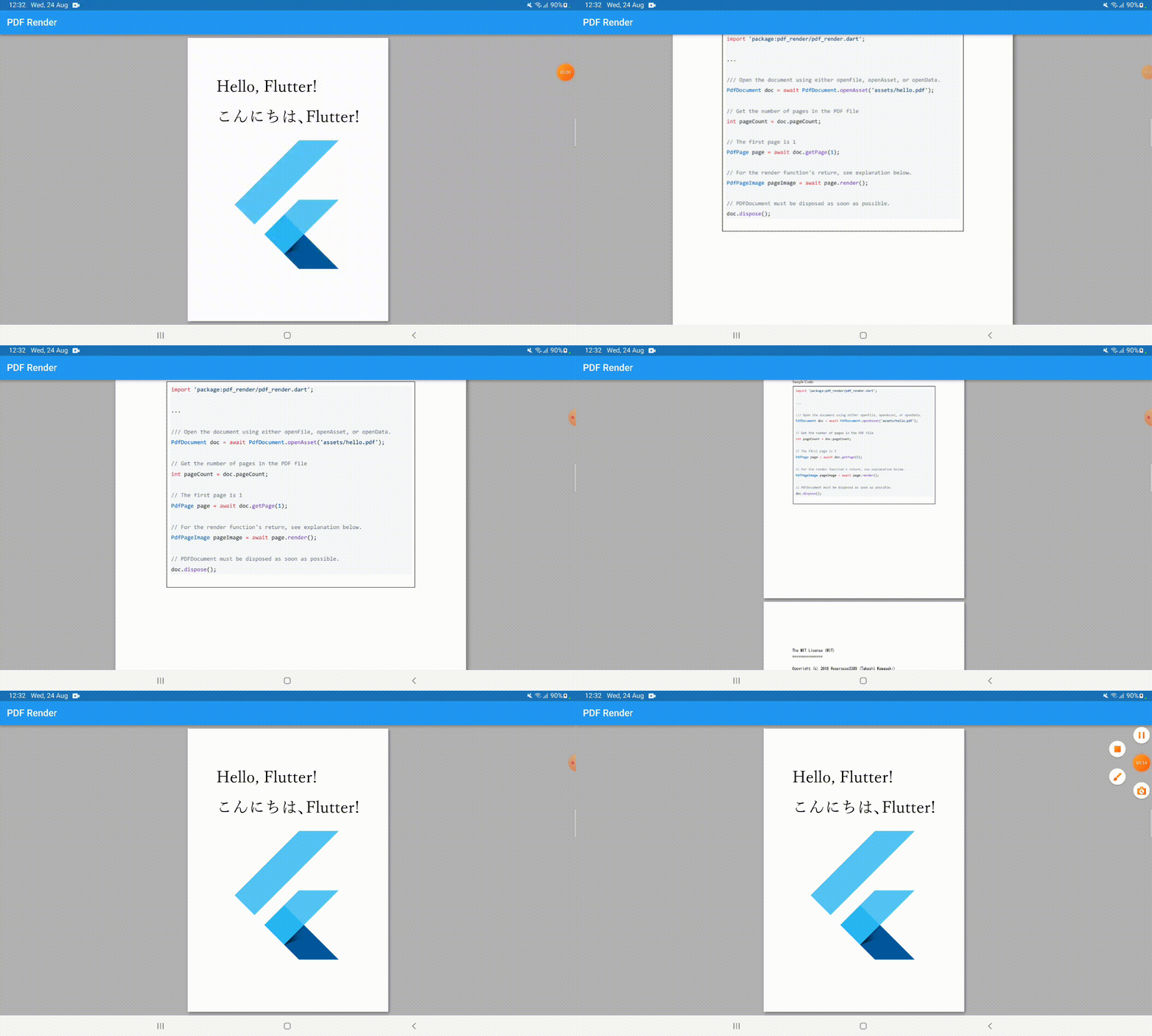
pdf_render एक Flutter प्लगइन है जो मध्यवर्ती PDF रेंडरिंग क्षमता प्रदान करता है और ऐप्स में PDF को दिखाने के लिए सुगम Flutter विजेट्स प्रदान करता है। यह विकासकर्मियों को PDF पेज को कुशलता से रेंडर करने की अनुमति देता है, जिसमें रस्टराइज्ड और वेक्टर-आधारित रेंडरिंग दोनों समर्थित हैं और कस्टमाइज़ेबल विकल्प भी हैं। पैकेज तैयार-उपयोग विजेट्स प्रदान करके एकीकरण को सरल बनाता है जो लेआउट, स्केलिंग और पेज नेविगेशन का ध्यान रखते हैं। प्रदर्शन और उपयोग में आसानी के लिए डिज़ाइन किया गया, यह ई-बुक्स, फॉर्म्स या रिपोर्ट्स जैसे दस्तावेज़ देखने की आवश्यकता वाले एप्लिकेशन के लिए आदर्श है।
उपयोग
एप्लिकेशन में PDF दस्तावेज़ प्रदर्शित करना
कस्टम स्टाइलिंग के साथ PDF रेंडर करना
दस्तावेज़ दर्शक इंटरफ़ेस बनाना
मोबाइल कार्य प्रवाह में PDF को एकीकृत करना
ऑफलाइन दस्तावेज़ पहुंच का समर्थन करना
मुख्य विशेषताएँ
मध्यवर्ती रेंडरिंग API
उपयोग में आसान फ्लटर विजेट्स
कस्टमाइज़ेबल पेज रेंडरिंग
कुशल मेमोरी उपयोग
कई PDF प्रारूपों का समर्थन
इनके लिए उपयुक्त
दस्तावेज़-भारी एप्लिकेशन
ई-बुक रीडर्स
फॉर्म और रिपोर्ट व्यूअर
PDF प्रदर्शन की आवश्यकता वाले मोबाइल एप्लिकेशन
हल्के PDF समाधान खोज रहे विकासकर्ता
विचार योग्य बातें
रेंडरिंग तक सीमित; संपादन समर्थन नहीं
बड़े PDFs का सावधानीपूर्वक निपटारा करने की आवश्यकता होती है
कोई बिल्ट-इन सर्च कार्यक्षमता नहीं है
प्लेटफॉर्म-विशिष्ट रेंडरिंग व्यवहार
जटिल लेआउट के लिए अतिरिक्त अनुकूलन की आवश्यकता हो सकती है
मूल README
संबंधित सोर्स रिपॉज़िटरी के मूल README का स्नैपशॉट। नवीनतम सामग्री के लिए रिपॉज़िटरी देखें।
Notice (2024-01-22)
If you want to move to pdfrx but you have some compatibility issues or any other problems or questions, please feel free to open new discussions on Discussions on pdfrx.
Notice (2023-12-05)
New plugin, named pdfrx, is a better replacement for pdf_render. And pdf_render is now in maintenance mode. No new features are added to pdf_render.
Add this to your package's pubspec.yaml file and execute flutter pub get:
dependencies:pdf_render:^1.4.12
Web
For Web, you should add <script> tags on your index.html:
The plugin utilizes PDF.js to support Flutter Web.
To use the Flutter Web support, you should add the following code just before <script src="main.dart.js" type="application/javascript"></script> inside index.html:
<!-- IMPORTANT: load pdfjs files --><scriptsrc="https://cdn.jsdelivr.net/npm/pdfjs-dist@3.4.120/build/pdf.min.js"type="text/javascript"
></script><scripttype="text/javascript">
pdfjsLib.GlobalWorkerOptions.workerSrc =
"https://cdn.jsdelivr.net/npm/pdfjs-dist@3.4.120/build/pdf.worker.min.js";
pdfRenderOptions = {
// where cmaps are downloaded fromcMapUrl: "https://cdn.jsdelivr.net/npm/pdfjs-dist@3.4.120/cmaps/",
// The cmaps are compressed in the casecMapPacked: true,
// any other options for pdfjsLib.getDocument.// params: {}
};
</script>
You can use any URL that specify PDF.js distribution URL.
cMapUrl indicates cmap files base URL and cMapPacked determines whether the cmap files are compressed or not.
Flutter app restrict its capability by enabling App Sandbox by default. You can change the behavior by editing your app's entitlements files depending on your configuration. See the discussion below.
The easiest option to access files on your disk, set com.apple.security.app-sandbox to false on your entitlements file though it is not recommended for releasing apps because it completely disables App Sandbox.
PdfViewer is an extensible PDF document viewer widget which supports pinch-zoom.
The following fragment is a simplest use of the widget:
@overrideWidgetbuild(BuildContext context) {
returnnewMaterialApp(
home: newScaffold(
appBar: newAppBar(
title: constText('Pdf_render example app'),
),
backgroundColor: Colors.grey,
// You can use either PdfViewer.openFile, PdfViewer.openAsset, or PdfViewer.openData
body: PdfViewer.openAsset(
'assets/hello.pdf',
params: PdfViewerParams(pageNumber: 2), // show the page-2
)
)
);
}
PdfViewer does not support any gestures except panning and pinch-zooming. To support other gestures, you can wrap the widget with GestureDetector as explained above.
typedefBuildPageContentFunc = WidgetFunction(
BuildContext context,
int pageNumber,
Rect pageRect);
The third parameter, pageRect is location of page in viewer's world coordinates.
Single page view
The following fragment illustrates the easiest way to render only one page of a PDF document using PdfDocumentLoader widget. It is suitable for showing PDF thumbnail.
Using PdfDocumentLoader in combination with PdfPageView, you can show multiple pages of a PDF document. In the following fragment, ListView.builder is utilized to realize scrollable PDF document viewer.
The most important role of PdfDocumentLoader is to manage life time of PdfDocument and it disposes the document when the widget tree is going to be disposed.
Both PdfDocumentLoader and PdfPageView accepts pageBuilder parameter if you want to customize the visual of each page.
The following fragment illustrates that:
PdfPageView(
pageNumber: index + 1,
// pageSize is the PDF page size in pt.
pageBuilder: (context, textureBuilder, pageSize) {
//// This illustrates how to decorate the page image with other widgets//returnStack(
alignment: Alignment.bottomCenter,
children: <Widget>[
// the container adds shadow on each pageContainer(
margin: EdgeInsets.all(margin),
padding: EdgeInsets.all(padding),
decoration: BoxDecoration(boxShadow: [
BoxShadow(
color: Colors.black45,
blurRadius: 4,
offset: Offset(2, 2))
]),
// textureBuilder builds the actual page image
child: textureBuilder()),
// adding page number on the bottom of rendered pageText('${index + 1}', style: TextStyle(fontSize: 50))
],
);
},
)
textureBuilder
textureBuilder (PdfPageTextureBuilder) generates the actual widget that directly corresponding to the page image. The actual widget generated may vary upon the situation. But you can of course customize the behavior of the function with its parameter.
So if you want to generate widget of an exact size, you can specify size explicitly.
Please note that the size is in density-independent pixels. The function is responsible for determining the actual pixel size based on device's pixel density.
placeholderBuilder is the final resort that controls the "placeholder" for loading or failure cases.
/// Creates page placeholder that is shown on page loading or even page load failure.typedefPdfPagePlaceholderBuilder = WidgetFunction(Size size, PdfPageStatus status);
/// Page loading status.enumPdfPageStatus {
/// The page is currently being loaded.
loading,
/// The page load failed.
loadFailed,
}
PDF rendering APIs
The following fragment illustrates overall usage of PdfDocument:
import'package:pdf_render/pdf_render.dart';
...
// Open the document using either openFile, openAsset, or openData.// For Web, file name can be relative path from index.html or any arbitrary URL// but affected by CORS.PdfDocument doc = awaitPdfDocument.openAsset('assets/hello.pdf');
// Get the number of pages in the PDF fileint pageCount = doc!.pageCount;
// The first page is 1PdfPage page = await doc!.getPage(1);
// For the render function's return, see explanation belowPdfPageImage pageImage = await page.render();
// Now, you can access pageImage!.pixels for raw RGBA data// ...// Generating dart:ui.Image cache for later use by imageIfAvailableawait pageImage.createImageIfNotAvailable();
// PDFDocument must be disposed as soon as possible.
doc!.dispose();
To embed the image in the widget tree, you can use RawImage:
@overrideWidgetbuild(BuildContext context) {
returnCenter(
child: Container(
padding: EdgeInsets.all(10.0),
color: Colors.grey,
child: Center(
// before using imageIfAvailable, you should call createImageIfNotAvailable
child: RawImage(image: pageImage.imageIfAvailable, fit: BoxFit.contain))
)
);
}
If you just building widget tree, you had better use faster and efficient PdfPageImageTexture.
PdfDocument.openXXX
On PdfDocument class, there are three functions to open PDF from a real file, an asset file, or a memory data.
// from an asset filePdfDocument docFromAsset = awaitPdfDocument.openAsset('assets/hello.pdf');
// from a file// For Web, file name can be relative path from index.html or any arbitrary URL// but affected by CORS.PdfDocument docFromFile = awaitPdfDocument.openFile('/somewhere/in/real/file/system/file.pdf');
// from PDF memory image on Uint8ListPdfDocument docFromData = awaitPdfDocument.openData(data);
classPdfDocument{
/// File path, `asset:[ASSET_PATH]` or `memory:` depending on the content opened.finalString sourceName;
/// Number of pages in the PDF document.finalint pageCount;
/// PDF major version.finalint verMajor;
/// PDF minor version.finalint verMinor;
/// Determine whether the PDF file is encrypted or not.finalbool isEncrypted;
/// Determine whether the PDF file allows copying of the contents.finalbool allowsCopying;
/// Determine whether the PDF file allows printing of the pages.finalbool allowsPrinting;
// Get a page by page number (page number starts at 1)Future<PdfPage> getPage(int pageNumber);
// Dispose the instance.Future<void> dispose();
}
classPdfPage{
finalPdfDocumentdocument; // For internal purposefinalint pageNumber; // Page number (page number starts at 1)finaldouble width; // Page width in points; pixel size on 72-dpifinaldouble height; // Page height in points; pixel size on 72-dpi// render sub-region of the PDF page.Future<PdfPageImage> render({
int x = 0,
int y = 0,
int? width,
int? height,
double? fullWidth,
double? fullHeight,
bool backgroundFill = true,
bool allowAntialiasingIOS = false
});
}
render function extracts a sub-region (x,y) - (x + width, y + height) from scaled fullWidth x fullHeight PDF page image. All the coordinates are in pixels.
The following fragment renders the page at 300 dpi:
classPdfPageImage{
/// Page number. The first page is 1.finalint pageNumber;
/// Left X coordinate of the rendered area in pixels.finalint x;
/// Top Y coordinate of the rendered area in pixels.finalint y;
/// Width of the rendered area in pixels.finalint width;
/// Height of the rendered area in pixels.finalint height;
/// Full width of the rendered page image in pixels.finalint fullWidth;
/// Full height of the rendered page image in pixels.finalint fullHeight;
/// PDF page width in points (width in pixels at 72 dpi).finaldouble pageWidth;
/// PDF page height in points (height in pixels at 72 dpi).finaldouble pageHeight;
/// RGBA pixels in byte array.finalUint8List pixels;
/// Get [dart:ui.Image] for the object.Future<Image> createImageIfNotAvailable() async;
/// Get [Image] for the object if available; otherwise null./// If you want to ensure that the [Image] is available,/// call [createImageIfNotAvailable].Image? get imageIfAvailable;
}
If you just need RGBA byte array, you can use pixels for that purpose. The pixel at (x,y) is on pixels[(x+y*width)*4]. Anyway, it's highly discouraged to modify the contents directly though it would work correctly.
classPdfPageImageTexture{
finalPdfDocument pdfDocument;
finalint pageNumber;
finalint texId;
boolget hasUpdatedTexture;
PdfPageImageTexture({requiredthis.pdfDocument, requiredthis.pageNumber, requiredthis.texId});
/// Create a new Flutter [Texture]. The object should be released by calling [dispose] method after use it.staticFuture<PdfPageImageTexture> create({requiredPdfDocument pdfDocument, requiredint pageNumber});
/// Release the object.Future<void> dispose();
/// Extract sub-rectangle ([x],[y],[width],[height]) of the PDF page scaled to [fullWidth] x [fullHeight] size./// If [backgroundFill] is true, the sub-rectangle is filled with white before rendering the page content.Future<bool> extractSubrect({
int x = 0,
int y = 0,
requiredint width,
requiredint height,
double? fullWidth,
double? fullHeight,
bool backgroundFill = true,
});
}
Sometimes, when you're using Landscape mode on your Phone or Tablet and you need to show pdf fit to the center of the screen then you can use this code to customize the pdf layout.
@overrideWidgetbuild(BuildContext context) {
returnScaffold(
appBar: AppBar(
title: Text(widget.title),
),
backgroundColor: Colors.white70,
body: PdfViewer.openAsset(
'assets/hello.pdf',
params: PdfViewerParams(
layoutPages: (viewSize, pages) {
List<Rect> rect = [];
final viewWidth = viewSize.width;
final viewHeight = viewSize.height;
final maxHeight = pages.fold<double>(0.0, (maxHeight, page) => max(maxHeight, page.height));
final ratio = viewHeight / maxHeight;
var top = 0.0;
for (var page in pages) {
final width = page.width * ratio;
final height = page.height * ratio;
final left = viewWidth > viewHeight ? (viewWidth / 2) - (width / 2) : 0.0;
rect.add(Rect.fromLTWH(left, top, width, height));
top += height + 8/* padding */;
}
return rect;
},
),
),
);
}