패키지, 저장소 및 앱 카테고리 검색

패키지 상세v2.8.0

mobx_codegen

MobX용 코드 생성기로 @observable, @computed, @action를 사용하여 코드에 주석을 달고 Store 클래스를 생성하는 기능을 추가합니다.

AndroidiOSmacOSWindowsLinux
30일 다운로드
9.2만
좋아요
301
Pub 점수
150

패키지 설치

flutter pub add mobx_codegen

패키지 개요

공개 정보를 바탕으로 생성한 선택 가이드입니다.

MobX CodeGen은 Flutter 및 Dart의 MobX 상태 관리 라이브러리를 위한 코드 생성 도구입니다. 개발자가 클래스와 필드에 @observable, @computed, @action를 주석으로 추가함으로써 반응형 상태 관리를 위한 빌더플레이트 코드를 자동으로 생성할 수 있습니다. 이는 수동 작업을 줄이고 반복적인 패턴을 제거하여 코드 가독성을 향상시킵니다. 이 패키지는 최소한의 설정으로 Store 클래스를 만들 수 있도록 지원하며, 플랫폼 간 상태 처리를 단순화합니다.

사용 사례

  • 자동 상태 업데이트를 사용한 반응형 UI 개발
  • 대규모 앱에서 복잡한 상태 로직 간소화
  • 상태 관리에서 반복 코드 줄이기
  • 효율적인 관찰 가능한 저장소 생성
  • 형 안전한 계산된 값 활성화
  • MobX를 활용한 종속성 주입 간소화

주요 기능

  • @observable, @computed, @action에 대한 자동 코드 생성
  • Store 클래스 생성 지원
  • 상태 관리에서 수동적인 봐일러플레이트를 줄입니다
  • MobX와 원활하게 통합됩니다
  • 효율적이고 타입 안전한 코드를 생성합니다
  • 다중 플랫폼에서 작동합니다

적합한 대상

  • 상태 관리에 MobX를 사용하는 개발자
  • Flutter 앱에서 반복 코드를 줄이려는 팀
  • 반응성과 성능이 뛰어난 상태 처리가 필요한 프로젝트
  • 명확한 분리가 필요한 복잡한 상태 로직을 가진 앱
  • 주석 기반 상태 관리를 선호하는 개발자
  • 크로스 플랫폼 애플리케이션을 구축하는 사람들

고려 사항

  • 코드 생성을 위해 build_runner가 필요합니다
  • build.yaml의 올바른 설정이 필요합니다
  • 빌드 시간을 약간 증가시킬 수 있습니다
  • MobX 핵심 패키지에 의존
  • 런타임 전용 상태 변경에 적합하지 않습니다
  • MobX 개념을 이해하고 있어야 합니다

원본 README

연결된 소스 저장소의 README 원문 스냅샷입니다. 최신 내용은 저장소에서 확인하세요.

Language: English | Português | Chinese | Japanese | 한국어

mobx.dart


pub package pub package pub package

Build Status Publish Coverage Status Netlify Status Mutable.ai Auto Wiki

Join the chat at https://discord.gg/dNHY52k

MobX for the Dart language.

Supercharge the state-management in your Dart apps with Transparent Functional Reactive Programming (TFRP)

We are looking for maintainers. Reach out on Discord or GitHub Issues!

Introduction

MobX is a state-management library that makes it simple to connect the reactive data of your application with the UI. This wiring is completely automatic and feels very natural. As the application-developer, you focus purely on what reactive-data needs to be consumed in the UI (and elsewhere) without worrying about keeping the two in sync.

It's not really magic but it does have some smarts around what is being consumed (observables) and where (reactions), and automatically tracks it for you. When the observables change, all reactions are re-run. What's interesting is that these reactions can be anything from a simple console log, a network call to re-rendering the UI.

MobX has been a very effective library for the JavaScript apps and this port to the Dart language aims to bring the same levels of productivity.

Sponsors

We are very thankful to our sponsors to make us part of their Open Source Software (OSS) program. [Become a sponsor]

Past Sponsors
Get Started

Follow along with the Getting Started guide on the MobX.dart Website.

Go deep

For a deeper coverage of MobX, do check out MobX Quick Start Guide. Although the book uses the JavaScript version of MobX, the concepts are 100% applicable to Dart and Flutter.

Core Concepts

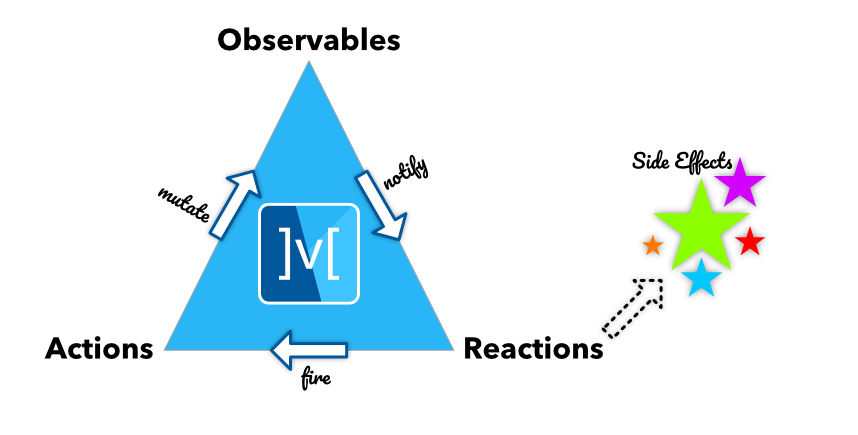
MobX Triad

At the heart of MobX are three important concepts: Observables, Actions and Reactions.

Observables

Observables represent the reactive-state of your application. They can be simple scalars to complex object trees. By defining the state of the application as a tree of observables, you can expose a reactive-state-tree that the UI (or other observers in the app) consume.

A simple reactive-counter is represented by the following observable:

import 'package:mobx/mobx.dart';

final counter = Observable(0);

More complex observables, such as classes, can be created as well.

class Counter {
  Counter() {
    increment = Action(_increment);
  }

  final _value = Observable(0);
  int get value => _value.value;

  set value(int newValue) => _value.value = newValue;
  Action increment;

  void _increment() {
    _value.value++;
  }
}

On first sight, this does look like some boilerplate code which can quickly go out of hand! This is why we added mobx_codegen to the mix that allows you to replace the above code with the following:

import 'package:mobx/mobx.dart';

part 'counter.g.dart';

class Counter = CounterBase with _$Counter;

abstract class CounterBase with Store {
  @observable
  int value = 0;

  @action
  void increment() {
    value++;
  }
}

Note the use of annotations to mark the observable properties of the class. Yes, there is some header boilerplate here but its fixed for any class. As you build more complex classes this boilerplate will fade away and you will mostly focus on the code within the braces.

Note: Annotations are available via the mobx_codegen package.

Readonly

If you want to reduce your code you may want to swap @observable for @readonly. For every private variable it generates a public getter such that the client of your store can't change its value. Read more about it here

Computed Observables

What can be derived, should be derived. Automatically.

The state of your application consists of core-state and derived-state. The core-state is state inherent to the domain you are dealing with. For example, if you have a Contact entity, the firstName and lastName form the core-state of Contact. However, fullName is derived-state, obtained by combining firstName and lastName.

Such derived state, that depends on core-state or other derived-state is called a Computed Observable. It is automatically kept in sync when its underlying observables change.

State in MobX = Core-State + Derived-State

import 'package:mobx/mobx.dart';

part 'contact.g.dart';

class Contact = ContactBase with _$Contact;

abstract class ContactBase with Store {
  @observable
  String firstName;

  @observable
  String lastName;

  @computed
  String get fullName => '$firstName, $lastName';

}

In the example above fullName is automatically kept in sync if either firstName and/or lastName changes.

Actions

Actions are how you mutate the observables. Rather than mutating them directly, actions add a semantic meaning to the mutations. For example, instead of just doing value++, firing an increment() action carries more meaning. Besides, actions also batch up all the notifications and ensure the changes are notified only after they complete. Thus the observers are notified only upon the atomic completion of the action.

Note that actions can also be nested, in which case the notifications go out when the top-most action has completed.

final counter = Observable(0);

final increment = Action((){
  counter.value++;
});

When creating actions inside a class, you can take advantage of annotations!

import 'package:mobx/mobx.dart';

part 'counter.g.dart';

class Counter = CounterBase with _$Counter;

abstract class CounterBase with Store {
  @observable
  int value = 0;

  @action
  void increment() {
    value++;
  }
}
Asynchronous Actions

MobX.dart handles asynchronous actions automatically and does not require wrapping the code with runInAction.

@observable
String stuff = '';

@observable
bool loading = false;

@action
Future<void> loadStuff() async {
  loading = true; //This notifies observers
  stuff = await fetchStuff();
  loading = false; //This also notifies observers
}
Reactions

Reactions complete the MobX triad of observables, actions and reactions. They are the observers of the reactive-system and get notified whenever an observable they track is changed. Reactions come in few flavors as listed below. All of them return a ReactionDisposer, a function that can be called to dispose the reaction.

One striking feature of reactions is that they automatically track all the observables without any explicit wiring. The act of reading an observable within a reaction is enough to track it!

The code you write with MobX appears to be literally ceremony-free!

ReactionDisposer autorun(Function(Reaction) fn)

Runs the reaction immediately and also on any change in the observables used inside fn.

import 'package:mobx/mobx.dart';

final greeting = Observable('Hello World');

final dispose = autorun((_){
  print(greeting.value);
});

greeting.value = 'Hello MobX';

// Done with the autorun()
dispose();


// Prints:
// Hello World
// Hello MobX

ReactionDisposer reaction<T>(T Function(Reaction) predicate, void Function(T) effect)

Monitors the observables used inside the predicate() function and runs the effect() when the predicate returns a different value. Only the observables inside predicate() are tracked.

import 'package:mobx/mobx.dart';

final greeting = Observable('Hello World');

final dispose = reaction((_) => greeting.value, (msg) => print(msg));

greeting.value = 'Hello MobX'; // Cause a change

// Done with the reaction()
dispose();


// Prints:
// Hello MobX

ReactionDisposer when(bool Function(Reaction) predicate, void Function() effect)

Monitors the observables used inside predicate() and runs the effect() when it returns true. After the effect() is run, when automatically disposes itself. So you can think of when as a one-time reaction. You can also dispose when() pre-maturely.

import 'package:mobx/mobx.dart';

final greeting = Observable('Hello World');

final dispose = when((_) => greeting.value == 'Hello MobX', () => print('Someone greeted MobX'));

greeting.value = 'Hello MobX'; // Causes a change, runs effect and disposes


// Prints:
// Someone greeted MobX

Future<void> asyncWhen(bool Function(Reaction) predicate)

Similar to when but returns a Future, which is fulfilled when the predicate() returns true. This is a convenient way of waiting for the predicate() to turn true.

final completed = Observable(false);

void waitForCompletion() async {
  await asyncWhen(() => _completed.value == true);

  print('Completed');
}

Observer

One of the most visual reactions in the app is the UI. The Observer widget (which is part of the flutter_mobx package), provides a granular observer of the observables used in its builder function. Whenever these observables change, Observer rebuilds and renders.


Below is the Counter example in its entirety.

import 'package:flutter/material.dart';
import 'package:flutter_mobx/flutter_mobx.dart';
import 'package:mobx/mobx.dart';

part 'counter.g.dart';

class Counter = CounterBase with _$Counter;

abstract class CounterBase with Store {
  @observable
  int value = 0;

  @action
  void increment() {
    value++;
  }
}

class CounterExample extends StatefulWidget {
  const CounterExample({Key key}) : super(key: key);

  @override
  _CounterExampleState createState() => _CounterExampleState();
}

class _CounterExampleState extends State<CounterExample> {
  final _counter = Counter();

  @override
  Widget build(BuildContext context) => Scaffold(
        appBar: AppBar(
          title: const Text('Counter'),
        ),
        body: Center(
          child: Column(
            mainAxisAlignment: MainAxisAlignment.center,
            children: <Widget>[
              const Text(
                'You have pushed the button this many times:',
              ),
              Observer(
                  builder: (_) => Text(
                        '${_counter.value}',
                        style: const TextStyle(fontSize: 20),
                      )),
            ],
          ),
        ),
        floatingActionButton: FloatingActionButton(
          onPressed: _counter.increment,
          tooltip: 'Increment',
          child: const Icon(Icons.add),
        ),
      );
}

Contributing

If you have read up till here, then 🎉🎉🎉. There are couple of ways in which you can contribute to the growing community of MobX.dart.

  • Pick up any issue marked with "good first issue"
  • Propose any feature, enhancement
  • Report a bug
  • Fix a bug
  • Participate in a discussion and help in decision making
  • Write and improve some documentation. Documentation is super critical and its importance cannot be overstated!
  • Send in a Pull Request :-)
  • Chime in and Join the chat at https://discord.gg/dNHY52k

Contributors ✨

All Contributors

Thanks goes to these wonderful people (emoji key):

Pavan Podila
Pavan Podila

💻 📖 👀
katis
katis

💻 🤔 👀 ⚠️
Scott Hyndman
Scott Hyndman

💻 🤔 👀 ⚠️
Michael Bui
Michael Bui

💻 📖 👀 💡
Remi Rousselet
Remi Rousselet

💻 📖 👀
adiaKhaitan
adiaKhaitan

📖
Jacob Moura
Jacob Moura

💻 📖 🌍
Daniel Albuquerque
Daniel Albuquerque

🌍
Marco Scannadinari
Marco Scannadinari

📖
lsaudon
lsaudon

💻 📖
Efthymis Sarmpanis
Efthymis Sarmpanis

💻
Giri Jeedigunta
Giri Jeedigunta

📖 💡
Hebri Ramnath Nayak
Hebri Ramnath Nayak

📖
Robert Brunhage
Robert Brunhage

📖
Brady Trainor
Brady Trainor

📖
Kushagra Saxena
Kushagra Saxena

📖 💡
Pedro Massango
Pedro Massango

🌍
Peter Czibik
Peter Czibik

💻
Luan Nico
Luan Nico

📖
Kobi
Kobi

💻
Ryan
Ryan

📖
Ivan Terekhin
Ivan Terekhin

💻
Yoav Rofé
Yoav Rofé

📖
Mateusz Wojtczak
Mateusz Wojtczak

📖
Timur Artikov
Timur Artikov

💻
Saurabh Sohoni
Saurabh Sohoni

📖
renanzdm
renanzdm

📖
Rachman Chavik
Rachman Chavik

💻
Nathan Cabasso
Nathan Cabasso

🐛 💻
geisterfurz007
geisterfurz007

📖 🖋
Romuald Barbe
Romuald Barbe

💻
Alexander Mazuruk
Alexander Mazuruk

💡
Alberto Bonacina
Alberto Bonacina

📖
Roland Ibragimov
Roland Ibragimov

📖
zyzhao
zyzhao

📖
Xinhai Wang
Xinhai Wang

📖
Henry Mayer
Henry Mayer

💻 ⚠️
Sergey
Sergey

💻 ⚠️
Jason Rai
Jason Rai

📖
Joshua de Guzman
Joshua de Guzman

💡
Jan Hertlein
Jan Hertlein

📖
Evo Stamatov
Evo Stamatov

💻
Davi Eduardo
Davi Eduardo

📖
Leonardo Custodio
Leonardo Custodio

💻 📖
Prince Srivastava
Prince Srivastava

💡 💻
Muhammad Muhajir
Muhammad Muhajir

📖
D
D

📖
David Martos
David Martos

💻
Issa Nimaga
Issa Nimaga

📖
Ascênio
Ascênio

💻 📖
Alex Isaienko
Alex Isaienko

💻
Moritz Weber
Moritz Weber

💻
Carter Snook
Carter Snook

📖
Brian Robles
Brian Robles

💻 ⚠️
harrypunk
harrypunk

📖
Ikko Ashimine
Ikko Ashimine

📖
amond
amond

💻 ⚠️ 👀 📖
fzyzcjy
fzyzcjy

💻 📖 👀
Vandad Nahavandipoor

📖
Sergey Molchanovsky
Sergey Molchanovsky

💻
ko16a46
ko16a46

💻
Yatharth Chauhan
Yatharth Chauhan

📖
Parth Baraiya
Parth Baraiya

💻 🐛
Altynbek Aidarbekov
Altynbek Aidarbekov

💻
CpedniyNikon
CpedniyNikon

📖
Tirth
Tirth

📖
Joshua Wade
Joshua Wade

💻
Jonathan Landon
Jonathan Landon

💻

This project follows the all-contributors specification. Contributions of any kind welcome!

카테고리

의존성

의존성 목록 6 개

소스 저장소

이 패키지를 사용하는 프로젝트

순위