Dart Code Linter ist ein Software-Analysetool, das Entwicklern hilft, die Softwarequalität zu analysieren und zu verbessern. Dart Code Linter basiert auf einer Fork von Dart Code Metrics.
Aus öffentlichen Paketdaten erstellte Orientierung.
Der Dart Code Linter ist ein Werkzeug, das entwickelt wurde, um die Softwarequalität durch die Analyse von Dart-Code auf potenzielle Probleme, Stilverstöße und Best Practices zu verbessern. Als Fork von Dart Code Metrics bietet er umfassende Lint-Funktionen, um saubere, konsistente und wartbare Codebasen zu gewährleisten. Das Tool lässt sich nahtlos in Flutter- und Dart-Projekte integrieren und hilft Entwicklern, Probleme bereits in frühen Phasen des Entwicklungscyclops zu erkennen. Es unterstützt anpassbare Regeln und ist für Teams geeignet, die Codierungsstandards über Projekte hinweg durchsetzen möchten.
Anwendungsfälle
Codierungsstandards in Teamprojekten durchsetzen
Code Smells und Anti-Patterns identifizieren
Verbesserung der Lesbarkeit und Wartbarkeit des Codes
Automatisierung der Codequalitätsprüfungen in CI/CD-Pipelines
Konsistente Stilgestaltung über große Codebasen hinweg unterstützen
Hauptmerkmale
Umfangreiche Reihe vordefinierter Lint-Regeln
Anpassbare Regelkonfigurationen
Integration mit Flutter- und Dart-Arbeitsabläufen
Abgeleitet von Dart Code Metrics mit Erweiterungen
Unterstützt sowohl statische Analyse als auch Stilvorgaben
Geeignet für
Entwicklungsteams, die Codequalität priorisieren
Projekte, die eine strenge Einhaltung der Codierungsrichtlinien erfordern
CI/CD-Umgebungen, die automatisierte Codeüberprüfungen benötigen
Dart- und Flutter-Entwickler, die sich auf wartbaren Code konzentrieren
Hinweise
Erfordert Konfiguration, um mit Projektstandards übereinzustimmen
Möglicherweise sind Aktualisierungen erforderlich, um die Kompatibilität mit neuen Dart-Versionen zu gewährleisten
Zusätzliche Einrichtung erforderlich für vollständige Integration
Nicht alle Regeln gelten für jeden Projektzusammenhang
Leistungsbeeinträchtigung in sehr großen Codebasen
Original-README
Originaler README-Schnappschuss aus dem verknüpften Quell-Repository. Aktuelle Inhalte finden Sie im Repository.
Dart Code Linter
Dart Code Linter (DCL) is a powerful toolkit designed to enhance your development process by identifying and resolving issues within your Dart and Flutter code. Whether you're dealing with potential runtime bugs, violations of best practices, or styling concerns, DCL has got you covered. With a comprehensive collection of over 70 pre-built rules, you can effortlessly validate your code against a variety of expectations. Furthermore, DCL offers the flexibility to customize these rules to cater to your specific requirements, ensuring an optimized coding experience.
Links
See CHANGELOG.md for major/breaking updates, and releases for a detailed version history.
DCL can be used as a plugin for the Dart analyzerpackage providing additional rules. All issues produced by rules or anti-patterns will be highlighted in the IDE.
Depending on your Dart SDK version, you can configure the plugin in two ways:
1. Analysis Server Plugin (Recommended for Dart >= 3.10)
Dart 3.9 is not supported by this release's plugin integrations. Use Dart >= 3.10 for the Analysis Server Plugin and Dart < 3.9 for the Legacy Analyzer Plugin.
DCL supports the new Dart Analysis Server plugin protocol (analysis_server_plugin). To use it, add plugin configuration under the top-level plugins key in analysis_options.yaml:
Top-level plugins.dart_code_linter.diagnostics controls IDE enablement and severity. The top-level dart_code_linter.rules section supplies full DCL rule configuration, including arbitrary parameters used by both IDE integration and CLI.
Dart 3.13 accepts only scalar diagnostic values in plugins.dart_code_linter.diagnostics:
true: enable the rule with its analyzer default severity.
false: disable the rule in the IDE.
info, warning, or error: enable the rule with that IDE severity.
Do not put a map below plugins.dart_code_linter.diagnostics.<rule> on Flutter 3.47 / Dart 3.13. The analyzer rejects that shape with invalid_section_format before the plugin runs. Put rule maps under dart_code_linter.rules instead.
Rules with mandatory configuration, such as avoid-banned-imports and ban-name, work with the modern plugin when their configuration lives under dart_code_linter.rules.
2. Legacy Analyzer Plugin (Dart < 3.9)
Configure the plugin under analyzer in your analysis_options.yaml:
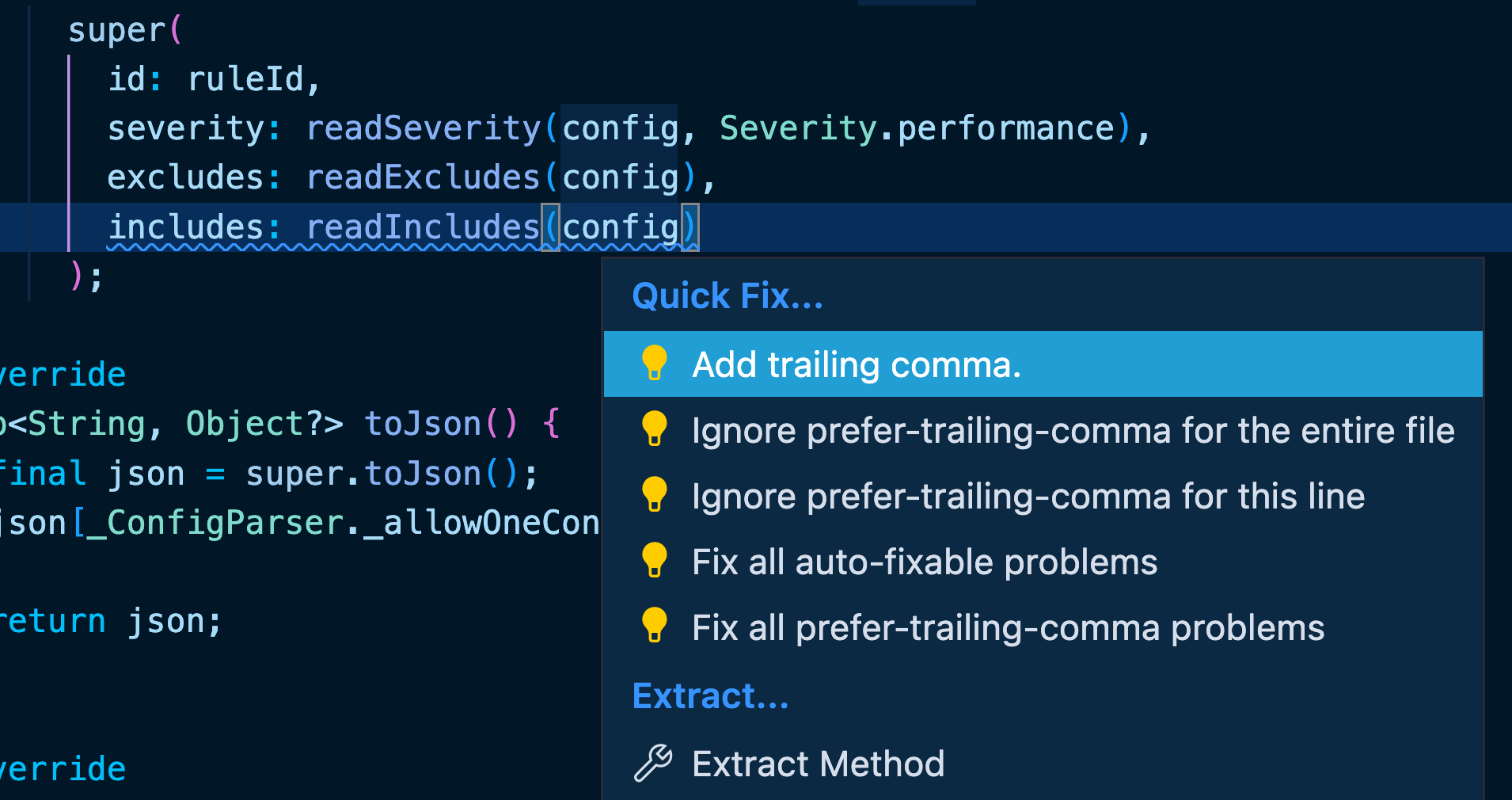
Rules that are marked with 🛠 have auto-fixes available through the IDE context menu. VS Code example:
Compatibility
As DCL depends on the Dart analyzer package. The following table shows the compatible versions:
DCL Version
Analyzer Version
Dart SDK
4.4.0
>=10.0.0 <15.0.0
>=3.5.0 <4.0.0
4.3.0
>=10.0.0 <15.0.0
>=3.5.0 <4.0.0
4.2.2
>=10.0.0 <15.0.0
>=3.5.0 <4.0.0
4.2.1
>=10.0.0 <15.0.0
>=3.5.0 <4.0.0
4.2.0
>=10.0.0 <15.0.0
>=3.5.0 <4.0.0
4.1.9
>=10.0.0 <15.0.0
>=3.5.0 <4.0.0
4.1.8
>=10.0.0 <15.0.0
>=3.5.0 <4.0.0
4.1.7
>=10.0.0 <14.0.0
>=3.5.0 <4.0.0
4.1.6
>=10.0.0 <14.0.0
>=3.5.0 <4.0.0
4.1.5
>=10.0.0 <14.0.0
>=3.5.0 <4.0.0
4.1.4
>=10.0.0 <14.0.0
>=3.5.0 <4.0.0
4.1.3
>=10.0.0 <14.0.0
>=3.5.0 <4.0.0
4.1.2
>=10.0.0 <14.0.0
>=3.5.0 <4.0.0
4.1.1
>=10.0.0 <14.0.0
>=3.5.0 <4.0.0
4.1.0
>=10.0.0 <14.0.0
>=3.5.0 <4.0.0
4.0.5
>=10.0.0 <13.0.0
>=3.5.0 <4.0.0
4.0.4
>=10.0.0 <13.0.0
>=3.5.0 <4.0.0
4.0.3
>=10.0.0 <13.0.0
>=3.5.0 <4.0.0
4.0.2
>=10.0.0 <13.0.0
>=3.5.0 <4.0.0
4.0.1
>=10.0.0 <13.0.0
>=3.5.0 <4.0.0
4.0.0
>=11.0.0 <12.0.0
>=3.5.0 <4.0.0
>=3.2.0 <4.0.0
^8.0.0
>=3.4.0 <4.0.0
>=3.0.0 <3.2.0
^7.4.1
>=3.4.0 <4.0.0
>=2.0.0 <3.0.0
^6.0.0
>=3.0.0 <4.0.0
CLI
The package can be used as CLI and supports multiple commands:
Command
Example of use
Short description
analyze
dart run dart_code_linter:metrics analyze lib
Reports code metrics, rules and anti-patterns violations.
check-unnecessary-nullable
dart run dart_code_linter:metrics check-unnecessary-nullable lib
Checks unnecessary nullable parameters in functions, methods, constructors.
check-unused-files
dart run dart_code_linter:metrics check-unused-files lib
Checks unused *.dart files.
check-unused-l10n
dart run dart_code_linter:metrics check-unused-l10n lib
Check unused localization in *.dart files.
check-unused-code
dart run dart_code_linter:metrics check-unused-code lib
Checks unused code in *.dart files.
For additional help on any of the commands, enter dart run dart_code_linter:metrics help <command>
Note: if you're setting up DCL for multi-package repository (a.k.a. monorepo), it'll pick up analysis_options.yaml files correctly.
You can define one analysis_options.yaml at the root file.
Analyze
Reports code metrics, rules and anti-patterns violations. To execute the command, run
dart run dart_code_linter:metrics analyze lib
It will produce a result in one of the format:
Console
GitHub
Codeclimate
HTML
JSON
Check unnecessary nullable parameters
Checks unnecessary nullable parameters in functions, methods, constructors. To execute the command, run
dart run dart_code_linter:metrics check-unnecessary-nullable lib
It will produce a result in one of the format:
Console
JSON
Check unused files
Checks unused *.dart files. To execute the command, run
dart run dart_code_linter:metrics check-unused-files lib
It will produce a result in one of the format:
Console
JSON
Check unused localization
Checks unused Dart class members, that encapsulates the app’s localized values.
An example of such class:
classClassWithLocalization{
Stringget title {
returnIntl.message(
'Hello World',
name: 'title',
desc: 'Title for the Demo application',
locale: localeName,
);
}
}
To execute the command, run
dart run dart_code_linter:metrics check-unused-l10n lib
It will produce a result in one of the format:
Console
JSON
Check unused code
Checks unused code in *.dart files. To execute the command, run
dart run dart_code_linter:metrics check-unused-code lib
It will produce a result in one of the format:
Console
JSON
By default only top level declarations (classes, functions, variables, and so
on) are checked. Unused private members of type declarations (methods, fields,
getters, setters and named constructors) are reported too when the check is
opted in:
dart run dart_code_linter:metrics check-unused-code lib --analyze-private-members
The same can be enabled through analysis_options.yaml, so it applies to every
run:
The CLI flag wins over the analysis_options.yaml value when both are set. Two
limitations are worth knowing about:
A private field that is only ever assigned, never read, is reported as unused,
the same way an unused top level variable is.
Usages that live only in files excluded from analysis (generated part files,
for example) are invisible, so members used exclusively from there are
reported.
Public members are covered by a separate opt in, because they need more
guesswork than private ones and are therefore less reliable:
dart run dart_code_linter:metrics check-unused-code lib --analyze-public-members
The two options are independent, so a large project can keep the cheap private
members check on while leaving this one off. Members that cannot be seen to be
used through a reference are skipped rather than reported:
Members that override or implement an inherited member, since dispatch
resolves to the supertype's declaration. This covers toString, hashCode
and noSuchMethod on every class, and overrides that carry no @override
annotation.
Members annotated @override, @mustBeOverridden, @visibleForOverriding,
@redeclare, @protected, @visibleForTesting, @JS, or
@pragma('vm:entry-point').
Members exported to JavaScript with @JSExport, which JavaScript calls
through createJSInteropWrapper. This one also counts when the annotation
sits on the enclosing class, though only for that class's instance members,
since statics are never wrapped. Note that a @pragma('vm:entry-point') on
the enclosing class does not work the same way: it only permits allocation
from native code, so members still need their own pragma and are otherwise
reported.
Members whose name is invoked or read somewhere on a target of an unknown
(dynamic) type. Operators count too: a host + 1, host[0] = 1 or
host(1) on a dynamic target keeps every operator +, operator []= and
call member, since any of them could be the one reached.
toJson, which json.encode calls by convention rather than by reference.
Enum constants of an enum whose values is referenced anywhere, since
iteration, byName and name based deserialization reach the constants without
naming any of them.
Unnamed constructors, whose invocations carry no identifier to record. Named
constructors are analyzed.
Even so, expect more false positives than from the private members check.
Members reached only through code generation, reflection or a package that
depends on yours cannot be seen at all. Note also that members used only by
your tests are reported when the analysis covers lib alone; pass the test
folder too (check-unused-code lib test) if you want those usages counted.
A third opt in reports the opposite situation: public declarations that are
used, but only ever from inside the library that declares them, and so could
carry a private name instead.
dart run dart_code_linter:metrics check-unused-code lib --suggest-private-members
It covers both type members and top level declarations, and is independent of
the other two options. Because it reports code that is used rather than dead
code, it has its own exit gate, --[no-]fatal-could-be-private, so a project
can keep the suggestions visible without failing the build on them.
A declaration nothing references at all is never reported here: that is dead
code, which is what the two options above are for. When both checks are on, an
unused declaration is reported once, as unused. One shape slips through that
rule: a dead declaration sharing its name with a used declaration of the same
library is matched by the deliberately loose name comparison that works around
dart-lang/sdk#49182, so it
reads as used and can be reported as a suggestion rather than as dead code.
Members of a type that is itself reported dead are dropped, so what is left of
this is a dead member of a live type.
Every exemption of the public members check applies here too, since an analysis
that cannot see how a declaration is reached cannot tell that everything
reaching it sits in one library either. On top of those, these are never
suggested:
Operators, which have no private spelling at all; enum constants, whose
identifier is observable at run time through name and toString, so
renaming one can silently change serialized output; and the call method
that makes its type callable, since obj(...) binds a member spelled
exactly call, so the rename fails to compile even inside the declaring
library. Only a method is exempt: a field, a getter or a static named call
is reached by an ordinary reference and is still suggested.
Fields bound by a named this.x or super.x formal. Dart forbids a named
parameter starting with an underscore, so the rename does not compile even
for a constructor nothing outside the library calls.
Instance members redeclared by a type in another library, anywhere in that
type's own hierarchy. Making such a member private compiles, but silently
stops dispatch from reaching the override or the interface implementation.
A member that no foreign subtype mentions is still suggested: a private
member is inherited across libraries and keeps working untouched. An
implementer that declares the member nowhere in its hierarchy is the one
gap, since there is nothing to match it against: an abstract class, or a
hand written mock answering through noSuchMethod. The rename compiles
there, but a mock that stubs by name stops matching the call.
Members of a type that is already private. No other library can name the
type, so the rename would change nothing. For a mixin it would change more
than nothing, since a public class can mix a private mixin in and republish
its members under a name other libraries do reach, which is the other reason
to leave the whole group alone. An unnamed extension does not count as
private here: its members apply in every library that imports the declaring
one, so they are still suggested.
Everything in a library any consumer of the package can import, which is
either of two things: a file another file in the analysis re-exports (a
barrel), or a file that simply sits under lib/ outside lib/src, since
Dart lets a consumer import that directly whether or not anything exports
it. The cut covers the members of its types as well as its top level
declarations: a consumer that can name the type reaches the public members
of that type just as directly, so the rename breaks it either way. Only the
suggestions are dropped, and the unused check still reports these files
exactly as it always has. --monorepo lifts the exemption, as it does for
the unused check, since it says there are no unseen consumers to protect. An
application is in that same position, since nothing outside it can import
its lib/ at all, so pass --monorepo there too. A published package that
keeps nothing under lib/src will otherwise see no suggestions at all,
which is the intended answer rather than a gap: every declaration it has is
reachable by a consumer this analysis cannot see.
The same blind spot as above applies: a subtype or a reference living in a
package that depends on yours, or in a folder outside the analysis, cannot be
seen, so run the check over every folder that uses the code
(check-unused-code lib test).
Troubleshooting
Please read the following guide if the plugin is not working as you'd expect it to work.
Contributing
If you are interested in contributing, please check out the contribution guidelines. Feedback and contributions are welcome!