搜索插件、代码仓与 APP 分类

observe_internet_connectivity 封面
插件详情v1.0.3

observe_internet_connectivity

一个 Flutter 包,通过可自定义的观察策略帮助您监控互联网连接。

AndroidiOSmacOSWindowsLinux
近 30 天下载
6410
喜欢数
33
Pub 分数
160

安装插件

flutter pub add observe_internet_connectivity

插件介绍

基于插件公开信息、社区数据与项目使用情况整理的选型参考。

一个专为监控互联网连接而设计的 Flutter 包,具有可自定义的观察策略。它提供跨多个平台(包括 Android、iOS、macOS、Windows 和 Linux)的实时网络状态更新。开发者可以自定义连接变化的检测和响应方式,从而灵活地集成到需要可靠网络感知的应用程序中。该包简化了在线/离线状态的处理,无需依赖外部组件即可实现基本功能。

适合场景

  • 实时网络状态监控
  • 应用程序中的离线模式处理
  • 基于连接性的动态UI更新
  • 背景网络状态跟踪
  • 应用行为在连接性变化期间的自适应
  • 失败请求的自动重试逻辑

主要特点

  • 可自定义的观测策略
  • 跨平台支持
  • 实时连接更新
  • 轻量且依赖极少
  • 简单的集成API
  • 可配置的轮询间隔

适合对象

  • 需要响应式网络反馈的应用程序
  • 开发离线功能的开发者
  • 需要跨平台连接性检查的项目
  • 注重代码整洁性和可维护性的团队
  • 频繁网络操作的应用程序

使用建议

  • 某些平台可能需要额外的权限
  • 自定义策略需要仔细实施
  • 电池使用情况取决于轮询频率
  • 不适用于高频、低延迟网络检查
  • 仅限基本连接检测(无速度或质量指标)

原始 README

以下为关联源码仓库的 README 原文快照,最新内容请访问源码仓库。

A flutter package that helps to observe internet connection via a customizable observing strategy

Problem Statement

I found that just using the connectivity package was not enough to tell if the internet was available or not. It only checks if there is WIFI or if mobile data is turned on, it does not check for an actual internet connection...

Read more about the issue here

Available Features

  1. Check to know if a device has an internet connection
  final hasInternet = await InternetConnectivity().hasInternetConnection;
  if (hasInternet) {
    //You are connected to the internet
  } else {
    //"No internet connection
  }
  1. Listen to internet connection changes via stream
  final subscription =
      InternetConnectivity().observeInternetConnection.listen((bool hasInternetAccess) {
        if(!hasInternetAccess){
          showToast('No Internet Connection');
        }
      });

   await Future.delayed(const Duration(seconds: 10 ));
   subscription.cancel();

Note:bell:: This example uses the DefaultObServingStrategy therefore you need to remember to cancel the subscription manually, Other available strategies have a mechanism in which the subscription is automatically cancelled.

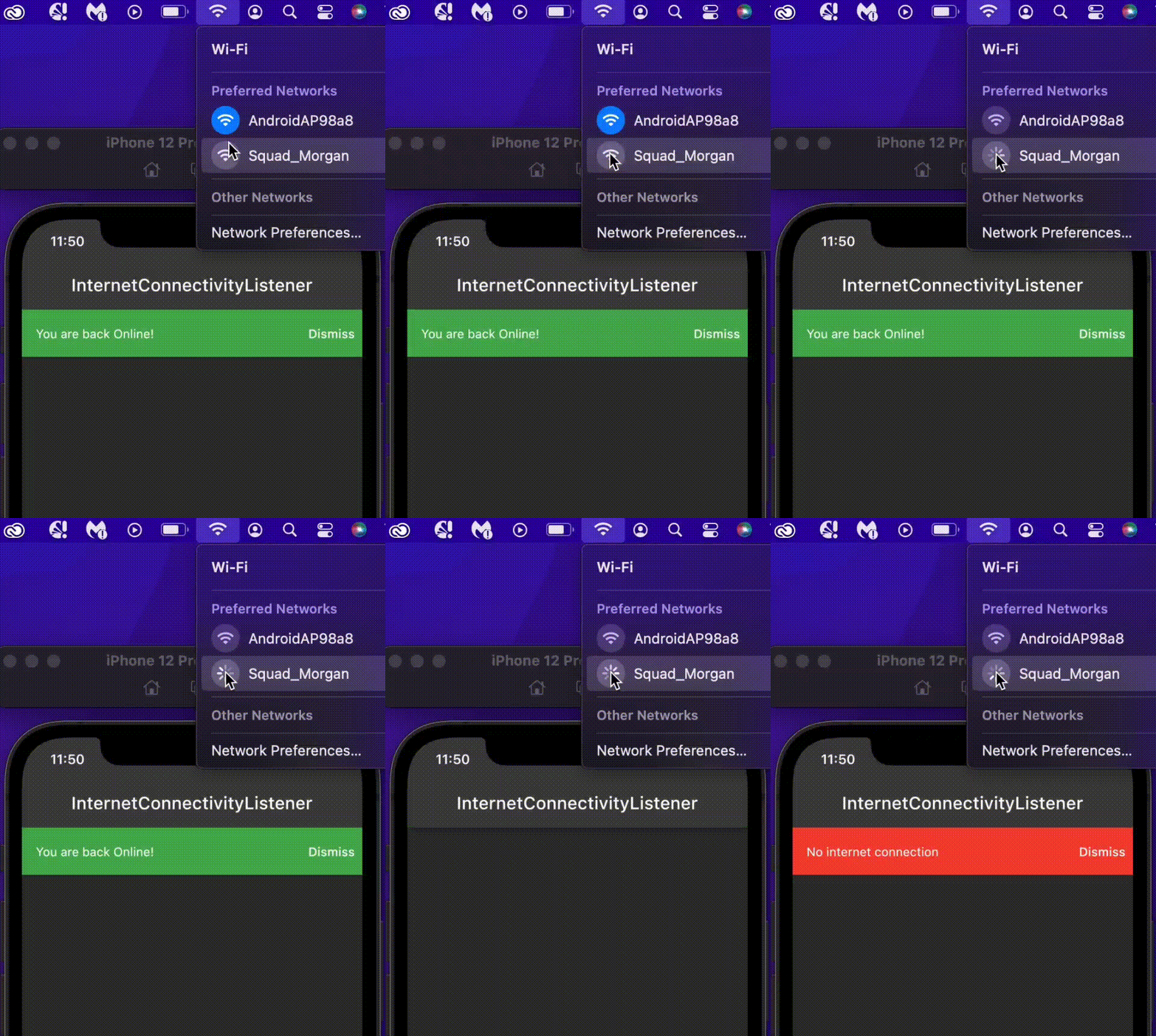
  1. Use InternetConnectivityListener to listen to internet connectivity changes inside a flutter widget
    return InternetConnectivityListener(
      connectivityListener: (BuildContext context, bool hasInternetAccess) {
        if (hasInternetAccess) {
          context.showBanner('You are back Online!', color: Colors.green);
        } else {
          context.showBanner('No internet connection', color: Colors.red);
        }
      },
      child: Scaffold(
        body: Container(),
      ),
    );

This is mostly useful if you want to get notified of internet connection changes in the widget class, either to retry a failed request or to give the user some feedback about their network state.

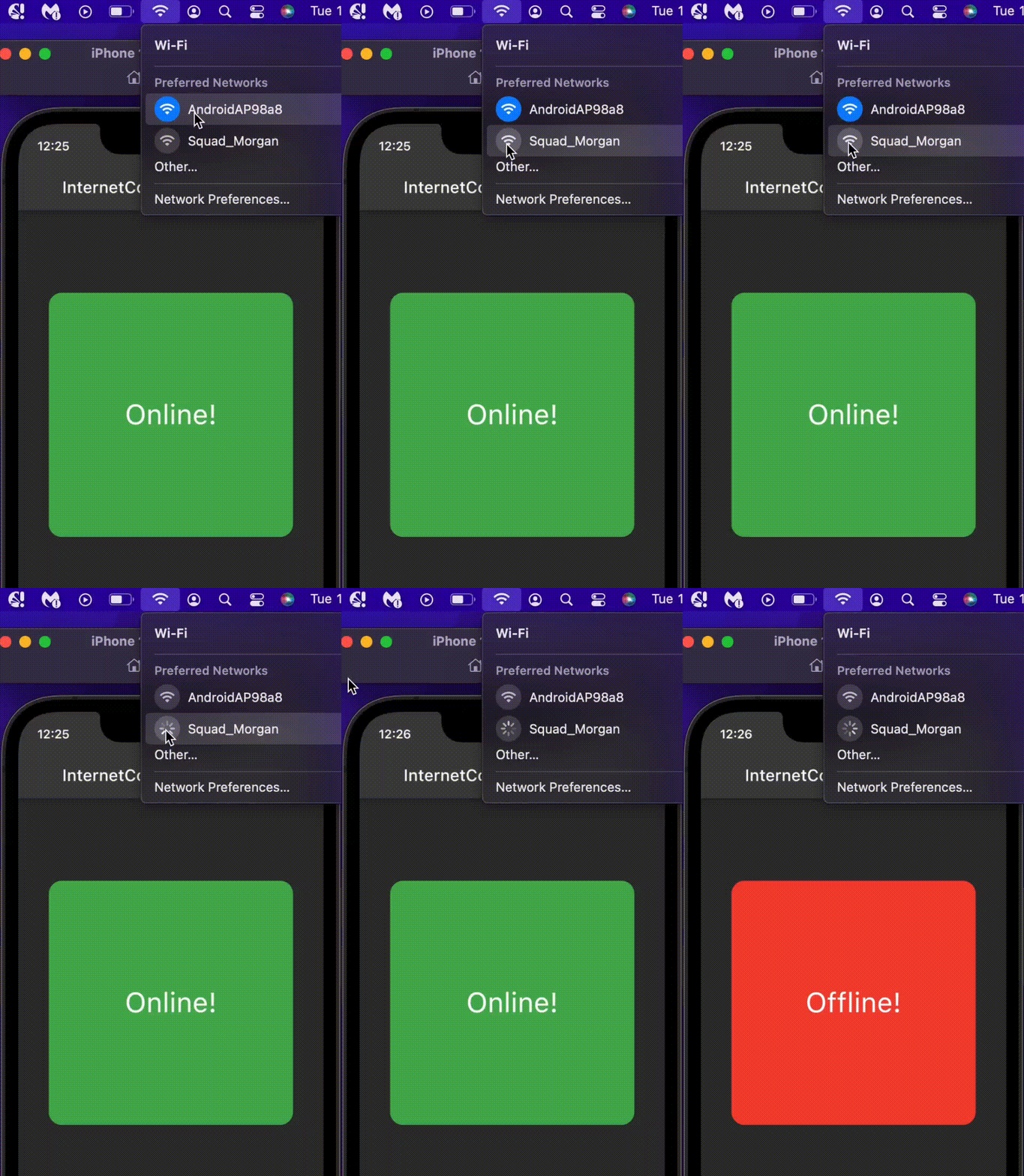
  1. Use InternetConnectivityBuilder to build internet connection aware widgets
    return InternetConnectivityBuilder(
      connectivityBuilder: (BuildContext context, bool hasInternetAccess, Widget? child) { 
        if(hasInternetAccess) {
          return OnlineWidget();
        } else {
          return OfflineWidget();
        }
      },
      child: ChildWidget(),
    );

This returns the OnlineWidget when the user has an internet connection and returns the OfflineWidget widget when the user is disconnected

Deep Dive

The InternetConnectivity class is responsible for observing the internet connectivity using the InternetObservingStrategy and a StreamController to emit internet connection changes. If no strategy is supplied when creating InternetConnectivity, the DefaultObServingStrategy will be used.

  InternetConnectivity({InternetObservingStrategy? internetObservingStrategy}) {
    _internetObservingStrategy =
        internetObservingStrategy ?? DefaultObServingStrategy();
    _internetAccessCheckController = StreamController<bool>.broadcast(
        onCancel: _onCancelStream, onListen: _emitInitialInternetAccess);
  }

The package checks for active internet connection by opening a socket to a list of specified addresses, each with an individual port and timeout using SocketObservingStrategy. If you'd like to implement a different type of observing strategy, you can create a new strategy by extending InternetObservingStrategy. All observing strategies are a sub-class of InternetObservingStrategy

SocketObservingStrategy
abstract class SocketObservingStrategy extends InternetObservingStrategy {
  /// The initial duration to wait before observing internet access
  ///
  /// Defaults to [kDefaultInitialDuration] (0 seconds)
  @override
  final Duration? initialDuration;

  /// The interval between periodic observing.
  ///
  /// Defaults to [kDefaultInterval] (5 seconds).
  @override
  final Duration interval;

  /// The timeout period before a check request is dropped and an address is
  /// considered unreachable.
  ///
  /// If not null, it is set to the [timeOut] for each of the [internetAddresses].
  ///  if (timeOut != null) {
  ///       internetAddresses = internetAddresses
  ///           .map((e) => e.copyWith(timeOut: timeOut))
  ///           .toList(growable: false);
  ///     }
  final Duration? timeOut;

  /// A list of internet addresses (with port and timeout) to ping.
  ///
  /// These should be globally available destinations.
  ///
  /// Default is [kDefaultInternetAddresses].
  List<InternetAddress> internetAddresses;

  SocketObservingStrategy(
      {this.initialDuration,
      required this.interval,
      this.timeOut,
      required this.internetAddresses}) {
    if (timeOut != null) {
      internetAddresses = internetAddresses
          .map((e) => e.copyWith(timeOut: timeOut))
          .toList(growable: false);
    }
  }

  /// The observing strategy is to ping each of the [internetAddresses] supplied,
  /// Using [stream.any] to check for the first address to connect.
  /// Once an address connects, it is assumed that there is internet access and the process stops
  ///
  @override
  Future<bool> get hasInternetConnection async {
    final futures = internetAddresses
        .map((internetAddress) => _hasInternet(internetAddress));
    final stream = Stream.fromFutures(futures);
    return stream.any((element) => element);
  }

  Future<bool> _hasInternet(InternetAddress internetAddress) async {
    Socket? sock;
    try {
      sock = await Socket.connect(
        internetAddress.host,
        internetAddress.port,
        timeout: internetAddress.timeOut,
      )
        ..destroy();
      return true;
    } catch (_) {
      sock?.destroy();
      return false;
    }
  }
}

The library comes with 4 different strategies that extend SocketObservingStrategy for a different use cases, namely;

  1. DefaultObServingStrategy: This is the strategy used if you don't supply any strategy to the InternetConnectivity class, you will have to cancel the subscription manually.

  2. DisposeOnFirstConnectedStrategy: This strategy cancels the subscription automatically after the first connected event, i.e once the device has an internet connection, the stream subscription will be automatically closed.

  3. DisposeOnFirstDisconnectedStrategy: This strategy cancels the subscription automatically after the first disconnected event, i.e once the device is offline, the stream subscription will be automatically closed.

  4. DisposeAfterDurationStrategy: This strategy set the duration to listen for the internet connection events, the subscription will be closed once the duration elapses

class DisposeAfterDurationStrategy extends SocketObservingStrategy {
  @override
  final Duration duration;
  
  DisposeAfterDurationStrategy(
      {required this.duration,
      super.timeOut,
      super.interval = kDefaultInterval,
      super.initialDuration = kDefaultInitialDuration,
      super.internetAddresses = kDefaultInternetAddresses});
}

each of the strategies is initiated with default values for convenience, you can override any of the default values. e.g creating a DefaultObServingStrategy with a timeOut of 5 sec and initialDuration of 2 mins.

    DefaultObServingStrategy(
      timeOut: const Duration(seconds: 5),
      initialDuration: const Duration(minutes: 2)
    )
The Default values

const kDefaultInternetAddresses = [
 InternetAddress(
     host: _googleHost, port: _defaultPort, timeOut: _defaultTimeOut),
 InternetAddress(
     host: _cloudFlareHost, port: _defaultPort, timeOut: _defaultTimeOut),
];

const kDefaultInterval = Duration(seconds: 5);
const kDefaultInitialDuration = Duration(seconds: 0);
const _googleHost = '8.8.8.8';
const _cloudFlareHost = '1.1.1.1';
const _defaultPort = 53;
const _defaultTimeOut = Duration(seconds: 3);

Implementing your own InternetObservingStrategy

For example, you can implement a fake observing strategy for testing as follows;

class FakeObservingStrategy extends InternetObservingStrategy{
  @override
  Future<bool> get hasInternetConnection async=> true;

  @override
  Duration? get initialDuration => const Duration(seconds: 0);

  @override
  Duration get interval => const Duration(seconds: 5);
}

You can also implement an HttpsObservingStrategy as follows;

class HttpsObservingStrategy extends InternetObservingStrategy {
  final String lookUpAddress;

  HttpsObservingStrategy({this.lookUpAddress = 'www.google.com'});

  @override
  Duration? get initialDuration => const Duration(seconds: 0);

  @override
  Duration get interval => const Duration(seconds: 10);

  @override
  Future<bool> get hasInternetConnection async {
    try {
      var url = Uri.https(lookUpAddress, '',);
     await http.get(url);
     return true;
    } catch (_) {
      return false;
    }
  }
}

Auto retry example

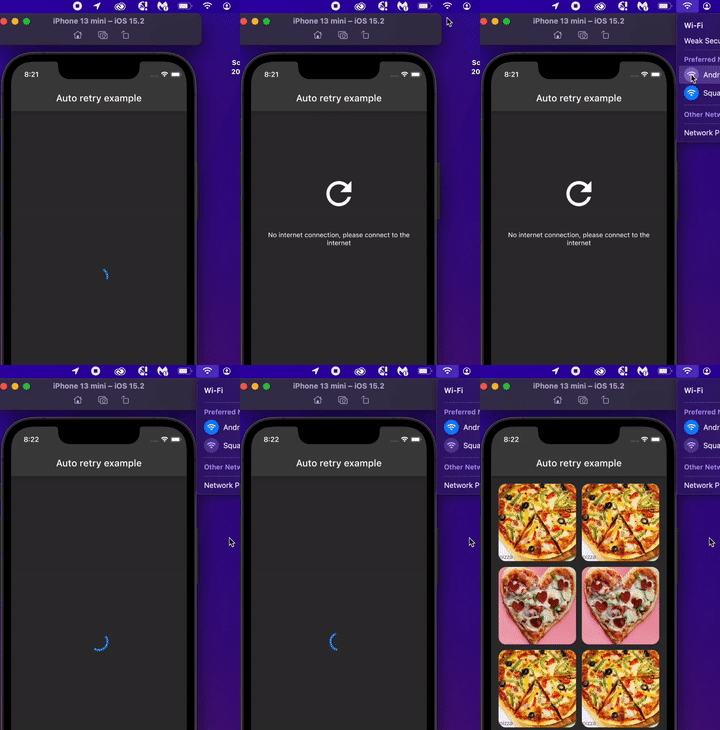
This example showcase how you can use the InternetConnectivityListener and the DisposeOnFirstConnectedStrategy to automaticaly retry a failed network request once the device is back online.

class _RetryWidget extends ConsumerWidget {
  const _RetryWidget({Key? key}) : super(key: key);

  @override
  Widget build(BuildContext context, WidgetRef ref) {
    return InternetConnectivityListener(
      internetConnectivity: ref.read(disposeOnFirstConnectedProvider),
      connectivityListener: (BuildContext context, bool hasInternetAccess) {
        if (hasInternetAccess) {
          ref.read(dataProvider.notifier).fetchData();
        }
      },
      child: Column(
        crossAxisAlignment: CrossAxisAlignment.center,
        children: const [
          Spacer(flex: 3,),
          Icon(Icons.refresh_outlined, size: 80,),
          Spacer(),
          Text('No internet connection, please connect to the internet', textAlign: TextAlign.center,),
          Spacer(flex: 10,),
        ],
      ),
    );
  }
}

Please check auto_retry_widget.dart for the complete code.

Additional information

Note:bell:: The InternetConnectivity is not a singleton, for the ease of testing. If you would like to maintain a single instance throughout the app lifecycle, you can:

  1. provide a global instance (not recommended)
final globalInstance = InternetConnectivity(
  internetObservingStrategy:   DefaultObServingStrategy(
      timeOut: const Duration(seconds: 5),
      initialDuration: const Duration(minutes: 2)
  )
);
  1. Register it with any dependency injection framework e.g GetIt
  GetIt.instance.registerSingleton<InternetConnectivity>(
      InternetConnectivity(
          internetObservingStrategy:   DefaultObServingStrategy(
              timeOut: const Duration(seconds: 5),
              initialDuration: const Duration(minutes: 2)
          )
      )
  );
  1. Use Riverpod Provider (recommended)
final observingStrategyProvider = Provider<InternetObservingStrategy>((ref)=> 
    DefaultObServingStrategy(
    timeOut: const Duration(seconds: 5),
    initialDuration: const Duration(minutes: 2)
));

final internetConnectivityProvider = Provider<InternetConnectivity>((ref) {
  return InternetConnectivity(internetObservingStrategy: ref.watch(observingStrategyProvider));
});

Check more examples in the example folder. If you like the project, don't forget to star ⭐️

License

This package is licensed under the MIT license. See LICENSE for details.

所属分类

源码仓库

使用此插件的项目

暂无相关数据。