Flutter Gemini 是一个 Flutter 包,可将 Google 的先进大型语言模型(LLMs)集成到移动和桌面应用程序中。它使开发者能够在其 Flutter 应用中利用前沿的 AI 功能,如自然语言理解、文本生成和对话智能。该 SDK 针对 Android、iOS、Web、macOS、Windows 和 Linux 平台进行了优化,通过简洁的 API 简化了对 Google Gemini 强大 AI 功能的访问。非常适合用于构建智能聊天机器人、内容助手和 AI 驱动的用户体验。
适合场景
人工智能驱动的聊天机器人
内容生成
语音转文字助手
智能表单填充
实时翻译
个性化推荐
主要特点
与 Google Gemini LLM 的原生集成
跨平台支持
文本生成的简单 API
安全的身份验证处理
实时响应流
离线模式就绪
适合对象
开发AI聊天应用的开发者
将 LLM 集成到 Flutter 应用中的团队
教育和生产力工具
初创公司探索生成式人工智能
使用建议
需要 Google Cloud API 密钥
依赖互联网连接
响应中的潜在延迟
基于API调用的使用成本
有限的离线功能
速率限制适用
原始 README
以下为关联源码仓库的 README 原文快照,最新内容请访问源码仓库。
Flutter Gemini
Google Gemini is a set of cutting-edge large language models (LLMs) designed to be the driving force behind Google's future AI initiatives.
This package provides a powerful bridge between your Flutter application and Google's revolutionary Gemini AI. It empowers you to seamlessly integrate Gemini's capabilities into your app, unlocking possibilities for building innovative, intelligent, and engaging experiences that redefine user interaction.
To use the Gemini API, you'll need an API key. If you don't already have one, create a key in Google AI Studio. Get an API key.
Initialize Gemini
For initialization, you must call the init constructor for Flutter Gemini in the main function.
const apiKey = '--- Your Gemini Api Key ---';
voidmain() {
/// Add this lineGemini.init(apiKey: apiKey);
runApp(constMyApp());
}
Now you can create an instance
Content-based APIs
Prompt Stream
Offers a powerful method promptStream that allows developers to interact with
a stream of data in a flexible and efficient way. One of the key features of this package is
the ability to use different types of Part classes,
enabling the transmission of various forms of data.
Usage Example
To use the promptStream method, you can pass an array of Part objects, where each Part can represent different types of data. For instance, a simple request to ask a question could look like this:
Gemini.instance.promptStream(parts: [
  Part.text('Write a story about a magic backpack'),
]).listen((value) {
  print(value?.output);
});
Available Part Types
Part.text | TextPart: For sending text data.
Part.inline | InlinePart: For sending raw byte data.
Part.file | FilePart: For sending uploaded file to Gemini cloud ( will be updated )
...
( Others will be added ASAP )
These Part types are abstracted into a base class, providing flexibility to add more data types in the future. This modular design ensures that users can easily extend the package to accommodate their specific needs, whether it's for text, files, or binary data.
By using these different Part classes, you can tailor the behavior of the promptStream method to meet your application's specific requirements.
Prompt
You can send a question or request and get an immediate response using the prompt method. This method works with various Part types to allow flexible input, such as text, videos, or audios.
Usage Example
The following example shows how to use the Flutter_Gemini package with the Future approach to send a text request and handle the response:
Gemini.instance.prompt(parts: [
  Part.text('Write a story about a magic backpack'),
]).then((value) {
  print(value?.output);
}).catchError((e) {
  print('error ${e}');
});
Explanation:
The prompt method takes a list of Part objects, such as Part.text ( TextPart ), to define the request.
The response is processed once it is available, and you can access the result via value?.output.
Errors can be handled using catchError.
This method provides a straightforward way to handle asynchronous tasks without dealing with streams.
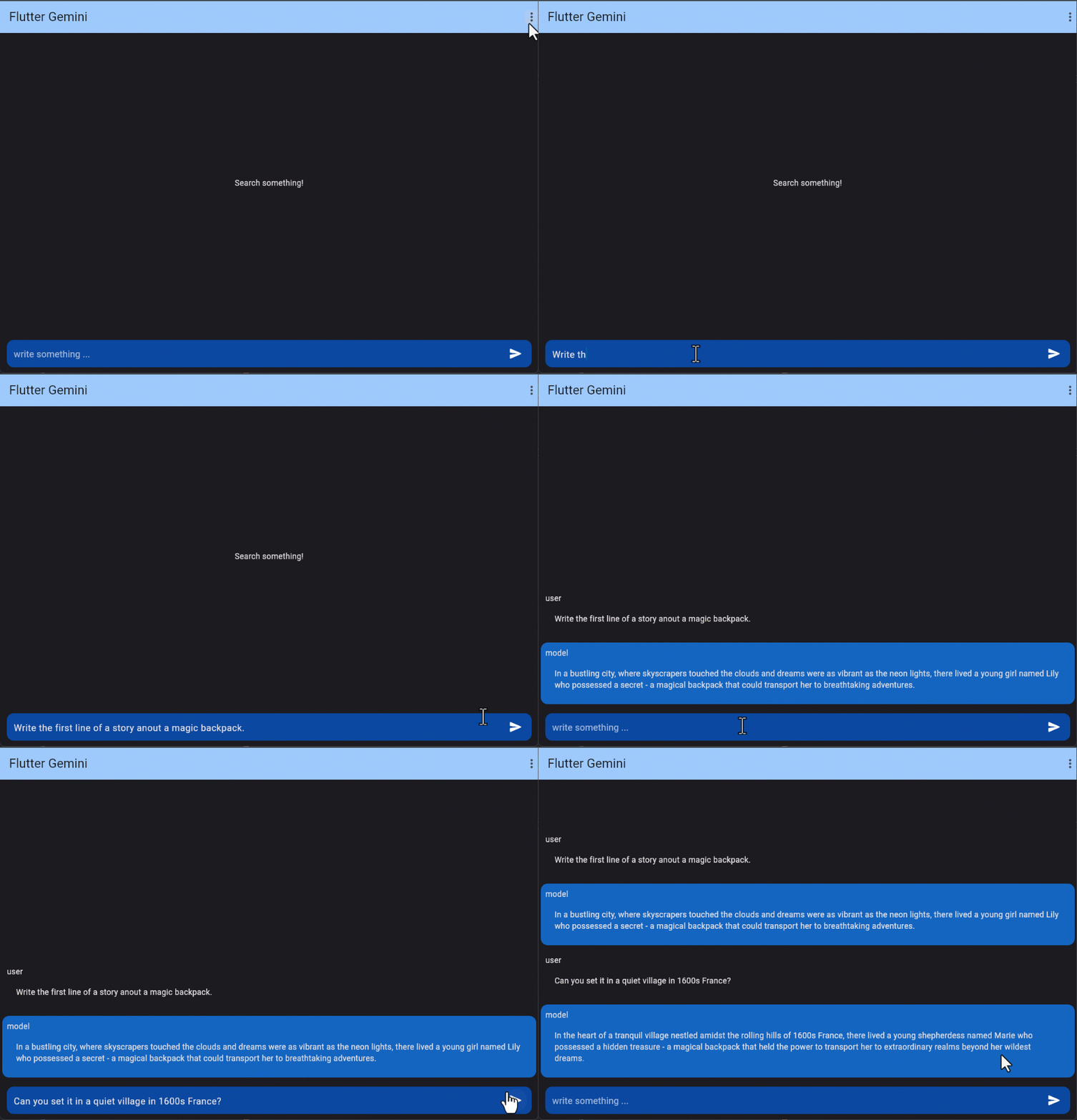
Multi-turn conversations (chat)
Using Gemini, you can build freeform conversations across multiple turns.
  final gemini = Gemini.instance;

  gemini.chat([
    Content(parts: [
      Part.text('Write the first line of a story about a magic backpack.')],
        role: 'user'),
    Content(parts: [
      Part.text('In the bustling city of Meadow brook, lived a young girl named Sophie. She was a bright and curious soul with an imaginative mind.')],
        role: 'model'),
    Content(parts: [
      Part.text('Can you set it in a quiet village in 1600s France?')],
        role: 'user'),
    ])
        .then((value) => log(value?.output ?? 'without output'))
        .catchError((e) => log('chat', error: e));
Count tokens
When using long prompts, it might be useful to count tokens before sending any content to the model.
final gemini = Gemini.instance;

gemini.countTokens("Write a story about a magic backpack.")
    .then((value) => print(value)) /// output like: `6` or `null`
    .catchError((e) => log('countTokens', error: e));
Model info
If you GET a model's URL, the API uses the get method to return information about that model such as version, display name, input token limit, etc.
If you GET the models directory, it uses the list method to list all of the models available through the API, including both the Gemini and PaLM family models.
final gemini = Gemini.instance;

gemini.listModels()
    .then((models) => print(models)) /// list
    .catchError((e) => log('listModels', error: e));
embedContents and batchEmbedContents
Embedding is a method that transforms information, like text, into a list of floating-point numbers in an array. Gemini enables the representation of text, such as words or sentences, in a vectorized form. This facilitates the comparison of embeddings, allowing for the identification of similarities between texts through mathematical techniques like cosine similarity. For instance, texts with similar subject matter or sentiment should exhibit similar embeddings.
The generation_config argument allows you to modify the generation parameters.
gemini.streamGenerateContent('Utilizing Google Ads in Flutter',
          generationConfig: GenerationConfig(
            temperature: 0.75,
            maxOutputTokens: 512,
          ))
      .listen((value) {})
      .onError((e) {});
Legacy APIs
Stream Generate Content
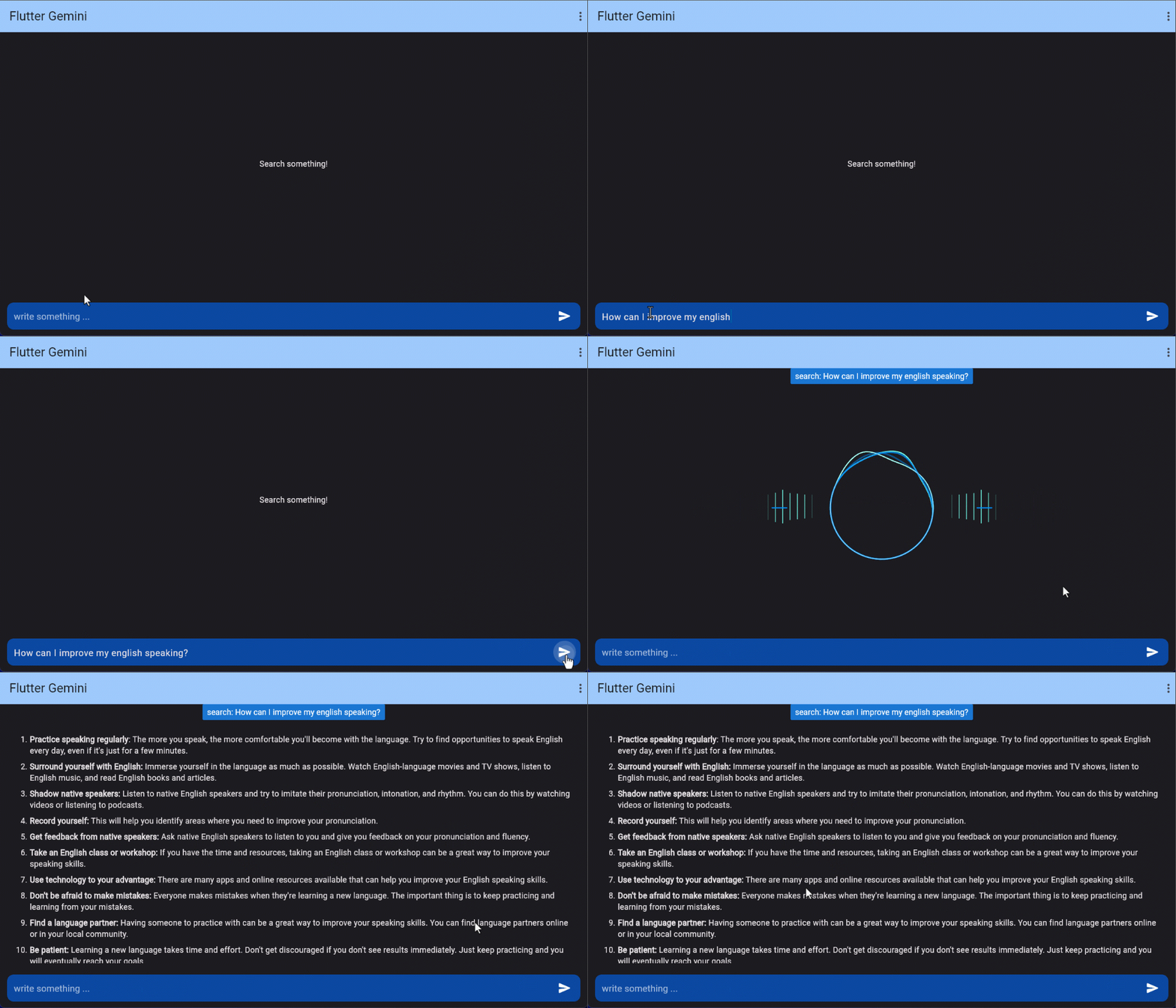
The model usually gives a response once it finishes generating the entire output. To speed up interactions, you can opt not to wait for the complete result and instead use streaming to manage partial results.
final gemini = Gemini.instance;

gemini.streamGenerateContent('Utilizing Google Ads in Flutter')
  .listen((value) {
    print(value.output);
  }).onError((e) {
    log('streamGenerateContent exception', error: e);
  });
Text-only input
This feature lets you perform natural language processing (NLP) tasks such as text completion and summarization.
final gemini = Gemini.instance;

gemini.text("Write a story about a magic backpack.")
  .then((value) => print( value?.output )) /// or value?.content?.parts?.last.text
  .catchError((e) => print(e));
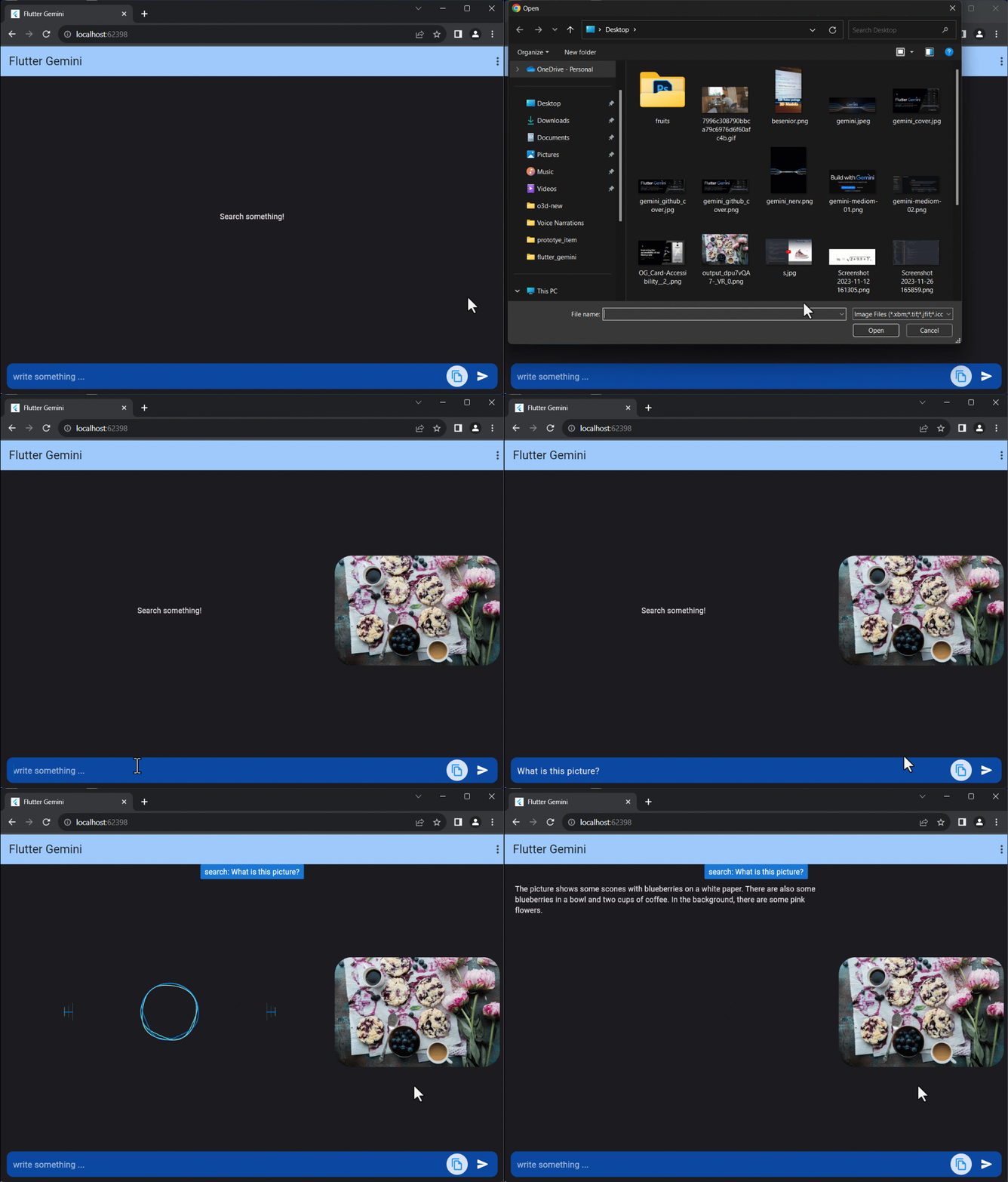
Text-and-image input
If the input contains both text and image, You can send a text prompt with an image to the gemini-1.5-flash model to perform a vision-related task. For example, captioning an image or identifying what's in an image.
  final gemini = Gemini.instance;

  final file = File('assets/img.png');
  gemini.textAndImage(
        text: "What is this picture?", /// text
        images: [file.readAsBytesSync()] /// list of images
      )
      .then((value) => log(value?.content?.parts?.last.text ?? ''))
      .catchError((e) => log('textAndImageInput', error: e));
Note that, there are changes on properties
- image: file.readAsBytesSync(), /// image+ images: [file.readAsBytesSync()] /// list of images