搜索插件、代码仓与 APP 分类

插件详情v2.0.5

nfc_in_flutter

适用于 Android 和 iOS 的 Flutter 插件,用于读取和写入 NFC 标签。目前仅支持读取 NDEF 格式的标签。

近 30 天下载
124
喜欢数
107
Pub 分数
40

安装插件

flutter pub add nfc_in_flutter

插件介绍

基于插件公开信息、社区数据与项目使用情况整理的选型参考。

nfc_in_flutter 是一个 Flutter 插件,可在 Android 和 iOS 上实现 NFC 标签读取功能,目前仅支持 NDEF 格式的标签。它提供了一个简单的接口,用于检测和获取 NFC 标签中的数据,非常适合需要非接触式数据交换的应用程序。该插件专为希望以最少设置实现跨平台 NFC 功能的开发者设计。虽然支持只读功能,但写入操作尚未支持。该包正在积极维护且为开源项目,GitHub 仓库中提供了文档和示例。

适合场景

  • 在零售应用中读取NDEF标签
  • 启用非接触式访问控制
  • 促进活动签到
  • 通过NFC传输小数据
  • 与智能海报集成

主要特点

  • 跨平台支持(Android 和 iOS)
  • 仅读取NDEF标签
  • NFC检测的简单API
  • 开源且持续维护
  • 轻量级集成

适合对象

  • 需要NFC数据检索的移动应用
  • 开发无接触解决方案的开发者
  • 使用NDEF格式标签的项目
  • 原型设计NFC功能
  • 面向 Android 和 iOS 用户的应用

使用建议

  • 写操作不支持
  • 仅限NDEF格式
  • 需要设备兼容性
  • iOS 可能限制了后台扫描
  • 平台特定的权限需要

原始 README

以下为关联源码仓库的 README 原文快照,最新内容请访问源码仓库。

nfc_in_flutter

NFC in Flutter is a plugin for reading and writing NFC tags in Flutter. It works on both Android and iOS with a simple stream interface.

⚠️ Currently only NDEF formatted tags are supported.

Usage

Read NFC tags
// NFC.readNDEF returns a stream of NDEFMessage
Stream<NDEFMessage> stream = NFC.readNDEF();

stream.listen((NDEFMessage message) {
    print("records: ${message.records.length}");
});
Read one NFC tag
NDEFMessage message = await NFC.readNDEF(once: true).first;
print("payload: ${message.payload}");
// once: true` only scans one tag!
Writing to tags

You can access a message's NFC tag using the NDEFMessage's .tag property. The tag has a .write method, which allows you to write a NDEF message to the tag.

Note that the read stream must still be open when the .write method is called. This means that the once argument in .readNDEF() cannot be used.

Stream<NDEFMessage> stream = NFC.readNDEF();

stream.listen((NDEFMessage message) {
    NDEFMessage newMessage = NDEFMessage.withRecords(
        NDEFRecord.mime("text/plain", "hello world")
    );
    message.tag.write(newMessage);
});

You can also use the NFC.writeNDEF(NDEFMessage) method, which wraps the code above with support for the once argument.

NDEFMessage newMessage = NDEFMessage.withRecords(
    NDEFRecord.mime("text/plain", "hello world")
);
Stream<NDEFTag> stream = NFC.writeNDEF(newMessage);

stream.listen((NDEFTag tag) {
    print("wrote to tag");
});

If you only want to write to one tag, you can set the once argument to true.

NDEFMessage newMessage = NDEFMessage.withRecords(
    NDEFRecord.mime("text/plain", "hello world")
);
Stream<NDEFTag> stream = NFC.writeNDEF(newMessage, once: true);

stream.listen((NDEFTag tag) {
    print("only wrote to one tag!");
});

And if you would rather use a Future based API, you can await the returned stream's .first method.

NDEFMessage newMessage = NDEFMessage.withRecords(
    NDEFRecord.type("text/plain", "hello world")
);

await NFC.writeNDEF(newMessage, once: true).first;

Example

import 'package:nfc_in_flutter/nfc_in_flutter.dart';

class NFCReader extends StatefulWidget {
    @override
    _NFCReaderState createState() => _NFCReaderState();
}

class _NFCReaderState extends State {
    bool _supportsNFC = false;
    bool _reading = false;
    StreamSubscription<NDEFMessage> _stream;

    @override
    void initState() {
        super.initState();
        // Check if the device supports NFC reading
        NFC.isNDEFSupported
            .then((bool isSupported) {
                setState(() {
                    _supportsNFC = isSupported;
                });
            });
    }

    @override
    Widget build(BuildContext context) {
        if (!_supportsNFC) {
            return RaisedButton(
                child: const Text("You device does not support NFC"),
                onPressed: null,
            );
        }

        return RaisedButton(
            child: Text(_reading ? "Stop reading" : "Start reading"),
            onPressed: () {
                if (_reading) {
                    _stream?.cancel();
                    setState(() {
                        _reading = false;
                    });
                } else {
                    setState(() {
                        _reading = true;
                        // Start reading using NFC.readNDEF()
                        _stream = NFC.readNDEF(
                            once: true,
                            throwOnUserCancel: false,
                        ).listen((NDEFMessage message) {
                            print("read NDEF message: ${message.payload}"),
                        }, onError: (e) {
                            // Check error handling guide below
                        });
                    });
                }
            }
        );
    }
}

Full example in example directory

Installation

Add nfc_in_flutter to your pubspec.yaml

dependencies:
    nfc_in_flutter: 2.0.5
iOS

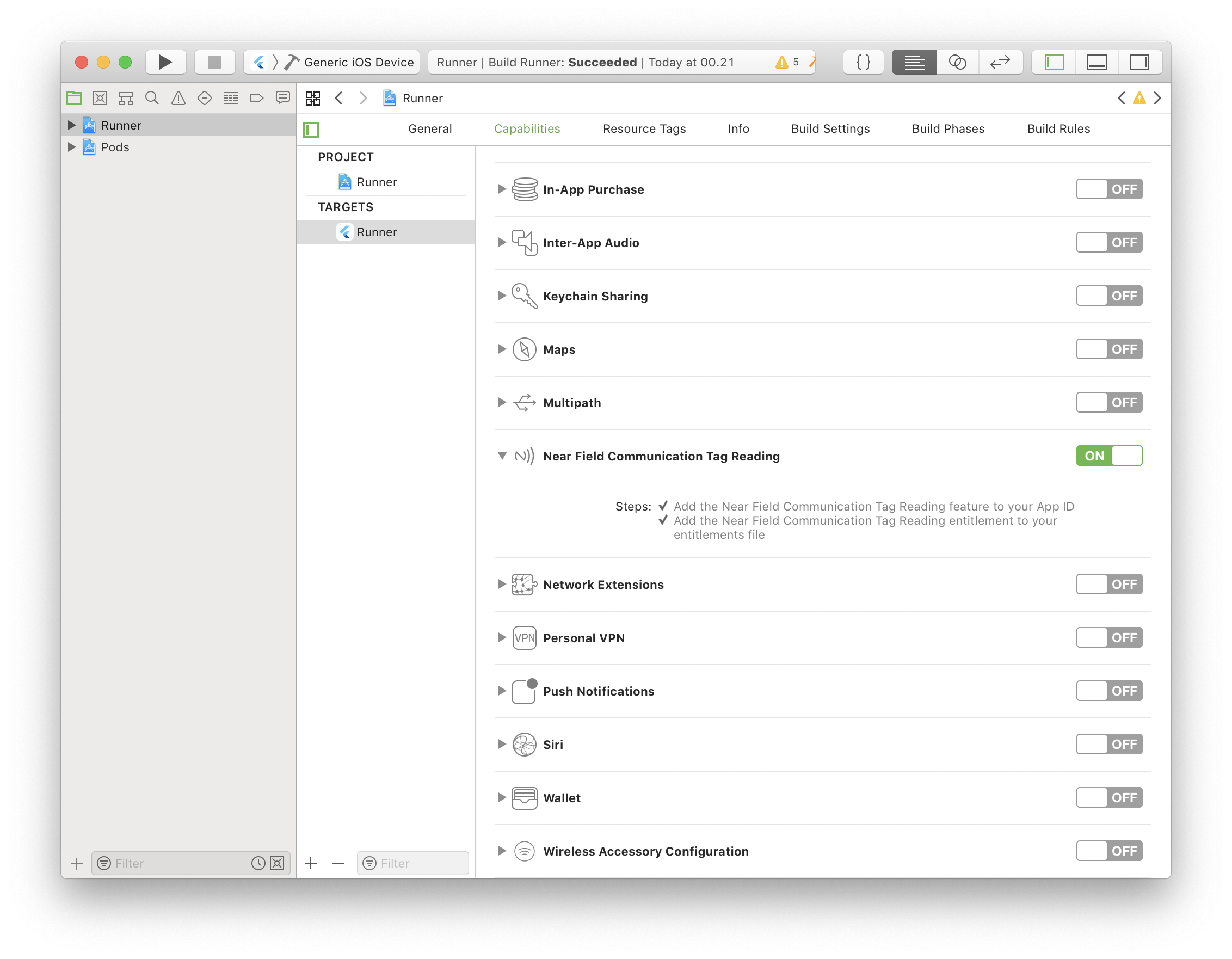
On iOS you must add turn on the Near Field Communication capability, add a NFC usage description and a NFC entitlement.

Turn on Near Field Communication Tag Reading

Open your iOS project in Xcode, find your project's target and navigate to Capabilities. Scroll down to 'Near Field Communication Tag Reading' and turn it on.

Turning on 'Near Field Communication Tag reading'

  • Adds the NFC tag-reading feature to the App ID.
  • Adds the Near Field Communication Tag Reader Session Formats Entitlement to the entitlements file.

from developer.apple.com: Building an NFC Tag-Reader app

'Turn on Near Field Communication Tag Reading' capability  turned on for a project in Xcode

NFC Usage Description

Open your ios/Runner/Info.plist file and add a new NFCReaderUsageDescription key. It's value should be a description of what you plan on using NFC for.

<key>NFCReaderUsageDescription</key>
<string>...</string>
Android

Add the following to your app's AndroidManifest.xml file:

<uses-permission android:name="android.permission.NFC" />

If your app requires NFC, you can add the following to only allow it to be downloaded on devices that supports NFC:

<uses-feature android:name="android.hardware.nfc" android:required="true" />

"What is NDEF?"

If you're new to NFC you may come to expect a lot of readNFC() calls, but instead you see readNDEF() and NDEFMessage. NDEF is just a formatting standard the tags can be encoded in. There are other encodings than NDEF, but NDEF is the most common one. Currently NFC in Flutter only supports NDEF formatted tags.

Host Card Emulation

NFC in Flutter supports reading from emulated host cards*.

To read from emulated host cards, you need to do a few things.

  • Call readNDEF() with the readerMode argument set to an instance of NFCDispatchReaderMode.
  • Insert the following <intent-filter /> in your AndroidManifest.xml activity:
<intent-filter>
    <action android:name="android.nfc.action.NDEF_DISCOVERED" />
    <category android:name="android.intent.category.DEFAULT" />
</intent-filter>
  • Not properly tested on iOS
⚠️ Multiple reader modes

If you start a readNDEF() stream with the reader mode set to an instance of NFCDispatchReaderMode, while another stream is active with the NFCNormalReaderMode, it will throw a NFCMultipleReaderModesException.

Platform differences

When you call readNDEF() on iOS, Core NFC (the iOS framework that allows NFC reading) opens a little window. On Android it just starts listening for NFC tag reads in the background.

image from developer.apple.com: Near Field Communication

⚠️ This will also freeze Flutter while open. Please send a Pull Request if you can fix this.

Error handling

Errors are no exception to NFC in Flutter (hah, get it). The stream returned by NFC.readNDEF() can send 7 different exceptions, and even worse: they are different for each platform!

See the full example in the example directory for an example on how to check for errors.

Exceptions for both platforms
NDEFReadingUnsupportedException

Thrown when a reading session is started, but not actually supported.

iOS
NFCUserCanceledSessionException

Thrown when the user clicks Cancel/Done core NFC popup. If you don't need to know if the user canceled the session you can start reading with the throwOnUserCancel argument set to false like so: readNDEF(throwOnUserCancel: false)

NFCSessionTimeoutException

Core NFC limits NFC reading sessions to 60 seconds. NFCSessionTimeoutException is thrown when the session has been active for 60 seconds.

NFCSessionTerminatedUnexpectedlyException

Thrown when the reading session terminates unexpectedly.

NFCSystemIsBusyException

Throw when the reading session fails because the system is too busy.

Android
NFCIOException

Thrown when a I/O exception occurs. Will for example happen if a tag is lost while being read or a tag could not be connected to.

NDEFBadFormatException

Thrown when the tag is expected to NDEF formatted, but it is incorrectly formatted.

所属分类

源码仓库

使用此插件的项目

暂无相关数据。