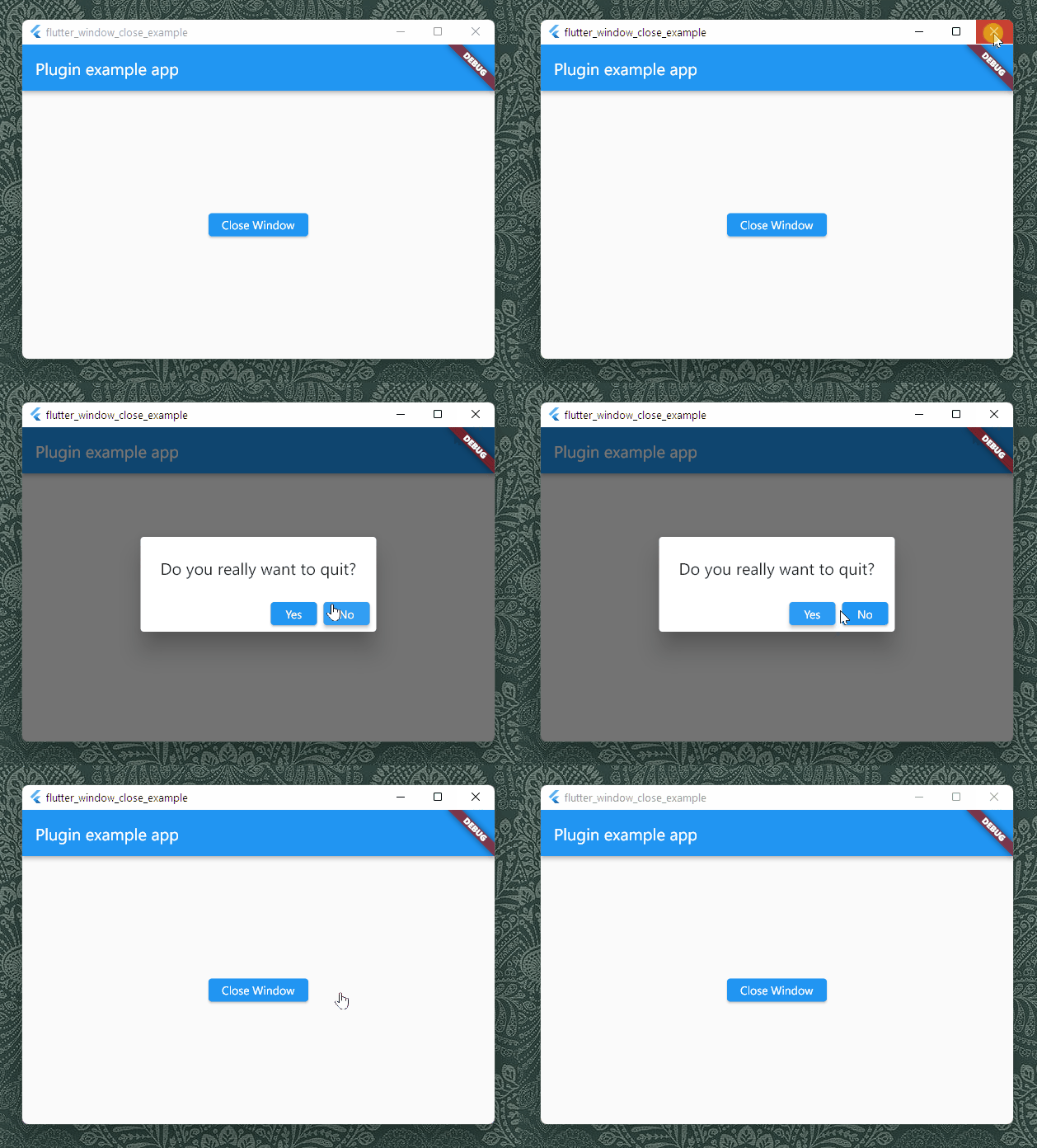
Package selection guidance compiled from public package information, community data, and project usage.
The flutter_window_close package enables Flutter applications on desktop platforms to intercept window close events and prompt users for confirmation before exiting. This is particularly useful for apps that need to save unsaved data or prevent accidental closure. It provides a simple API to register a callback that runs when the user attempts to close the window, allowing developers to show custom dialogs or perform cleanup tasks. The package supports macOS, Windows, Linux, and Web, making it ideal for cross-platform desktop applications requiring graceful shutdown handling.
Use cases
Preventing accidental app closure
Saving unsaved data before exit
Displaying confirmation dialogs
Graceful shutdown on desktop
Custom exit logic
Web and desktop compatibility
Key features
Intercepts window close events
Supports multiple desktop platforms
Simple callback API
Cross-platform desktop support
Optional confirmation dialog
Web and native integration
Suitable for
Desktop Flutter apps
Apps with unsaved data
User-facing desktop applications
Developers needing exit control
Applications requiring confirmation prompts
Cross-platform desktop projects
Considerations
Not applicable on mobile platforms
Requires platform-specific setup
May conflict with system-level close behavior
Limited to desktop and web
Does not handle app termination from task manager
User experience depends on implementation
Original README
Original README snapshot from the linked source repository. Visit the repository for the latest content.
flutter_window_close lets your Flutter app has a chance to confirm if the user
wants to close your app. It works on desktop platforms including Windows, macOS
and Linux.
Getting Started
It is very common that an app would prompt a message like "Do you really want to
quit" when users click on the close button, in order to notify that there are
still undone tasks and the users may lose their data if they want to quit
anyway. It prevents the users from losing data unwillingly.
To let a Flutter desktop app to support that, the plug-in listens to the events
from the window hosting Flutter's view, and send the events to Flutter. What you
need to do is to assign an anonymous function that can answer if the window
should be closed. For example, you can show an alert dialog to ask what the
current user is willing to do:
It does not support mobile platforms, since there is no such event for closing
windows. You can use a custom
WillPopScope
to capture if a user is leaving your app with a back key.
macOS
There could be some issues while using the package on macOS. Each platform has
its paradigm and the developer framework macOS sees window objects in a
different way from Windows and Linux.
On Windows and Linux, windows are more like controllers in MVC pattern , and
when it comes to Flutter, there would be always a root window in the process of
an app, and our plugin could easily know which is the window to listen to. In
the code level, we use
GetActiveWindow
while we can use
gtk_widget_get_ancestor
or
gtk_widget_get_toplevel.
On the contrary, windows are more like views on macOS. An app can have multiple
windows, and the app can stay still open event all windows are closed. We can
also create an object with multiple IBOutlets to multiple windows. Flutter macOS
does not tell plugins which window is the one running Flutter as well.
The plugin listens to the first window in the
windows
list of the singleton
NSApplication
object. It works if you have only one window in your macOS Flutter app. If you
just create a new app using the official template for macOS, you may need not to
change anything. However, if your app has multiple windows, the behavior of the
plugin might be unexpectable.
Flutter Web
We can do little when a user is closing the tab or window hosting your Flutter
Web app. The only way to let a user to confirm if he or she really want to close
is to set the return value of the
onbeforeunload
event. You can use the setWebReturnValue method to set the return value.