Search packages, repositories and app categories

laravel_echo cover
Package detailsv0.2.9

laravel_echo

Port of official Laravel Echo package for your Flutter apps.

30-day downloads
850
Likes
68
Pub points
30

Install package

flutter pub add laravel_echo

Package Overview

Package selection guidance compiled from public package information, community data, and project usage.

A Flutter/Dart package that brings the functionality of Laravel Echo to mobile applications, enabling real-time communication via WebSockets. It allows Flutter apps to listen to Laravel-powered backend events, such as notifications, chat messages, or live updates, directly from the server. Designed for seamless integration with Laravel's broadcasting system, it supports channels and private/public event subscriptions. The package is ideal for developers building real-time features in Flutter apps using Laravel as a backend.

Use cases

  • Real-time chat applications
  • Live notification systems
  • Event-driven UI updates
  • Laravel backend integration
  • Collaborative web app features

Key features

  • WebSocket-based real-time communication
  • Support for private and public channels
  • Integration with Laravel broadcasting
  • Event listener callbacks
  • Simple subscription management

Suitable for

  • Flutter apps with Laravel backends
  • Developers familiar with Laravel Echo
  • Real-time feature implementation
  • Full-stack Flutter and Laravel projects
  • Apps requiring live data synchronization

Considerations

  • Requires a Laravel backend with broadcasting configured
  • Limited to WebSocket transport
  • No built-in fallback mechanisms
  • Depends on external server setup
  • Platform-agnostic but requires network connectivity

Original README

Original README snapshot from the linked source repository. Visit the repository for the latest content.

Laravel Echo for Flutter

Basically, this package is port of official Laravel Echo javascript library. It helps subscribe to channels and listen for events broadcasted from your Laravel app.

API is mostly same as official Echo package, so everything in Official documentation should work.

Available connectors:

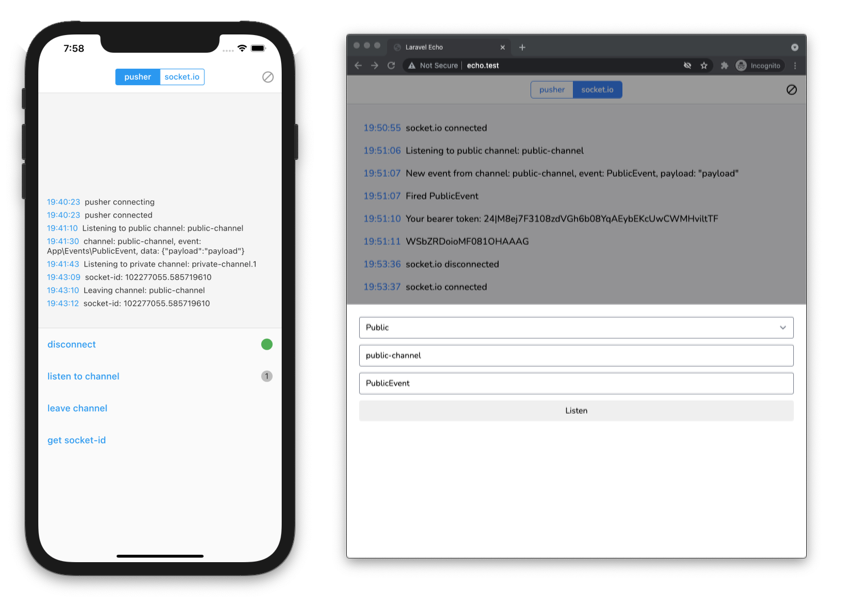
Screenshot

Getting started

Pusher

To use with Pusher, you need to install pusher_client for you Flutter app.

In your pubspec.yaml file:

dependencies:
  ...
  pusher_client: ^2.0.0
  laravel_echo: ^1.0.0

import laravel_echo and pusher_client

import 'package:laravel_echo/laravel_echo.dart';
import 'package:pusher_client/pusher_client.dart';
const String PUSHER_KEY = 'YOUR_PUSHER_KEY_HERE';
const String PUSHER_CLUSTER = 'YOUR_PUSHER_CLUSTER_HERE';
const String BEARER_TOKEN = 'YOUR_BEARER_TOKEN_HERE';
const String AUTH_URL = 'http://echo.test/api/broadcasting/auth';

PusherOptions options = PusherOptions(
  cluster: PUSHER_CLUSTER,
  auth: PusherAuth(
    AUTH_URL,
    headers: {
      'Authorization': 'Bearer $BEARER_TOKEN',
    },
  ),
);

// Create pusher client
PusherClient pusherClient = PusherClient(
  PUSHER_KEY,
  options,
  autoConnect: false,
  enableLogging: true,
);

// Create echo instance
Echo echo = new Echo(
  broadcaster: EchoBroadcasterType.Pusher,
  client: pusherClient,
);

// Listening public channel
echo.channel('public-channel').listen('PublicEvent', (e) {
  print(e);
});

// Accessing pusher instance
echo.connector.pusher.onConnectionStateChange((state) {
  print(state!.currentState.toString());
});
socket.io

To use with socket.io, you need to install socket_io_client for your Flutter app.

In your pubspec.yaml file:

dependencies:
  ...
  socket_io_client: ^1.0.1
  laravel_echo: ^1.0.0

import socket_io_client

import 'package:laravel_echo/laravel_echo.dart';
import 'package:socket_io_client/socket_io_client.dart' as IO;

usage

const String BEARER_TOKEN = 'YOUR_BEARER_TOKEN_HERE';

// Create socket.io client
IO.Socket socket = IO.io(
  'http://localhost:6001',
  IO.OptionBuilder()
      .disableAutoConnect()
      .setTransports(['websocket']).build(),
);

// Create echo instance
Echo echo = new Echo(
  broadcaster: EchoBroadcasterType.SocketIO,
  client: socket,
  options: {
    'auth': {
      'headers': {
        'Authorization': 'Bearer $BEARER_TOKEN',
      }
    },
  },
);

// Listening public channel
echo.channel('public-channel').listen('PublicEvent', (e) {
  print(e);
});

// Listening private channel
// Needs auth. See details how to authorize channel below in guides
echo.private('private-channel').listen('PrivateEvent', (e) {
  print(e);
});

// Listening presence channel
// Needs auth. See details how to authorize channel below in guides
echo.join('presence-channel')
  .here((users) {
    print(users);
  }).joining((user) {
    print(user);
  }).leaving((user) {
    print(user);
  }).listen('PresenceEvent', (e) {
    print(e);
  });

// Accessing socket instance
echo.connector.socket.onConnect((_) => print('connected'));
echo.connector.socket.onDisconnect((_) => print('disconnected'));

Guide

Options
Option Description Default
auth
authEndpoint /api/broadcasting/auth
broadcaster EchoBroadcasterType.Pusher
host Socket host http://localhost:6001
namespace Event namespace App.Events
... Any other options, passed as socket params

Sample backend

Backend used for example app could be found at echo-server

Credits

This package would not be existed without hard work of these awesome devs.

  • @chinloyal - maintainer of pusher_client
  • @rikolu - maintainer of socket_io_client
  • @heywhy - for initial Pusher intagration

Categories

Source repository

Projects using this package

No data available yet.