Package selection guidance compiled from public package information, community data, and project usage.
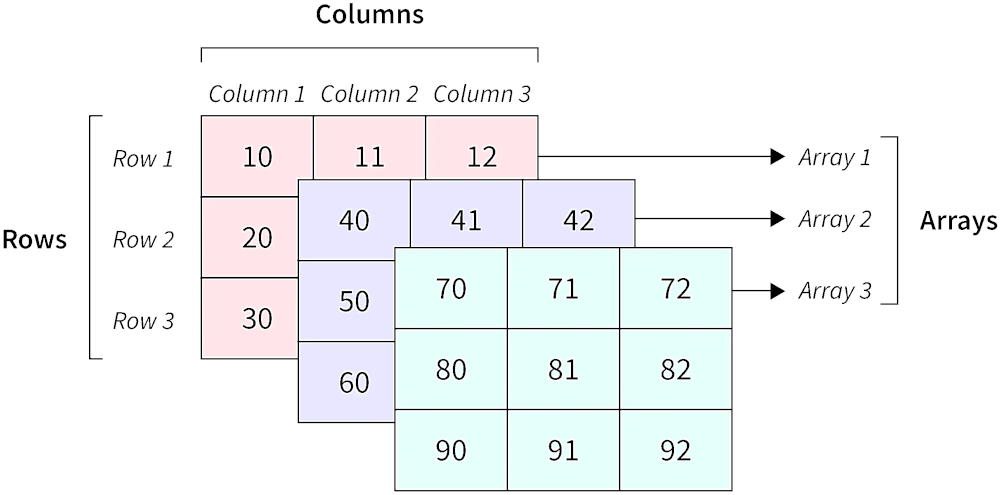
The n_dimensional_array package enables the creation and efficient manipulation of multi-dimensional arrays in Dart, supporting any number of dimensions. It provides a clean, intuitive API for initializing, accessing, and modifying array elements across various platforms. Ideal for mathematical computations, data processing, and scientific applications requiring structured data storage. The package is lightweight and integrates seamlessly with Flutter projects.
Use cases
Scientific computing
Data analysis
Game development
Machine learning preprocessing
Mathematical modeling
Key features
Supports arbitrary dimensions
Efficient element access
Easy initialization syntax
Cross-platform compatibility
Immutable and mutable array variants
Suitable for
Developers working with matrices and tensors
Mathematical algorithm implementation
Applications requiring structured multidimensional data
Considerations
Not optimized for extremely large arrays
Limited built-in mathematical operations
Requires manual handling of array bounds
No built-in serialization support
Original README
Original README snapshot from the linked source repository. Visit the repository for the latest content.
n-Dimensional Array
The n-Dimensional Array package is a powerful tool that empowers Flutter developers to create and work with multi-dimensional arrays. With this package, developers can easily define and manipulate n-dimensional arrays in their applications. This package offers a simple and intuitive interface to handle arrays of various dimensions efficiently.
Installation
In the pubspec.yaml of your flutter project, add the following dependency:
Just like with a normal list in Dart, you cannot add elements beyond the length of the list. For a list, you would use the add() method. Expanding a multi-dimensional list is a bit more complicated; so, the reshape method was created.
// The list from Example 1List myList = [[[1, 2], [3, 4]], [[5, 6], [7, 8]], [[9, 10], [11, 12]]];
NdArray ndArray = NdArray.fromList(myList);
// The current shape is [3, 2, 2]List<int> shape = ndArray.shape;
// Add one more element to the 3rd dimension
ndArray.reshape([3, 2, 3]);
// Note: Since we are only changing the third// dimension, we could alternatively call:// ndArray.reshape([-1, -1, 3]);// The `-1` counts as a placeholder, and the// original shape value is used.// The list now looks like:// [[[1, 2, null], [3, 4, null]], [[5, 6, null], [7, 8, null]], [[9, 10, null], [11, 12, null]]];// Shrink the array down.
ndArray.reshape([1, 1, 2]);
// The list now looks like:// [[[1, 2]]]// Note: The truncated data is lost. Be careful// when shrinking your arrays. Make sure that is// really what you want to do.
Example 3 - Getting and Setting values
You can get or set a value very much like a normal list, where you would call myList[i].
// 2D list is easier to followList myList = [[1, 2], [3, 4]];
NdArray ndArray = NdArray.fromList(myList);
// Some current valuesint value1 = ndArray[0][1]; // 2int value2 = ndArray[1][1]; // 4// Set a value
ndArray[0][1] = 8;
value1 = ndArray[0][1]; // 8// The list now looks like:// [[1, 8], [3, 4]]
Example 4 - Copy
When you use the copy() method, you create a new NdArray that is identical to the original. Any modifications to one does not affect the other.
Note: Any non-primitive data types that use references (like custom objects) might not create new versions of themselves when copied. If this is the case, changes to one of those objects will appear in both NdArrays.
// 2D list is easier to followList myList = [[1, 2], [3, 4]];
NdArray ndArray = NdArray.fromList(myList);
NdArray ndArrayCopy = ndArray.copy();
// Change only the copy
ndArrayCopy[0][0] = 99;
// The lists now look like:// ndArray.data == [[1, 2], [3, 4]]// ndArrayCopy.data == [[99, 2], [3, 4]]
If you found this helpful, please consider donating. Thanks!