Package selection guidance compiled from public package information, community data, and project usage.
The quick_settings package enables Flutter developers to create and manage custom tiles in Android's Quick Settings panel. By integrating with Android's system-level UI, it allows apps to expose quick actions directly from the notification shade. The package handles tile lifecycle events, state management, and interactions, making it easy to build responsive, system-integrated controls. It is specifically designed for Android and requires minimal setup via a simple pub add command. Ideal for productivity, media control, or device management apps needing direct access from the system UI.
Use cases
Adding custom quick actions to Android Quick Settings
Creating media playback controls
Enabling rapid device toggles like Wi-Fi or Bluetooth
Integrating app-specific shortcuts into system UI
Building productivity tools with instant access
Key features
Custom tile creation for Android Quick Settings
Lifecycle event handling for tiles
Simple integration with Flutter apps
Supports state persistence across reboots
Built-in tile interaction callbacks
Suitable for
Android-focused Flutter apps
Apps needing system-level quick access
Developers building utility or media apps
Teams targeting Android system integrations
Projects requiring low-latency user interactions
Considerations
Only works on Android platforms
Requires Android SDK 21+
Needs proper manifest configuration
Limited to Android Quick Settings only
May require user permission for some tile types
Original README
Original README snapshot from the linked source repository. Visit the repository for the latest content.
Quick Settings
This Flutter plugin lets you create and react to your own custom tile in the Android Quick Settings panel.
⚠️ This plugin features only work on Android ⚠️
On other platforms, it does nothing.
All of the following features are available directly from your Dart code:
Ask the user to add your custom tile
Handle clicks on your tile even when your app has been killed
React to user addition or removal of your tile
Using this plugin below Android 7.0 will have no effect.
The callbacks onTileClicked, onTileAdded and onTileRemovedmust be defined as top-level functions.
⚠️ They should also be annotated with @pragma("vm:entry-point") to avoid being tree-shaken by the Dart compiler in release mode.
See more details here.
After being setup, these callbacks will be called even if your app is not running.
If none of them is provided, your Tile and its associated service are disabled.
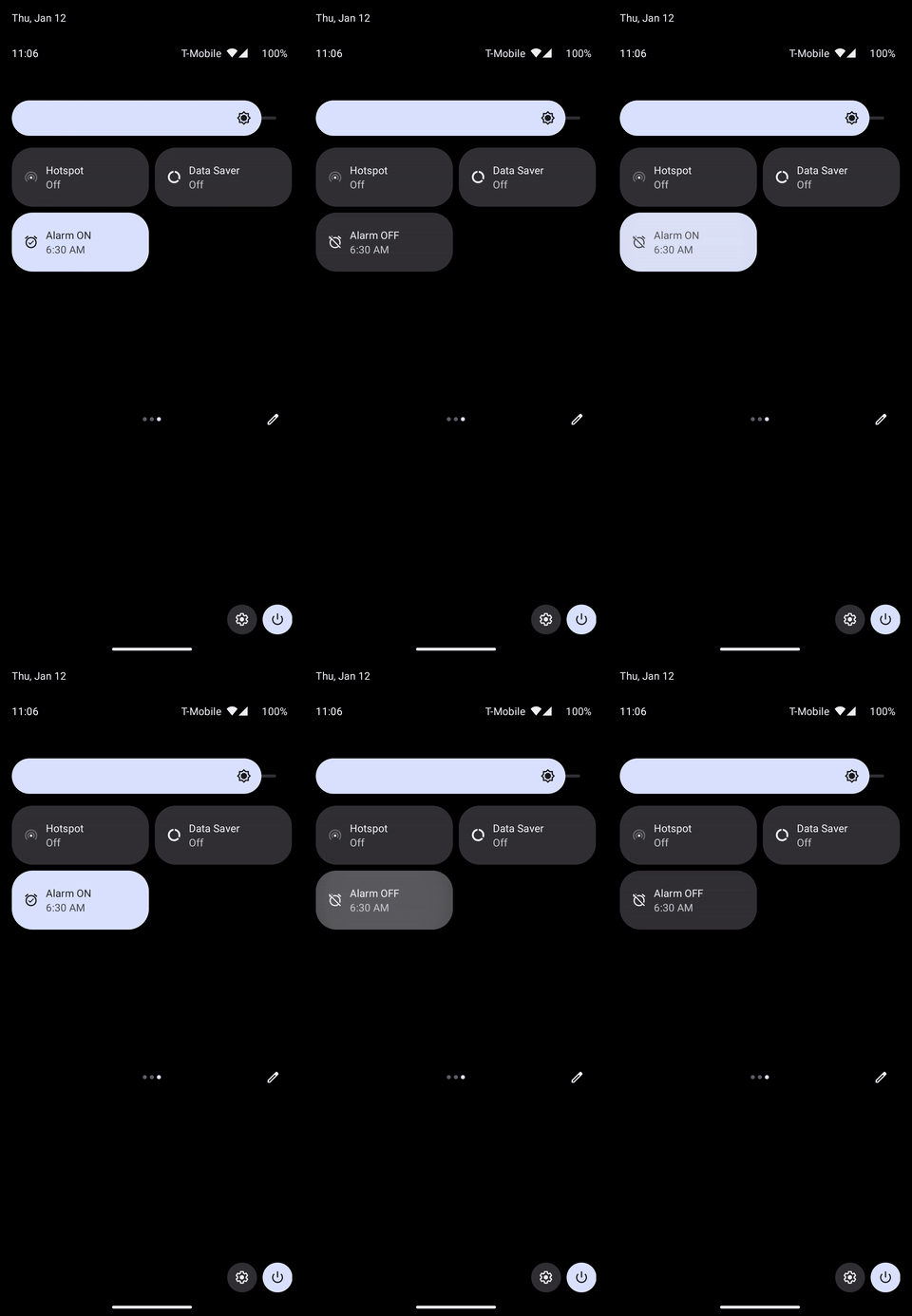
onTileClicked is triggered when your tile is clicked:
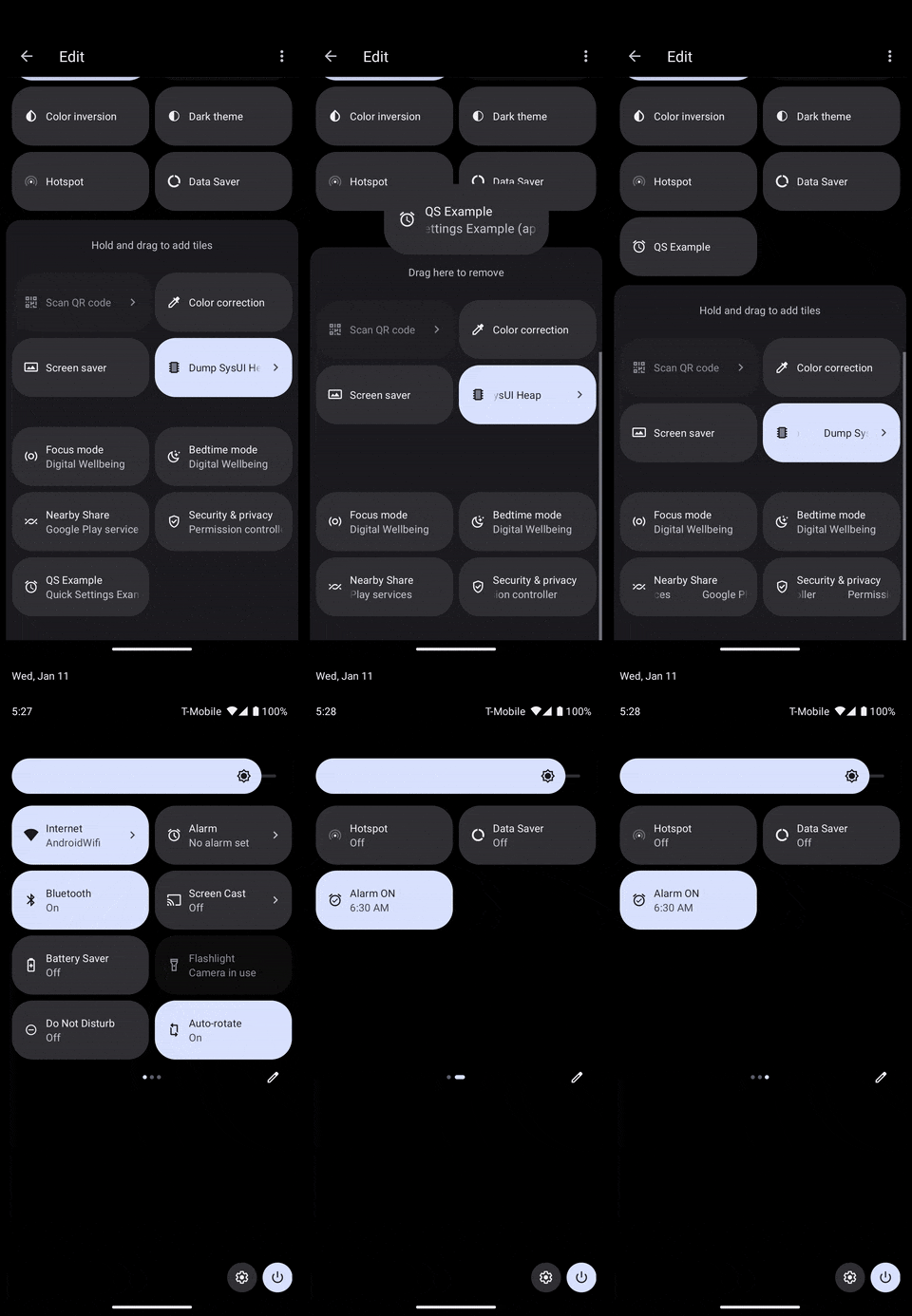
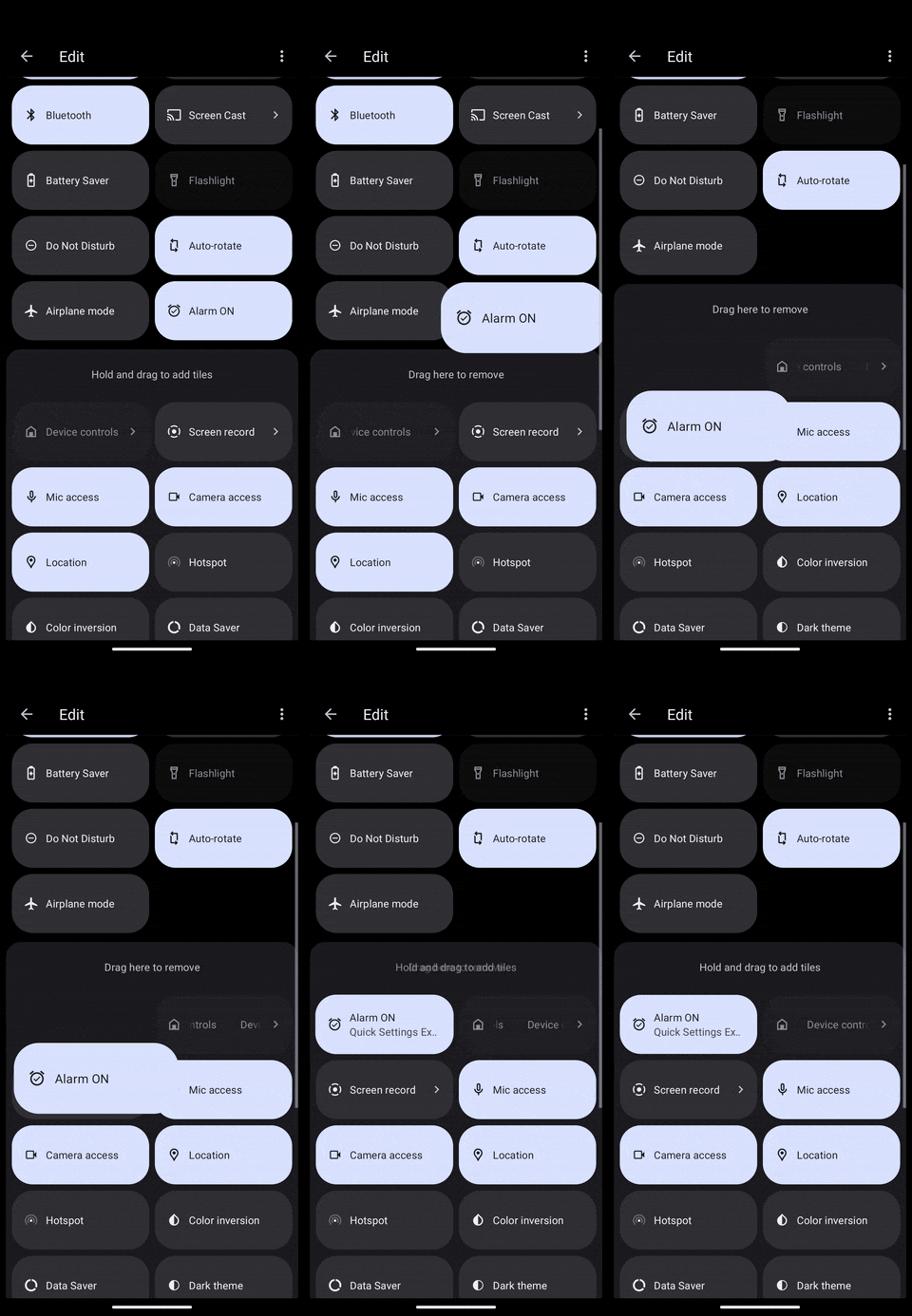
onTileAdded is triggered when your tile is added to the active Quick Settings tiles:
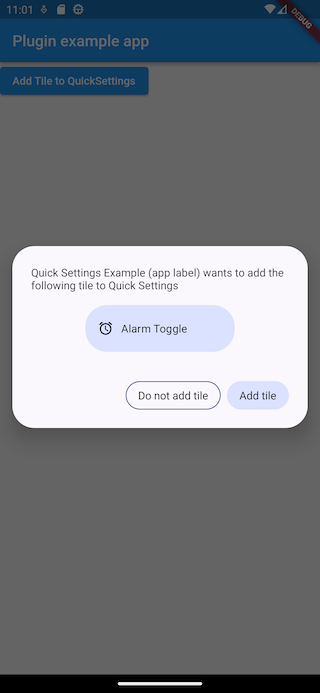
It can either be triggered by the user when they interact with the system UI like above, or from a call to QuickSettings.addTileToQuickSettings() in your app.
onTileRemoved is triggered when your tile is removed from the active Quick Settings tiles:
Let's see details on each of these callbacks.
Tile clicks
Clicks are handled with an OnTileClicked callback defined as below:
typedefOnTileClicked = Tile? Function(Tile tile);
The tile passed as parameter can let you decide what action to do depending on its TileStatus for instance.
Here is a concrete implementation:
In a more realistic scenario, you would probably fetch the current status of the alarm and update the Tile with either an active status if it is set or an inactive status otherwise.
You could also display the current hour of the alarm.
⚠️ onTileAdded should be a top-level function annotated with @pragma("vm:entry-point").
Tile removed
You also get an occasion to react to Tile removal. However, you can't return an updated Tile as with the other callbacks since it can't be updated at that moment.
Here is the callback definition:
If the user already has the Tile, this method has no effect.
The system might automatically deny if the user has already denied it several times.
Before Android 13, this has no effect.
QuickSettings.addTileToQuickSettings() returns an AddTileResult with a success parameter, but it is not reliable since the Android implementation's callback is not.
It will be mostly useful to know if your drawable has been correctly parsed by the plugin or not.
Customizing the default tile in the system UI
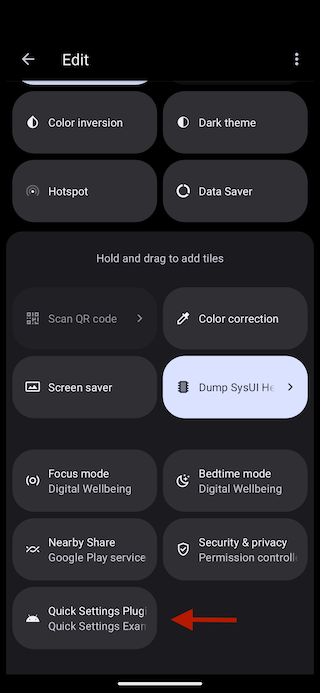
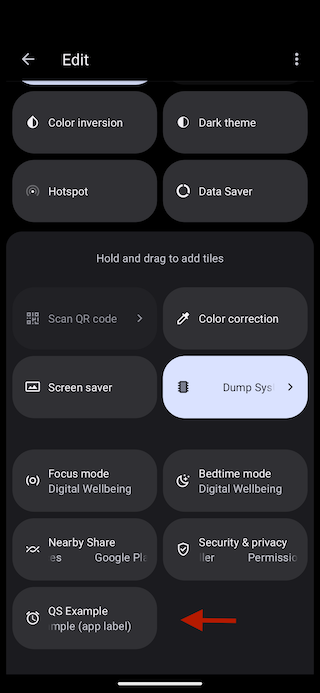
Your Tile will appear in the list of Quick Settings tiles with the following default appearance:
There are 3 elements displayed: a title, a subtitle and an icon.
To customize the title, you must override quick_settings_base_label in your Android resources.
If you don't have one, create the file /android/app/src/main/res/values/strings.xml and add the quick_settings_base_label String:
<?xml version="1.0" encoding="utf-8"?><resources><!-- Other resources --><stringname="quick_settings_base_label">QS Example</string></resources>
The subtitle is the android:label from your application's manifest.
You can find it at /android/app/src/main/AndroidManifest.xml.
<manifestxmlns:android="http://schemas.android.com/apk/res/android"package="io.apparence.quick_settings_example"><applicationandroid:label="Quick Settings Example (app label)"android:name="${applicationName}"android:icon="@mipmap/ic_launcher"><!-- Other elements --></application></manifest>
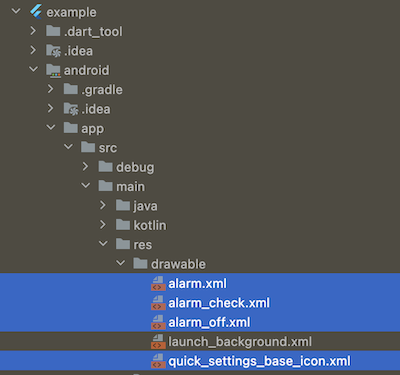
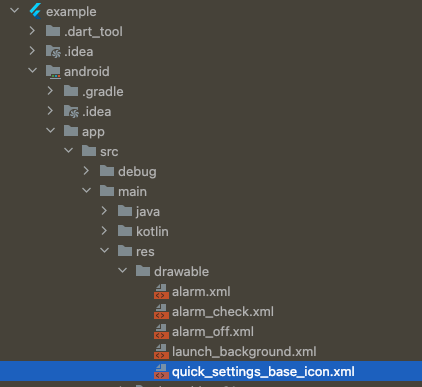
The default icon can also be overridden by providing your own drawable with the name quick_settings_base_icon.xml as it is done in the example project.
Here is the customized appearance:
Roadmap
If you are using this plugin and would like something added, please create an issue.