Package selection guidance compiled from public package information, community data, and project usage.
Updat is a straightforward and reliable Flutter-native package designed to manage application updates across multiple platforms. It simplifies the process of checking for, downloading, and applying updates seamlessly within Flutter apps. Built with ease of integration in mind, Updat supports Android, iOS, macOS, Windows, and Linux, making it ideal for cross-platform applications that require robust update mechanisms. The package handles background downloads, version comparisons, and automatic restarts after updates, ensuring a smooth user experience. Its lightweight design and clear API make it accessible for developers of all levels.
Use cases
Automating app updates in cross-platform Flutter apps
Handling silent background updates on desktop and mobile
Enabling automatic restart after update installation
Managing update checks on startup or scheduled intervals
Providing fallback mechanisms during failed update attempts
Key features
Cross-platform support (Android, iOS, macOS, Windows, Linux)
Simple integration with minimal boilerplate
Background update downloads and installation
Automatic app restart after update
Version comparison and update detection
Suitable for
Developers building cross-platform Flutter apps
Teams needing reliable auto-updating features
Apps requiring seamless update experiences on desktop and mobile
Projects where minimizing user intervention in updates is critical
Applications targeting users in environments with limited technical knowledge
Considerations
Requires proper server-side setup for update manifests
May need custom logic for handling update rollbacks
Not suitable for apps requiring complex update workflows
Limited customization for update UI/UX without additional code
Depends on external update metadata hosted on a server
Original README
Original README snapshot from the linked source repository. Visit the repository for the latest content.
Updat - The simple-to-use, flutter-based desktop update package
Updat is a simple-to-use reliable flutter-native updater that handles your application's updates. All you need is a place to host your files and a place to check for the latest version.
Demo
Installing
To get started simply type flutter pub add updat in your terminal.
🎉 Done, It's that simple.
Getting Started
Integration with your app requires just a few lines of code, add the following widget wherever you want your updat widget to be:
UpdatWidget(
currentVersion: "1.0.0",
getLatestVersion: () async {
// Here you should fetch the latest version. It must be semantic versioning for update detection to work properly.return"1.0.1";
},
getBinaryUrl: (latestVersion) async {
// Here you provide the link to the binary the user should download. Make sure it is the correct one for the platform!return"https://github.com/latest/release/bin.exe";
},
// Lastly, enter your app name so we know what to call your files.
appName: "Updat Example",
),
That should get you up and running in just a few seconds ⚡️.
or use the UpdatWindowManager, and let updat handle everything on autopilot. Just place it right after your MaterialApp.
Required. Must be a semantic version. This is the current package's version.
N/A
getLatestVersion
Future<String>
Required. Must be a semantic version. This should request the latest version to the server
N/A
getBinaryUrl
Future<String>
Required. This should provide the link download the binary for a certain app version. Arguments: latestVersion
N/A
appNme
String
Required. The Application's name. It is used to name the binaries when downloading.
N/A
getChangelog
Future<String>
This will render a plain text view of the changelog.
N/A
callback
void Function(UpdatStatus)
A callback that is called when the UpdatStatus gets updated.
N/A
controller
UpdatController
Optional controller for programmatic update checks and actions.
N/A
getDownloadFileLocation
Future<File>
Choose where to download the update.
N/A
updateChipBuilder
Widget Function(...)
Overrides the default update chip.
N/A
updateDialogBuilder
Widget Function(...)
Overrides the default update dialog.
N/A
openOnDownload
bool
Whether Updat should open the installer automatically once it has been downloaded.
true
closeOnInstall
bool
Whether Updat should close the application automatically once it has been downloaded.
false
Theming
Updat is extremely easy to theme. We also use updateChipBuilder and updateDialogBuilder internally to design our widgets, so you have the same customizability we do. We provide a couple of themes to get you started.
To change the theme simply add the desired theme to the builder and you're set.
Chips
defaultChip which is an elevatedButton that only shows when an update is available. Shown by default.
defaultChipWithCheckFor which is an elevatedButton that shows under all conditions, allowing to recheck for updates.
defaultChipWithSilentDownload which is an elevatedButton that only shows when an update is downloaded and ready to install.
flatChip which is an textButton that only shows when an update is available
flatChipWithCheckFor which is an textButton that shows under all condition, allowing to recheck for updates.
flatChipWithSilentDownload which is an textButton that only shows when an update is downloaded and ready to install.
floatingExtendedChip which is a compact version of the dialog, which is a bit bigger and grabs user's attention more easily.
floatingExtendedChipWithSilentDownload which is a compact version of the dialog, which is a bit bigger and grabs user's attention more easily, and only shows when the update is ready to be installed.
Dialogs
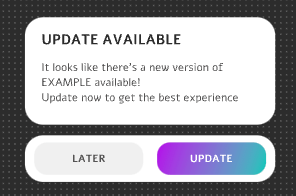
defaultDialog which is the default, M2 and M3 dialog that shows by default.
Programmatic update checks
Use an UpdatController to re-check for updates after the initial check completes — for example when your backend signals a new release via push notification or websocket:
final updatController = UpdatController();
UpdatWindowManager(
controller: updatController,
// ...
)
// Later, when your backend alerts the user:await updatController.checkForUpdate(notifyIfAvailable: true);
The *WithCheckFor chip themes also expose a UI button to recheck manually.
Advanced Usage
If you need to send additional HTTP headers when downloading a release asset, you may define your
headers by setting the downloadReleaseHeaders property of UpdatGlobalOptions, you should probably do this in the main function of your code.