Package selection guidance compiled from public package information, community data, and project usage.
The variable_app_icon package enables developers to dynamically change an app's icon on both Android and iOS platforms. It allows users to switch between multiple icons at runtime, enhancing personalization and branding flexibility. This is particularly useful for apps that want to reflect different themes, events, or user preferences through their icon. The plugin integrates seamlessly with Flutter projects and supports platform-specific icon configurations. It requires minimal setup and works with standard asset management practices.
Use cases
Dynamic icon switching based on user preference
Themed app icons for special events
Branding customization in multi-tenant apps
Personalized app experiences
Icon changes during app lifecycle
Key features
Supports Android and iOS
Runtime icon switching
Easy integration with Flutter
Multiple icon support
Platform-specific configuration
Suitable for
Apps needing icon personalization
Event-based or seasonal app themes
Branded applications
User-centric design apps
Developers targeting both iOS and Android
Considerations
Requires manual icon asset setup
Limited to supported platforms
May need additional build steps
Not suitable for all app stores due to policy restrictions
Icon changes may not reflect immediately on some devices
Original README
Original README snapshot from the linked source repository. Visit the repository for the latest content.
variable_app_icon
A plugin to use multiple app icon on Android and iOS.
If you don't know yet, you can use multiple app icon in an iOS app from 10.3. in android, you can do this using activity-alias. You can accomplish
this in your flutter app by using this plugin
Getting Started
First, add variable_app_icon as a dependency in your pubspec.yaml file.
dependencies:variable_app_icon:^0.0.1
Don't forget to flutter pub get.
Usage
1. Setting the app icons (Android)
Drop your app icons into mipmap folders. Then configure android/app/src/main/AndroidManifest.xml as follows.
Why this layout? Activity-aliases are how Android serves multiple launcher icons from one APK, but two known issues require extra care:
Flutter's tooling does not properly follow <activity-alias> for flutter run (flutter/flutter#38965). To make flutter run work, MainActivity must declare android:exported="true" (Android 12+ rule, since it is reachable from adb shell am start) and carry a MAIN + LAUNCHER intent-filter in the source manifest. The LAUNCHER category is then stripped at merge time via tools:node="remove" so MainActivity does not appear as a duplicate launcher icon next to the aliases at runtime.
Some OEM launchers (e.g. Huawei) read app metadata from <application> for the uninstall prompt and system dialogs — see issue #5. Keep android:icon and android:label on <application>.
Use this template (replace your_app_name / mipmap names / activity-alias ids as needed):
<manifestxmlns:android="http://schemas.android.com/apk/res/android"xmlns:tools="http://schemas.android.com/tools"><applicationandroid:name="${applicationName}"android:icon="@mipmap/ic_launcher"android:label="your_app_name"><!-- One activity-alias per selectable icon. The id (android:name) must contain at least one dot. --><activity-aliasandroid:name="appicon.DEFAULT"android:enabled="true"android:exported="true"android:icon="@mipmap/ic_launcher"android:label="your_app_name"android:targetActivity=".MainActivity"><intent-filter><actionandroid:name="android.intent.action.MAIN" /><categoryandroid:name="android.intent.category.LAUNCHER" /></intent-filter></activity-alias><!-- Repeat <activity-alias> for each additional icon, with android:enabled="false". --><activityandroid:name=".MainActivity"android:exported="true"android:launchMode="singleTop"android:taskAffinity=""android:theme="@style/LaunchTheme"android:configChanges="orientation|keyboardHidden|keyboard|screenSize|smallestScreenSize|locale|layoutDirection|fontScale|screenLayout|density|uiMode"android:hardwareAccelerated="true"android:windowSoftInputMode="adjustResize"><meta-dataandroid:name="io.flutter.embedding.android.NormalTheme"android:resource="@style/NormalTheme" /><!-- This intent-filter makes `flutter run` work with the activity-alias setup
(flutter/flutter#38965). Flutter's launchable-activity detection reads the
source manifest and needs MainActivity to declare MAIN + LAUNCHER; without
it, `flutter run` cannot locate MainActivity as launchable. If LAUNCHER
survived to runtime, however, MainActivity would appear as a duplicate
launcher icon next to the activity-aliases. `tools:node="remove"` strips
LAUNCHER at manifest-merge time, satisfying both constraints. --><intent-filter><actionandroid:name="android.intent.action.MAIN" /><categoryandroid:name="android.intent.category.LAUNCHER"tools:node="remove" /></intent-filter></activity><meta-dataandroid:name="flutterEmbedding"android:value="2" /></application></manifest>
Notes per icon:
android:name is the icon id (must contain at least one dot — e.g. appicon.DEFAULT, appicon.TEAL). You pass this id from Dart when calling VariableAppIcon.changeAppIcon.
android:enabled="true" on the default icon's alias, android:enabled="false" on the rest.
See example/android/app/src/main/AndroidManifest.xml in this repo for a complete working example with three icons.
2. Setting the app icons (iOS)
Open your ios project i.e. Runner in Xcode, then go to Build Settings tab.
Now search icon, you will find Assets Catalog Compiler Options. Set Include All App Icon
Assets to Yes.
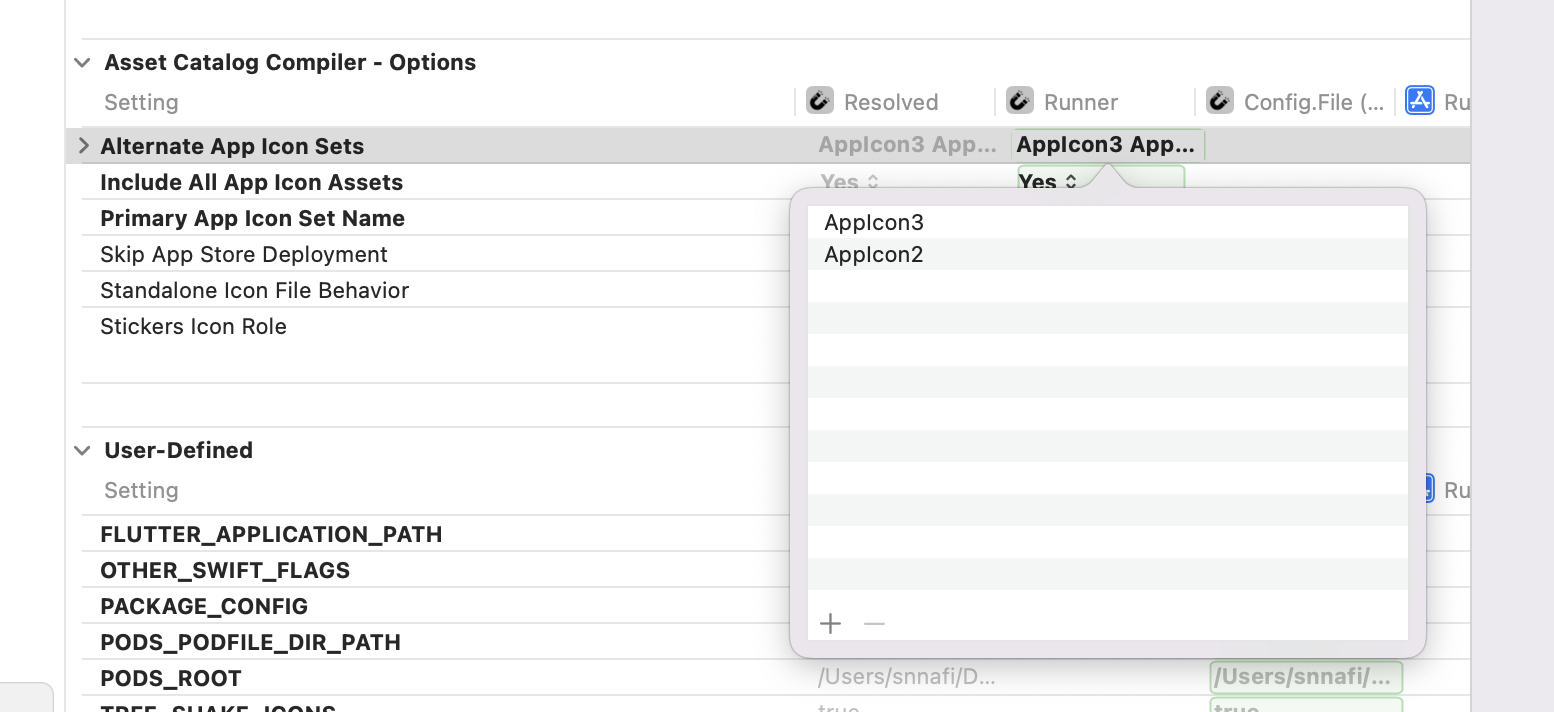
Then add all the icons name to the Alternate App Icon Sets.
3. From the flutter side
In main function set this two variable,
VariableAppIcon.iOSDefaultAppIcon = iosAppIcons[0]; // default ios iconVariableAppIcon.androidAppIconIds = androidIconIds; // all android icons ids, this is the android:name, you have specified in `AndroidManifest.xml` file. like, ["appicon.DEFAULT", others]

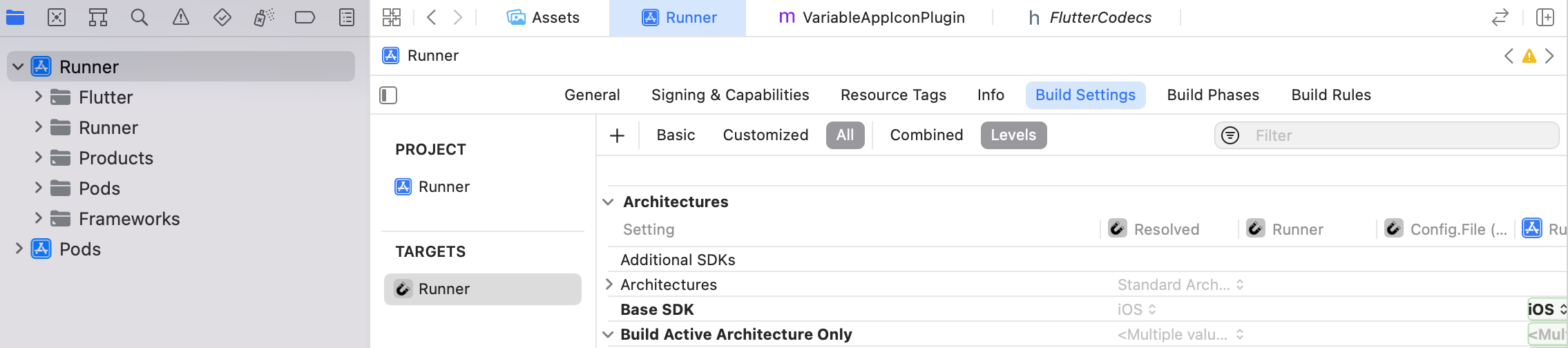 Now search icon, you will find Assets Catalog Compiler Options. Set Include All App Icon
Assets to Yes.
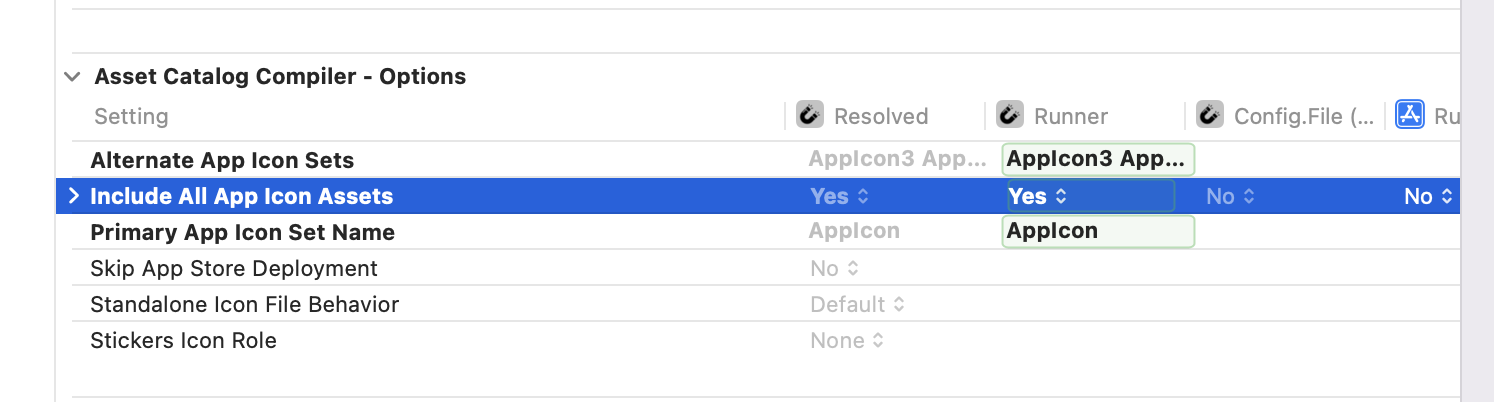 Then add all the icons name to the Alternate App Icon Sets.