Search packages, repositories and app categories

Package detailsv0.7.6

vm_snapshot_analysis

Utilities for analysing AOT snapshot size.

AndroidiOSWebmacOSWindowsLinux
30-day downloads
9.7M
Likes
10
Pub points
140

Install package

flutter pub add vm_snapshot_analysis

Package Overview

Package selection guidance compiled from public package information, community data, and project usage.

The vm_snapshot_analysis package provides tools to examine the size and composition of AOT (Ahead-of-Time) snapshots in Flutter applications. It helps developers understand how code and assets contribute to the final app size, enabling optimization by identifying large or redundant components. This is particularly useful during performance tuning and app size reduction efforts. The analysis supports multiple platforms including Android, iOS, Web, macOS, Windows, and Linux, making it a versatile debugging aid for cross-platform Flutter projects.

Use cases

  • Optimizing app bundle size
  • Identifying large code contributions
  • Debugging unexpected size growth
  • Analyzing AOT compilation output
  • Performance profiling
  • Cross-platform size comparison

Key features

  • Detailed snapshot size breakdown
  • Platform-agnostic analysis
  • Integration with Flutter build process
  • Support for multiple target platforms
  • Output in human-readable formats
  • Focus on AOT compilation efficiency

Suitable for

  • Flutter developers focused on app size
  • Performance engineers
  • Build optimization teams
  • Cross-platform app maintainers
  • DevOps engineers managing release pipelines

Considerations

  • Requires AOT snapshot files
  • Limited to static analysis
  • Not suitable for runtime profiling
  • May require additional setup for CI/CD
  • Best used post-build
  • Does not modify code or assets

Original README

Original README snapshot from the linked source repository. Visit the repository for the latest content.

Dart

An approachable, portable, and productive language for high-quality apps on any platform

Dart is:

  • Approachable: Develop with a strongly typed programming language that is consistent, concise, and offers modern language features like null safety and patterns.

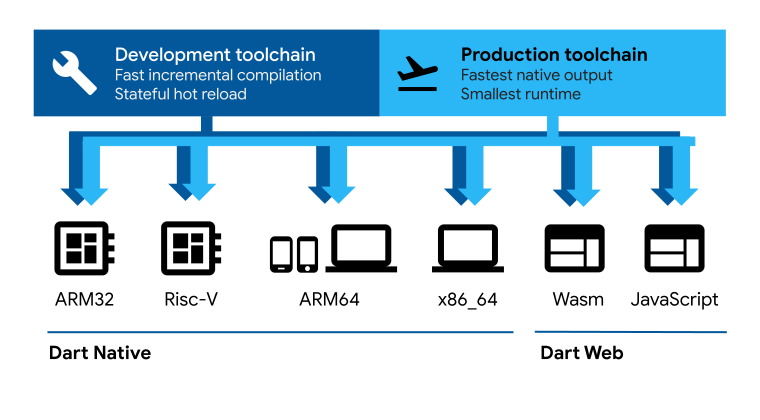
  • Portable: Compile to ARM, x64, or RISC-V machine code for mobile, desktop, and backend. Compile to JavaScript or WebAssembly for the web.

  • Productive: Make changes iteratively: use hot reload to see the result instantly in your running app. Diagnose app issues using DevTools.

Dart's flexible compiler technology lets you run Dart code in different ways, depending on your target platform and goals:

  • Dart Native: For programs targeting devices (mobile, desktop, server, and more), Dart Native includes both a Dart VM with JIT (just-in-time) compilation and an AOT (ahead-of-time) compiler for producing machine code.

  • Dart Web: For programs targeting the web, Dart Web includes both a development time compiler (dartdevc) and a production time compiler (dart2js).

Dart platforms illustration

License & patents

Dart is free and open source.

See LICENSE and PATENT_GRANT.

Using Dart

Visit dart.dev to learn more about the language, tools, and to find codelabs.

Browse pub.dev for more packages and libraries contributed by the community and the Dart team.

Our API reference documentation is published at api.dart.dev, based on the stable release. (We also publish docs from our beta and dev channels, as well as from the primary development branch).

Building Dart

If you want to build Dart yourself, here is a guide to getting the source, preparing your machine to build the SDK, and building.

There are more documents in our repo at docs.

Contributing to Dart

The easiest way to contribute to Dart is to file issues.

You can also contribute patches, as described in Contributing.

Roadmap

Future plans for Dart are included in the combined Dart and Flutter roadmap on the Flutter wiki.

Categories

Dependencies

Dependency list 3 items

Source repository

Projects using this package