Package selection guidance compiled from public package information, community data, and project usage.
VoiceNoteKit is a modern Flutter package designed for recording and playing voice notes with customizable UI, sound effects, and gesture support. It offers a seamless audio experience across Android, iOS, Web, and macOS platforms. Developers can easily integrate intuitive recording controls and playback features into their apps with minimal setup. The package supports real-time feedback through sound effects and responsive gestures, enhancing user interaction. Ideal for productivity, journaling, or communication apps requiring voice input.
Use cases
Voice memo applications
Journaling apps with audio entries
Communication tools with voice notes
Educational apps for student recordings
Productivity apps with quick voice capture
Key features
Customizable UI components
Built-in sound effects for recording
Gesture-based recording controls
Cross-platform compatibility
Real-time audio feedback
Simple integration with Flutter apps
Suitable for
Developers building audio-centric apps
Teams creating note-taking or messaging apps
Apps requiring lightweight voice recording
Designers wanting flexible UI customization
Projects targeting multiple platforms
Considerations
Requires microphone permissions on mobile platforms
Web support may have limited audio features
Sound effects may increase app size
Gesture sensitivity may need tuning for different devices
Original README snapshot from the linked source repository. Visit the repository for the latest content.
voice_note_kit
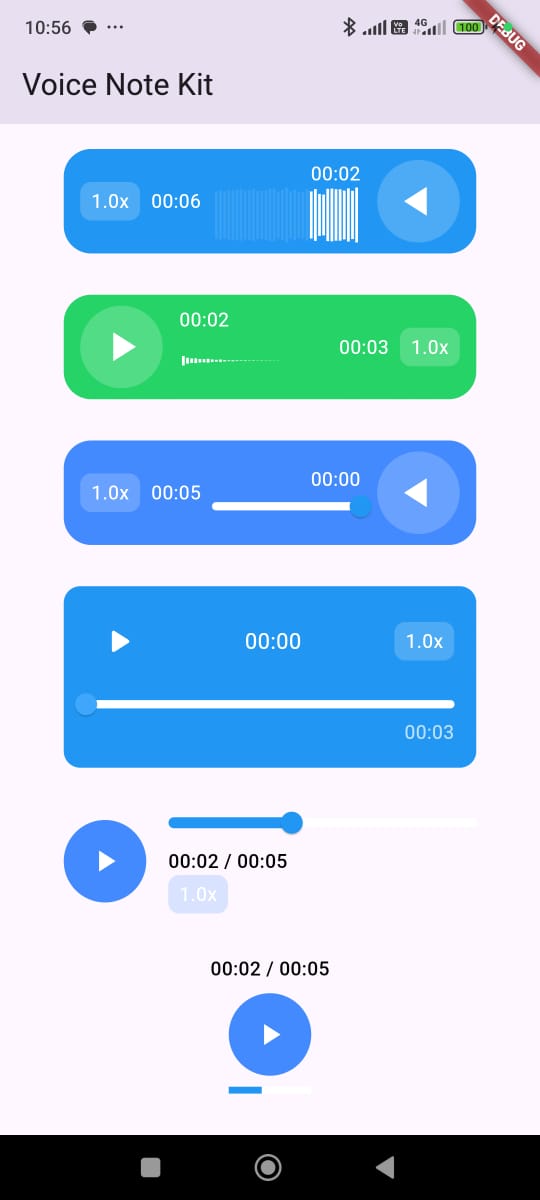
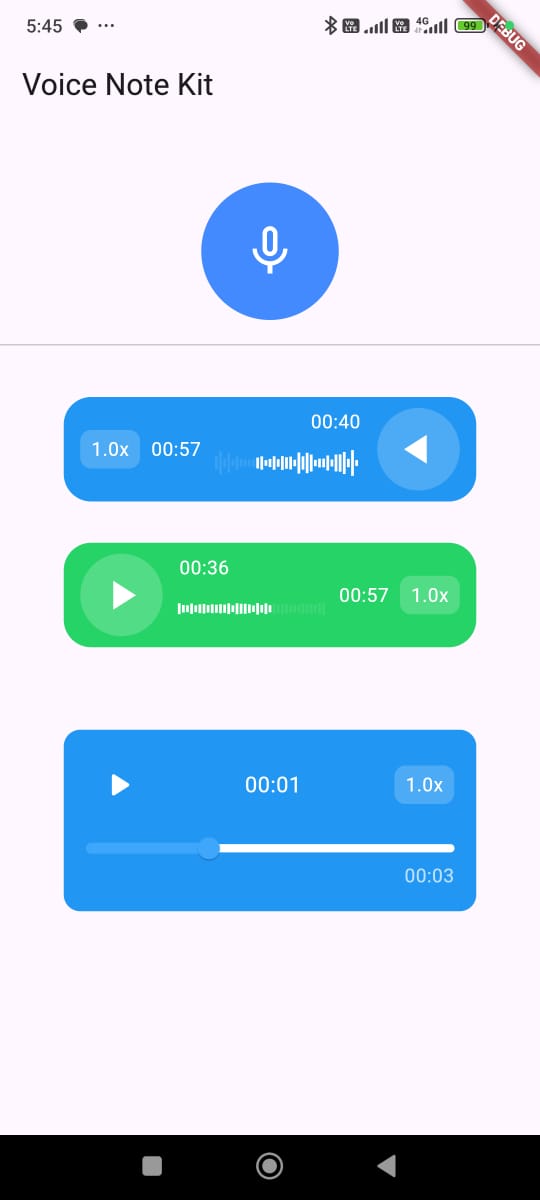
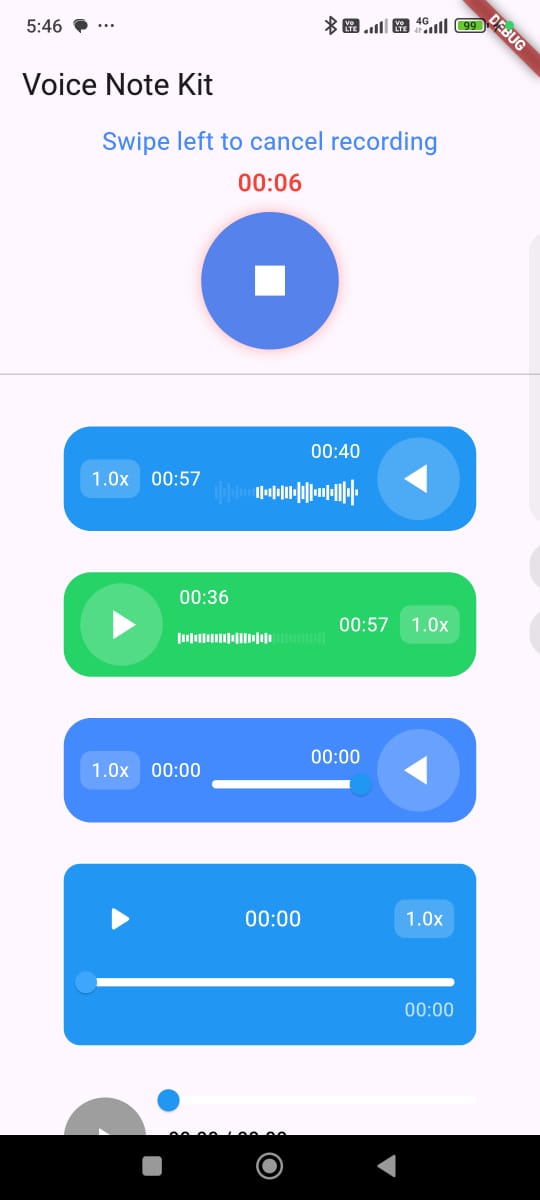
🎙️ Voice Note Kit is a Flutter plugin that allows you to record, save, and play voice notes with waveform visualization. It's built for mobile apps needing voice features like audio memos, task recordings, and more.
🎤 Record audio: Capture high-quality audio using the device's microphone.
💾 Save audio files locally: Store audio files locally on the device for later use.
🔊 Play recorded audio: Easily play back the recorded audio with built-in controls.
📈 Waveform visualization: Display a dynamic waveform using just_waveform for a visual representation of the audio.
🔁 Playback controls: Play, pause, resume, and stop recorded audio seamlessly.
🔐 Permissions management: Automatically handles permissions for recording audio and accessing the microphone using permission_handler.
🎨 Multiple audio player styles: Choose from various customizable player styles to fit the app’s theme and user interface.
🚀 Easy usage: Simple plug-and-play integration with minimal setup required, designed for seamless use in Flutter apps.
🏃♂️ Adjustable playback speed: Set the playback speed to multiple values (e.g., 0.5x, 1.0x, 1.5x, 2.0x, etc.) to suit the user’s preference for fast-forwarding or slowing down the audio.
🔧 Customizable UI components: Tailor the look and feel of the recorder and player with configurable options for icon sizes, colors, button shapes, and more.
Getting Started
Add dependency:
In your pubspec.yaml:
dependencies:voice_note_kit:^1.2.0
Install Package In your project:
flutter pub get
Android Configuration: In your AndroidManifest.xml:
<uses-permissionandroid:name="android.permission.RECORD_AUDIO" /><!-- Optional: Add this permission if you want to use bluetooth telephony device like headset/earbuds --><uses-permissionandroid:name="android.permission.MODIFY_AUDIO_SETTINGS" /><!-- Optional: Add this permission if you want to save your recordings in public folders --><uses-permissionandroid:name="android.permission.WRITE_EXTERNAL_STORAGE" />
in /android/app/build.gradle
minSdk = 23// Prefered
compileSdk = 35
iOS Configuration: In your iOS Info.plist, add:
<key>NSMicrophoneUsageDescription</key>
<string>This app needs access to the microphone to record audio.</string>
In Your Podfile
platform :ios, '12.0'
post_install do |installer|
  installer.pods_project.targets.each do |target|
    flutter_additional_ios_build_settings(target)
    target.build_configurations.each do |config|
      config.build_settings['GCC_PREPROCESSOR_DEFINITIONS'] ||= [
        '$(inherited)',
        'PERMISSION_MICROPHONE=1',
      ]
    end
  end
end
Macos Configuration: In your Macos Info.plist, add:
<key>NSMicrophoneUsageDescription</key>
<string>This app needs access to the microphone to record audio.</string>
In Your Podfile
platform :osx, '10.15'
Open your macos/Runner/DebugProfile.entitlements and macos/Runner/Release.entitlements files.
AudioPlayerWidget(
        autoPlay: false, // Whether to automatically start playback when the widget builds
        autoLoad: true, // Whether to preload the audio before the user presses play
        audioPath:
            "https://commondatastorage.googleapis.com/codeskulptor-demos/riceracer_assets/fx/engine-10.ogg", // The path or URL of the audio file
        audioType: AudioType.url, // Specifies if the audio is from a URL, asset, , file , or blobforWeb(for flutter web)
        playerStyle: PlayerStyle.style5, // The visual style of the player (you can choose between different predefined styles)
        textDirection: TextDirection.rtl, // Text direction for RTL or LTR languages
        size: 60, // Size of the play/pause button
        progressBarHeight: 5, // Height of the progress bar
        backgroundColor: Colors.blue, // Background color of the widget
        progressBarColor: Colors.blue, // Color of the progress bar (played portion)
        progressBarBackgroundColor: Colors.white, // Background color of the progress bar
        iconColor: Colors.white, // Color of the play/pause icon
        shapeType: PlayIconShapeType.circular, // Shape of the play/pause button (e.g., circular or square)
        showProgressBar: true, // Whether to show the progress bar
        showTimer: true, // Whether to display the current time/duration
        width: 300, // Width of the whole audio player widget
        audioSpeeds: const [0.5, 1.0, 1.5, 2.0, 3.0], // Supported audio playback speeds
        onSeek: (value) => print('Seeked to: $value'), // Callback when user seeks to a new position
        onError: (message) => print('Error: $message'), // Callback when an error occurs
        onPause: () => print("Paused"), // Callback when audio is paused
        onPlay: (isPlaying) => print("Playing: $isPlaying"), // Callback when audio starts or resumes playing
        onSpeedChange: (speed) => print("Speed: $speed"), // Callback when playback speed is changed
),
// If You Want to User Controller For The PlayerlatefinalVoiceNotePlayerController playerController;
@overridevoidinitState() {
playerController = VoiceNotePlayerController();
super.initState();
}
@overridevoiddispose() {
playerController.dispose();
super.dispose();
}
// Play the audio from the current position
playerController.play();
// Pause the audio playback
playerController.pause();
// Set the playback speed. Accepts a double value (e.g., 1.0 for normal speed, 1.5 for 1.5x speed)
playerController.setSpeed(1.5);
// Seek to a specific position in the audio. The value should be between 0 and 1, where 0 represents the beginning of the audio and 1 represents the end.
playerController.seekTo(0.2); // Seeks to 20% of the audio's total duration
This package uses (You do not have to import them):
just_audio:
just_waveform:
record:
path_provider:
permission_handler:
http:
About the Developer
Hello! 👋 I'm Abdallah Yassein, a Senior Flutter Developer with extensive experience in building high-quality mobile applications. I specialize in using clean architecture and native integrations to create scalable and efficient solutions with Flutter.
In addition to my development work, I am also a content creator and educator. I run a YouTube channel where I share in-depth Flutter tutorials in Arabic, helping developers across the Middle East enhance their skills and advance their careers in mobile app development.
I am also excited to offer an in-depth Flutter course on Udemy, designed to guide complete beginners to becoming job-ready Flutter developers. This course covers the fundamentals and best practices to help you build professional-quality Flutter apps.
Feel free to explore my YouTube channel and Udemy course for Flutter development tips, advanced topics, and step-by-step tutorials. Don’t forget to subscribe and enroll to continue your learning journey!