Search packages, repositories and app categories

page_transition cover
Package detailsv2.2.2

page_transition

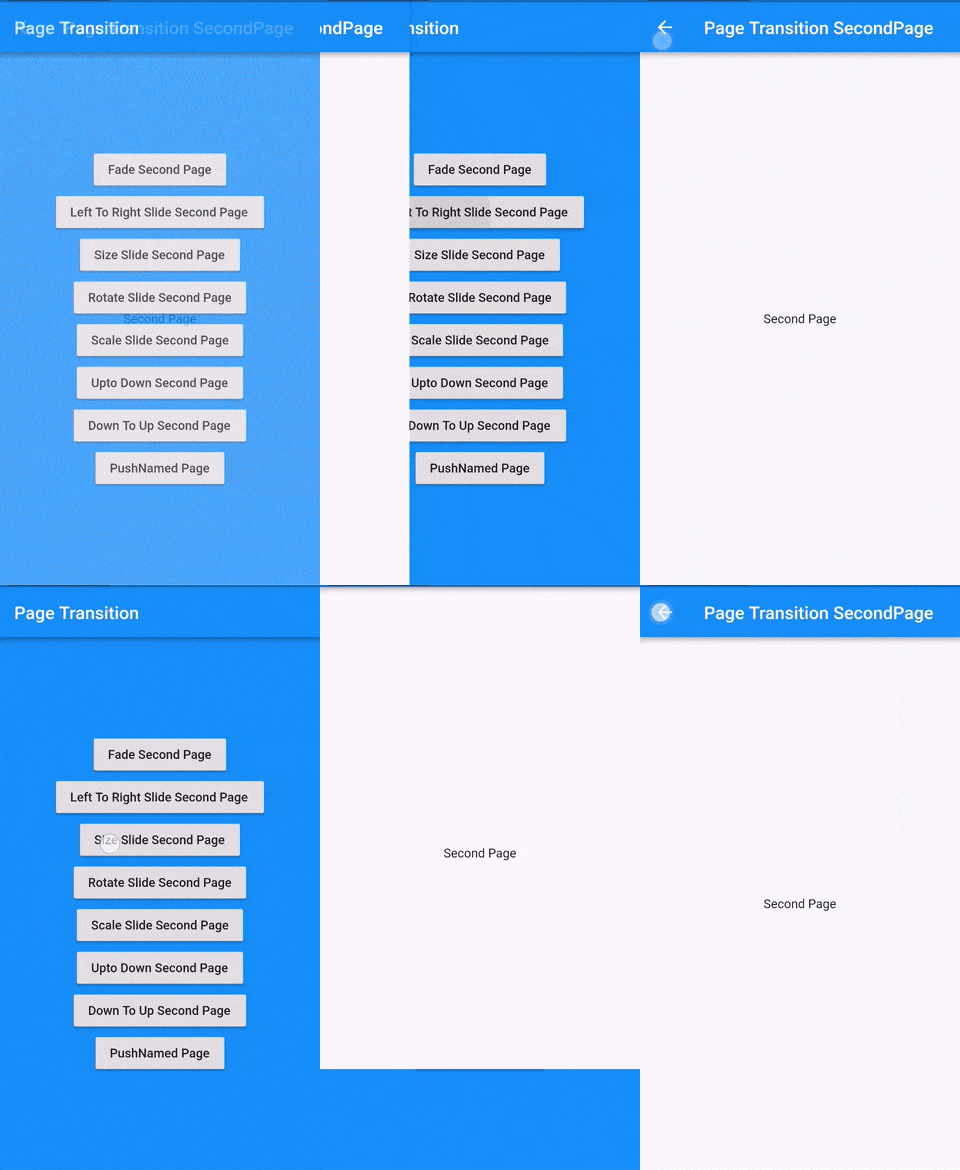
Flutter Page Transition Package which is the transition second page

AndroidiOSWebmacOSWindowsLinux
30-day downloads
463K
Likes
1.6K
Pub points
150

Install package

flutter pub add page_transition

Package Overview

Package selection guidance compiled from public package information, community data, and project usage.

The page_transition package enhances Flutter applications with smooth and customizable page transitions when navigating between screens. It provides a variety of built-in transition effects such as fade, slide, scale, and rotate, allowing developers to create engaging user experiences. The package is easy to integrate using a simple PageTransition widget and supports all major platforms including Android, iOS, Web, macOS, Windows, and Linux. Ideal for apps that prioritize visual feedback during navigation.

Use cases

  • Smooth screen navigation
  • Custom animation between pages
  • Enhancing app UX with transitions
  • Creating interactive app flows
  • Supporting multi-platform navigation
  • Adding visual polish to app transitions

Key features

  • Multiple built-in transition types
  • Easy integration with PageTransition widget
  • Cross-platform support
  • Configurable duration and curve
  • Lightweight and performant
  • Extensible for custom transitions

Suitable for

  • Developers seeking rich navigation animations
  • Apps focused on user experience
  • Design-driven Flutter projects
  • Multi-platform Flutter apps
  • Beginners learning Flutter transitions

Considerations

  • May impact performance if overused
  • Requires careful tuning of animation parameters
  • Limited to basic transition types without customization
  • Not ideal for complex stateful transitions
  • Best used with simple navigation patterns
  • Depends on consistent routing structure

Original README

Original README snapshot from the linked source repository. Visit the repository for the latest content.

Flutter Page Transition Package

A Flutter package that provides beautiful page transitions with an easy-to-use API.

flutter platform pub package BSD-2-Clause

Installation

dependencies:
  page_transition: ^latest_version

Usage

Using Extensions (Recommended)
// Simple transition
context.pushTransition(
  type: PageTransitionType.fade,
  child: DetailScreen(),
);

// Using builder pattern
context.pushTransition(
  type: PageTransitionType.fade,
  childBuilder: (context) => DetailScreen(
    id: someId,
    title: someTitle,
  ),
);

// Push replacement
context.pushReplacementTransition(
  type: PageTransitionType.rightToLeft,
  child: DetailScreen(),
);

// Push and remove until
context.pushAndRemoveUntilTransition(
  type: PageTransitionType.fade,
  child: HomePage(),
  predicate: (route) => false,
);

// Named route with transition
context.pushNamedTransition(
  routeName: '/detail',
  type: PageTransitionType.fade,
  arguments: {'id': 1},
);
Traditional Usage
Navigator.push(
  context,
  PageTransition(
    type: PageTransitionType.fade,
    child: DetailScreen(),
  ),
);

// Or using builder pattern
Navigator.push(
  context,
  PageTransition(
    type: PageTransitionType.fade,
    childBuilder: (context) => DetailScreen(id: someId),
  ),
);
Using with Route Generation (GoRouter, AutoRoute, etc.)
MaterialApp(
  onGenerateRoute: (settings) {
    switch (settings.name) {
      case '/details':
        return PageTransition(
          type: PageTransitionType.rightToLeftJoined,
          childCurrent: context.currentRoute, // Get current route widget
          child: DetailsPage(),
          settings: settings,
        );

      case '/shared-axis':
        // Example of shared axis transition
        return PageTransition(
          type: PageTransitionType.rightToLeftJoined,
          childCurrent: context.currentRoute,
          child: SharedAxisPage(),
          settings: settings,
          curve: Curves.easeInOut,
          duration: Duration(milliseconds: 400),
        );
    }
  },
);
Using with GoRouter
final router = GoRouter(
  routes: [
    GoRoute(
      path: '/details/:id',
      pageBuilder: (context, state) {
        return PageTransition(
          type: PageTransitionType.rightToLeftJoined,
          childCurrent: context.currentRoute,
          child: DetailsPage(id: state.params['id']),
          settings: RouteSettings(name: state.location),
        );
      },
    ),
  ],
);
Using with AutoRoute

First, define your routes:

@MaterialAutoRouter(
  replaceInRouteName: 'Page,Route',
  routes: <AutoRoute>[
    AutoRoute(
      page: HomePage,
      initial: true,
    ),
    CustomRoute(
      page: DetailsPage,
      path: '/details/:id',
      transitionsBuilder: (context, animation, secondaryAnimation, child) {
        return PageTransition(
          type: PageTransitionType.sharedAxisHorizontal,
          child: child,
        ).buildTransitions(
          context,
          animation,
          secondaryAnimation,
          child,
        );
      },
    ),
    CustomRoute(
      page: ProfilePage,
      path: '/profile',
      transitionsBuilder: (context, animation, secondaryAnimation, child) {
        return PageTransition(
          type: PageTransitionType.sharedAxisVertical,
          child: child,
        ).buildTransitions(
          context,
          animation,
          secondaryAnimation,
          child,
        );
      },
    ),
  ],
)
class $AppRouter {}

Then use it in your app:

@override
Widget build(BuildContext context) {
  return MaterialApp.router(
    routerDelegate: _appRouter.delegate(),
    routeInformationParser: _appRouter.defaultRouteParser(),
  );
}

// Navigate using AutoRoute
context.router.push(DetailsRoute(id: 123)); // Will use shared axis horizontal
context.router.push(const ProfileRoute()); // Will use shared axis vertical
Using with Navigation 2.0 (Router)
final router = GoRouter(
  routes: [
    GoRoute(
      path: '/details/:id',
      pageBuilder: (context, state) {
        return PageTransition(
          type: PageTransitionType.sharedAxisHorizontal,
          child: DetailsPage(id: state.params['id']),
          settings: RouteSettings(name: state.location),
        );
      },
    ),
  ],
);

Additional Features

iOS Swipe Back

Enable iOS-style swipe back gesture:

context.pushTransition(
  type: PageTransitionType.rightToLeft,
  child: DetailScreen(),
  isIos: true,
);

Note: iOS swipe back works only with rightToLeft and fade transitions.

Inherit Theme

Use the parent's theme in the transition:

context.pushTransition(
  type: PageTransitionType.rightToLeft,
  child: DetailScreen(),
  inheritTheme: true,
);
Custom Duration and Curve
context.pushTransition(
  type: PageTransitionType.fade,
  child: DetailScreen(),
  duration: Duration(milliseconds: 300),
  curve: Curves.easeInOut,
);

Advanced Usage

Shared Axis Transitions

Material Design 3 style shared axis transitions:

// Horizontal shared axis
context.pushTransition(
  type: PageTransitionType.sharedAxisHorizontal,
  child: DetailScreen(),
  duration: Duration(milliseconds: 400),
  curve: Curves.easeInOut,
);

// Vertical shared axis
context.pushTransition(
  type: PageTransitionType.sharedAxisVertical,
  child: DetailScreen(),
);

// Scale shared axis
context.pushTransition(
  type: PageTransitionType.sharedAxisScale,
  child: DetailScreen(),
);
Nested Navigation with Named Routes
MaterialApp(
  onGenerateRoute: (settings) {
    switch (settings.name) {
      case '/details':
        return PageTransition(
          type: PageTransitionType.sharedAxisHorizontal,
          settings: settings,
          child: DetailsPage(),
        );
      case '/profile/settings':
        return PageTransition(
          type: PageTransitionType.sharedAxisVertical,
          settings: settings,
          child: SettingsPage(),
        );
    }
  },
);

// Navigate using extensions
context.pushNamedTransition(
  routeName: '/details',
  type: PageTransitionType.sharedAxisHorizontal,
  arguments: {'id': 123},
);
Using with GoRouter
final router = GoRouter(
  routes: [
    GoRoute(
      path: '/details/:id',
      pageBuilder: (context, state) {
        return PageTransition(
          type: PageTransitionType.rightToLeftJoined,
          childCurrent: context.currentRoute,
          child: DetailsPage(id: state.params['id']),
          settings: RouteSettings(name: state.location),
        );
      },
    ),
  ],
);
Using with AutoRoute
final router = GoRouter(
  routes: [
    GoRoute(
      path: '/details/:id',
      pageBuilder: (context, state) {
        return PageTransition(
          type: PageTransitionType.rightToLeftJoined,
          childCurrent: context.currentRoute,
          child: DetailsPage(id: state.params['id']),
          settings: RouteSettings(name: state.location),
        );
      },
    ),
  ],
);
Using with Navigation 2.0 (Router)
final router = GoRouter(
  routes: [
    GoRoute(
      path: '/details/:id',
      pageBuilder: (context, state) {
        return PageTransition(
          type: PageTransitionType.sharedAxisHorizontal,
          child: DetailsPage(id: state.params['id']),
          settings: RouteSettings(name: state.location),
        );
      },
    ),
  ],
);

Resources

Video Tutorial

Check out Johannes Milke's tutorial for a detailed walkthrough.

Contributing

Pull requests are welcome! For major changes, please open an issue first to discuss what you would like to change.

License

BSD 2-Clause

Performance Tips

For optimal performance:

  1. Keep transition durations short (200-300ms)
  2. Use simpler curves like Curves.easeOut
  3. Avoid complex transitions for frequent navigation
  4. Consider using childBuilder for lazy widget construction
  5. Use RepaintBoundary on heavy widgets being transitioned
context.pushTransition(
  type: PageTransitionType.fade, // Simpler transitions are more performant
  duration: Duration(milliseconds: 200),
  curve: Curves.easeOut,
  child: RepaintBoundary(
    child: HeavyWidget(),
  ),
);

Categories

Source repository

Projects using this package